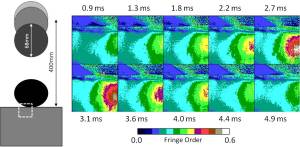
 Sir David Brewster was a prolific experimentalist who published seven papers in the Philosophical Transactions of the Royal Society during 1815 and 1816. In his report dated October 22nd, 1814 that was published by the Royal Society one hundred years ago in January 1815, he described his observations on the depolarisation in more than fifty materials as diverse as sulphur and the bladder of a cow. He followed this with a series of experiments on glass sheets subject to various loads and reported his observations in the of photographic plates that show photoelastic fringe patterns which would become instantly recognisable to generations of engineers. Two hundred year later, digital technology has revolutionised photoelasticity so that it is no longer necessary to generate fringes that can be ‘seen’, as in Brewster’s experiments. Instead, digital sensors allow us to measure changes in light intensity that are undetectable to the naked eye and digital computers permit the processing of arrays of tens of thousands of measurements in less than the blink of an eye to yield maps of strain magnitude and direction in complex components. However, the principles employed in digital photoelasticity are the same as those first elucidated by Brewster and involve collecting images at multiple rotational steps of one or more of the polarising elements in a polariscope and then using Fourier analysis or matrix algebra to solve the equations describing the stress-optic law, i.e. the relationship between the applied stress and the observed change in transmitted light intensity. A polariscope is the term given to the series of polarisers and quarter-waveplates used by almost every photoelastician since Brewster to observe photoelastic fringes. One of Brewster’s other great inventions was the kaleidoscope of which there is an early example in the Science Museum in London. Recently, the concept of the kaleidoscope has been combined with a polariscope to create the poleidoscope that allows the multiple images required for digital photoelasticity to be acquired simultaneously, which is useful for dynamic applications such as in the impact example shown in the picture. These advances allow digital photoelasticity to be used not only by laboratory-based stress analysts but also in quality assurance procedures, for instance to monitor in real-time the stresses induced in float glass during production, or to investigate the residual stress in silicon wafers using infra-red light.
The picture shows a sequence of maps of photoelastic fringe order (right) showing the stress induced in an epoxy resin block when impacted by a soft ball falling under gravity (left). The maps were obtained using a precursor to the poleidoscope and a high-speed digital camera recording 4000 frames per second for the 10x10mm area shown by the white box in the schematic.
For more a little more on photoelasticity see http://www.experimentalstress.com/basic_experimental_mechanics/photoelasticity.htm
Sources:
Brewster, D., Experiments on the depolarisation of light as exhibited by various mineral, animal , and vegetable bodies, with a reference of the phenomena to the general principles of polarisation, Phil. Trans. R. Soc. Lond. 105:29-53, 1815. http://rstl.royalsocietypublishing.org/content/105/29.full.pdf+html
Brewster, D., On the communication of the structure of doubly refracting crystals to glass, muriate of soda, fluor spar, and other substances by mechanical compression and dilatation, Phil. Trans. R. Soc. Lond. 106:156-178, 1816. http://rstl.royalsocietypublishing.org/content/106/156.full.pdf+html
Ramesh, K., Kasimayan, T., Neethi Simon, B., Digital photoelasticity – a comprehensive review, J. Strain Analysis, 46(4):245-266, 2011. http://sdj.sagepub.com/content/46/4/245.abstract
www.sciencemuseum.org.uk/online_science/explore_our_collections/objects/index/smxg-3823?agent=smxg-52657
Lesniak, J.R., Zhang, S.J., Patterson, E.A., The design and evaluation of the poleidoscope: a novel digital polariscope, Experimental Mechanics, 44(2):128-135, 2004.
Hobbs, J.W., Greene, R.J., Patterson, E.A., 2003, A novel instrument for transient photoelasticity, Experimental Mechanics, 43(4):403-409, 2003.
 Last month I described how computational models were used as more than fables in many areas of applied science, including engineering and precision medicine [‘Models as fables’ on March 16th, 2016]. When people need to make decisions with socioeconomic and, or personal costs, based on the predictions from these models, then the models need to be credible. Credibility is like beauty, it is in the eye of the beholder. It is a challenging problem to convince decision-makers, who are often not expert in the technology or modelling techniques, that the predictions are reliable and accurate. After all, a model that is reliable and accurate but in which decision-makers have no confidence is almost useless. In my research we are interested in the credibility of computational mechanics models that are used to optimise the design of load-bearing structures, whether it is the frame of a building, the wing of an aircraft or a hip prosthesis. We have techniques that allow us to characterise maps of strain using feature vectors [see my post entitled ‘Recognising strain‘ on October 28th, 2015] and then to compare the ‘distances’ between the vectors representing the predictions and measurements. If the predicted map of strain is an perfect representation of the map measured in a physical prototype, then this ‘distance’ will be zero. Of course, this never happens because there is noise in the measured data and our models are never perfect because they contain simplifying assumptions that make the modelling viable. The difficult question is how much difference is acceptable between the predictions and measurements . The public expect certainty with respect to the performance of an engineering structure whereas engineers know that there is always some uncertainty – we can reduce it but that costs money. Money for more sophisticated models, for more computational resources to execute the models, and for more and better quality measurements.


 Realize Engineering