Tag Archives: knowledge

Are we individuals?

It has been estimated that there are 150 species of bacteria in our gut with a megagenome correspondingly larger than the human genome; and that 90% of the cells in our bodies are bacterial [1].  This challenges a simple understanding of individual identity because on one level we are a collection of organisms, mainly bacteria, rather than a single entity.  The complexity is almost incomprehensible with 30 trillion cells in the human body each with about a billion protein molecules [2].  Each cell is apparently autonomous, making decisions about its role in the system based on information acquired through communicating and signalling with its neighbours, the rest of the system and the environment.  Its autonomy would appear to imbue it with a sense of individual identity which is shaped by its relationships within the network of cells [3].  This also holds for human beings within society although you could argue the network is simpler because the global population is only about 8 billion; however the quantity of information being communicated is probably greater than between cells, so perhaps that makes the network more complex.  Networks are horizontal hierarchies with no one or thing in overall control and they can adapt to cope with changes in the environment.  By contrast, vertical hierarchies depend on top-down obedience and tend to eliminate dissent, yet without dissent there is little or no innovation or adaptation.  Hence, vertical hierarchies can appear to be robust but are actually brittle [4].  In a network we can build connections and share knowledge leading to the development of a collective intelligence that enables us to solve otherwise intractable problems.  Our ability to acquire knowledge not just from own our experiences but also from the experience of others, and hence to progressively grow collective intelligence, is one of the secrets of our success as a species [5].  It also underpins the competitive advantage of many successful organisations; however, it needs a horizontal, stable structure with high levels of trust and mutual dependence, in which our sense of individual identity is shaped by our relationships.

References:

  1. Gilbert SF, Sapp J, Tauber AI, A symbiotic view of life: we have never been individuals, Quarterly Review of Biology, 87(4):325-341, 2012.
  2. Ball P, How Life Works, Picador, 2023.
  3. Wheatley M, Leadership and the New Science: Discovering Order in a Chaotic World, 2nd Edition, Berrett-Koehler Publishers Inc, San Francisco, 1999.
  4. McWilliams D, Money – A Story of Humanity, Simon & Schuster, London, 2024.
  5. Henrich J, The secret of our success: how culture is driving human evolution, domesticating our species, and making us smarter, Princeton, NJ: Princeton University Press, 2015.

Evolutionary model of knowledge management

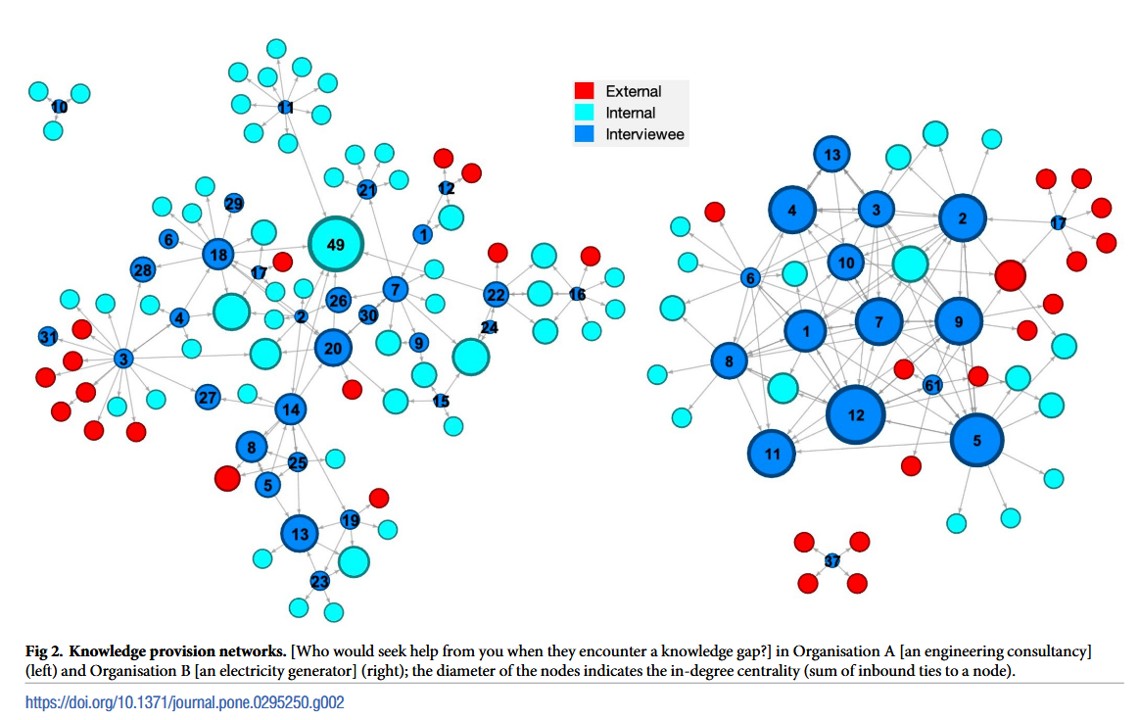
Towards the end of last year, I wrote about the challenges in deploying digital technologies in holistic approaches to knowledge management in order to gain organizational value and competitive advantage [see ‘Opportunities lost in knowledge management using digital technology’ on October 25th, 2023].  Almost on the last working day of 2023, we had an article published in PLOS ONE (my first in the journal) in which we explored ‘The impact of digital technologies on knowledge networks in two engineering organizations’.  We used social network analysis and semi-structured interviews to investigate the culture around knowledge management, and the deployment of digital technologies in support of it, in an engineering consultancy and an electricity generator.  The two organizations had different cultures and levels of deployment of digital technologies.  We proposed a new evolutionary model of the culture of knowledge management based on Hudson’s evolutional model of safety culture that is widely used in industry. Our new model is illustrated in the figure from our article, starting from ‘Ignored: we have no knowledge management and no plans for knowledge management’ through to ‘Embedded: knowledge management is integrated naturally into the daily workflow’.  We also proposed that social networks could be used as an indicator of the stage of evolution of knowledge management with low network density and dispersed networks representing higher stages of evolution, based on our findings for the two engineering organizations.

Sources:

Hudson, P.T.W., 2001. Safety management and safety culture: the long, hard and winding road. Occupational health and safety management systems, pp.3-32, 2001

Patterson EA, Taylor RJ, Yao Y. The impact of digital technologies on knowledge networks in two engineering organisations. PLoS ONE 18(12): e0295250, 2023.


Virtual reality and economic injustice in a world with limits

Decorative photograph of a pile of carved stonesIt is sometimes suggested that materialism and greed are key drivers of our social and political system that largely refuses to acknowledge that we live in a world of limits.  However, Rowan Williams has proposed that we have a ‘culture that is resentful about material reality, hungry for anything and everything that distances us from the constraints of being a physical animal subject to temporal processes, to uncontrollable changes and to sheer accident.’  In other words, it is our desire to be in control of our lives and surroundings that drives us to accumulate wealth and build our strongholds.  Education and learning lead to an understanding of the complexity of the world, a realisation that we cannot control the world and perhaps to unavoidable insecurity, particularly for those people who thought they had some distance between themselves and uncontrollable events.  It is more comfortable to believe that we are in control, adhere to the current out-dated paradigm, and ignore evidence to the contrary. This is equivalent to living in a virtual reality.  This approach not only accelerates uncontrollable changes to the planet but also leads to economic disparities because, as Williams states, economic justice will only arrive when everyone recognises a shared vulnerability and limitation in a world that is not infinite.

Source: Rowan Williams, Faith in the public square, London: Bloomsbury Publishing, 2015.

Image: a pile of carved stones in the cloisters of Hereford cathedral where I bought a second-hand copy of ‘Faith in the public square’ while on holiday [see ‘Personale mappa mundi‘ on November 1st, 2023].

Opportunities lost in knowledge management using digital technology

Decorative imageRegular readers of this blog will know that I occasionally feature publications from my research group.  The most recent was ‘Predicting release rates of hydrogen from stainless steel’ on September 13th, 2023 and before that ‘Label-free real-tracking of individual bacterium’ on January 25th 2023 and ‘A thermal emissions-based real-time monitoring system for in situ detection of cracks’ in ‘Seeing small changes is a big achievement’ on October 26th 2023.  The subject of these publications might seem a long way apart but they are linked by my interest in trying to measure events in the real-world and use the data to develop and validate high-fidelity digital models.  Recently, I have stretched my research interests still further through supervising a clutch of PhD students with a relatively new collaborator working in the social sciences.  Two of the students have had their first papers published by the ASME (American Society of Mechanical Engineers) and the IEEE (Institute of Electrical and Electronics Engineers).  Their papers are not directly connected but they both explore the use of published information to gain new insights on a topic.  In the first one [1], we have explored the similarities and differences between safety cases for three nuclear reactors: a pair of research reactors – one fission and one fusion reactor; and a commercial fission reactor.  We have developed a graphical representation of the safety features in the reactors and their relationships to the fundamental safety principles set out by the nuclear regulators. This has allowed us to gain a better understanding of the hazard profiles of fission and fusion reactors that could be used to create the safety case for a commercial fusion reactor.  Fundamentally, this paper is about exploiting existing knowledge and looking at it in a new way to gain fresh insights, which we did manually rather than automating the process using digital technology.  In the second paper [2], we have explored the extent to which digital technologies are being used to create, collate and curate knowledge during and beyond the life-cycle of an engineering product.  We found that these processes were happening but generally not in a holistic manner.  Consequently, opportunities were being lost through not deploying digital technology in knowledge management to undertake multiple roles simultaneously, e.g., acting as repositories, transactive memory systems (group-level knowledge sharing), communication spaces, boundary objects (contact points between multiple disciplines, systems or worlds) and non-human actors.  There are significant challenges, as well as competitive advantages and organisational value to be gained, in deploying digital technology in holistic approaches to knowledge management.  However, despite the rapid advances in machine learning and artificial intelligence [see ‘Update on position of AI on hype curve: it cannot dream’ on July 26th 2023] that will certainly accelerate and enhance knowledge management in a digital environment, a human is still required to realise the value of the knowledge and use it creatively.

References

  1. Nguyen, T., Patterson, E.A., Taylor, R.J., Tseng, Y.S. and Waldon, C., 2023. Comparative maps of safety features for fission and fusion reactors. Journal of Nuclear Engineering and Radiation Science, pp.1-24
  2. Yao, Y., Patterson, E.A. and Taylor, R.J., 2023. The Influence of Digital Technologies on Knowledge Management in Engineering: A Systematic Literature Review. IEEE Transactions on Knowledge and Data Engineering.