 Imagine building a humanoid robot with head, arms and legs from different organisations that will not share the technical details of the products, probably because they are worried about their intellectual property being stolen. The likely result would be a robot that moves in slow uncoordinated jerky steps, unlike those seen at the recent World Humanoid Robot Games in China where a humanoid robot beat Usain Bolt’s 100m record. We have encountered this problem in attempting to build an industrial metaverse consisting of a connected series of digital twins [see ‘Digital twins that thrive in the real-world’ on June 9th, 2021] that represent different parts of a complex engineering system, e.g., a power station. The organisations that have developed the digital twins or computer simulations are reluctant to share technical information because they want to protect their intellectual property. Our solution has been to develop an apex software architecture that seamlessly and securely connects computer models of all of the parts of the system with high-speed two-way exchange of information – the equivalent of the central nervous system in the humanoid robot. Our architecture reduced the processing times for simulations of a nuclear reactor sixteen-fold compared to current approaches and required one-third of the number of analysts to perform the simulations. The architecture is readily adaptable too; you can plug n’ play with different computational models – the equivalent to changing a leg on a humanoid robot using a snap-fit connector. Read our 2022 paper if you would like to know more or get in touch if you would like to use our apex architecture.
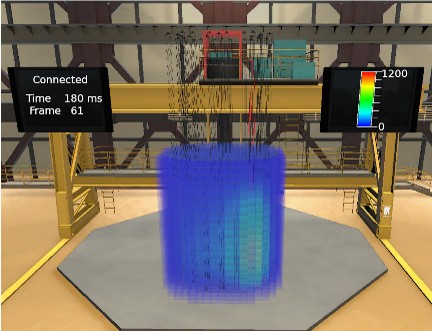
Image: Figure 9b from Bowman et al, 2022, showing simulated power distribution and control rod position overlayed on a model of a PWR reactor.
Reference: Bowman D, Dwyer L, Levers A, Patterson EA, Purdie S, Vikhorev K. A unified approach to digital twin architecture—proof-of-concept activity in the nuclear sector. IEEE Access, 10:44691-709, 2022