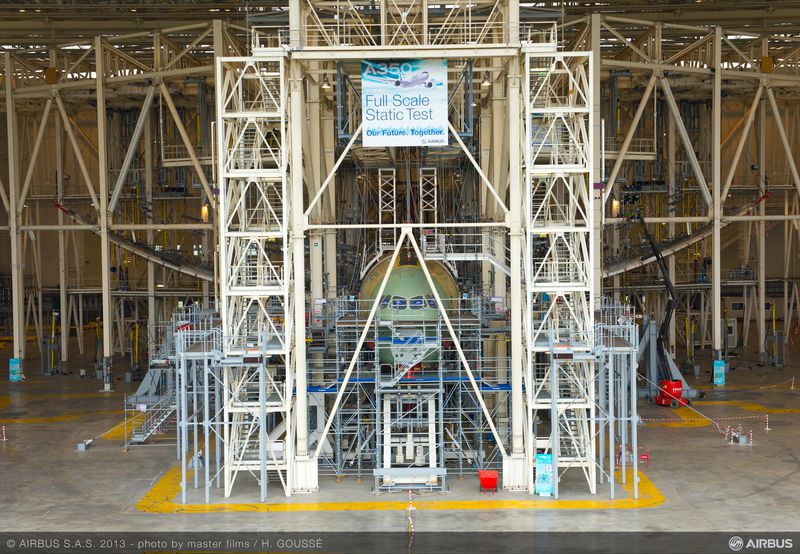
A350 XWB passes Maximum Wing Bending test [from: http://www.airbus.com/galleries/photo-gallery%5D
It is good practice to design experiments specifically to generate data for model validation but it is expensive, especially when your structure is a huge passenger aircraft. So naturally, you would like to extract as much information from each experiment as possible and to perform as few experiments as possible, whilst both ensuring predictions are reliable and providing confidence in them. In other words, you have to be very smart about designing and conducting the experiments as well as performing the validation process.
Together with researchers at Empa in Zurich, the Industrial Systems Institute of the Athena Research Centre in Athens and Dantec Dynamics in Ulm, I am embarking on a new EU Horizon 2020 project to try and make us smarter about experiments and validation. The project, known as MOTIVATE [Matrix Optimization for Testing by Interaction of Virtual and Test Environments (Grant Nr. 754660)], is funded through the Clean Sky 2 Joint Undertaking with Airbus acting as our topic manager to guide us towards an outcome that will be applicable in industry. We held our kick-off meeting in Liverpool last week, which is why it is uppermost in my mind at the moment. We have 36-months to get smarter on an industrial scale and demonstrate it in a full-scale test on an aircraft structure. So, some sleepness nights ahead…

Bibliography:
Hack E & Lampeas G (Guest Editors) & Patterson EA (Editor), Special issue on advances in validation of computational mechanics models, J. Strain Analysis, 51 (1), 2016.


![Windows of the Soul II [3D video art installation: http://www.haigallery.com/sonia-falcone/]](https://realizeengineering.blog/wp-content/uploads/2016/09/windows-of-soul-11.jpg)
 Realize Engineering