 This is the last in a series of posts reflecting on my steps towards becoming an engineer. At the end of the previous post, I described how I moved to Canada becoming a biomedical engineer in the Medical School at the University of Calgary. It was a brief period of my career, because shortly after I started, I was encouraged to apply for a lectureship in mechanical engineering at my alma mater which I did successfully. So, I returned to the University of Sheffield and started my career as an academic engineer. I continued to work in biomedical engineering, focussing initially on cardiac mechanics [see ‘Tears in the heart’ on July 20th, 2022], then on osseointegrated prostheses [see ‘Turning the screw in dentistry’ on September 9th, 2020] and, more recently, on computational biology [see ‘Hierarchical modelling in engineering and biology’ on March 14th, 2018] and cellular dynamics [see ‘Label-free real-time tracking of individual bacterium’ on January 25th, 2023]. However, the dominant application area of my research has been aerospace engineering informed by, if not also influenced by, my experiences in the Royal Navy, including flying a jet trainer aircraft shortly before leaving. In the last decade, I have been introduced to nuclear reactor engineering, both fission and fusion, and have used them as vehicles for developing research in digital engineering [see ‘Thought leadership in fusion engineering’ on October 9th, 2019]. This biographical series of posts has described my evolution as an engineer – it was not an ambition I ever had nor did anyone push me towards engineering but I have found that my way of thinking about problems is well-suited to engineering, or perhaps engineering has taught me a way of thinking.
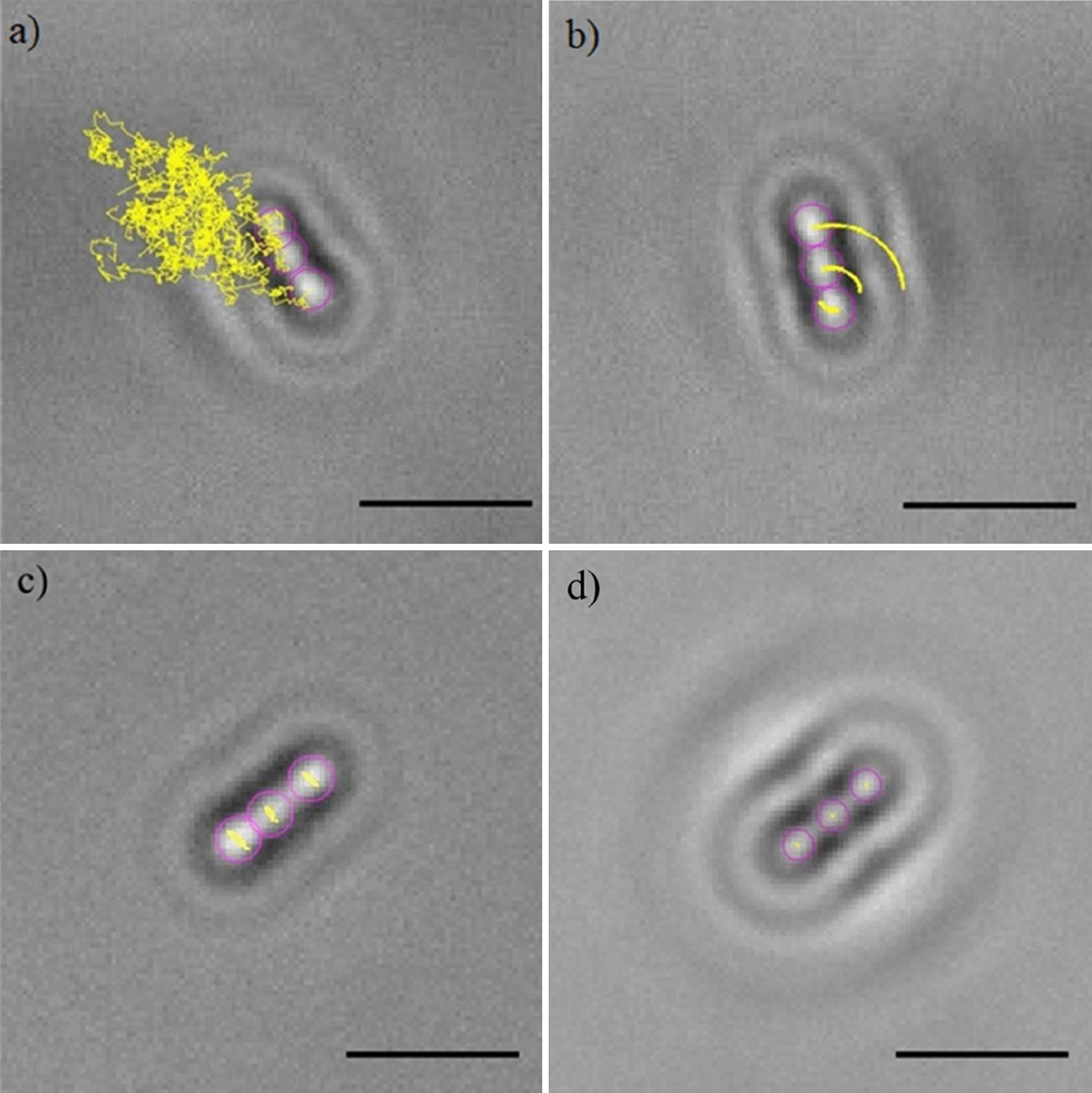
Image: Figure 4 – Tracks (yellow lines) of the sections (purple circles) of four E. coli bacteria experiencing: (a) random diffusion above the surface; (b) rotary attachment; (c) lateral attachment; (d) static attachment. The dynamics of the four bacteria was monitored for approximately 20 s. The length of the scale bars is 5 μm. From Scientific Reports, 12:18146, 2022.


 Realize Engineering