Category Archives: structures

Slowing down time to think [about strain energy]

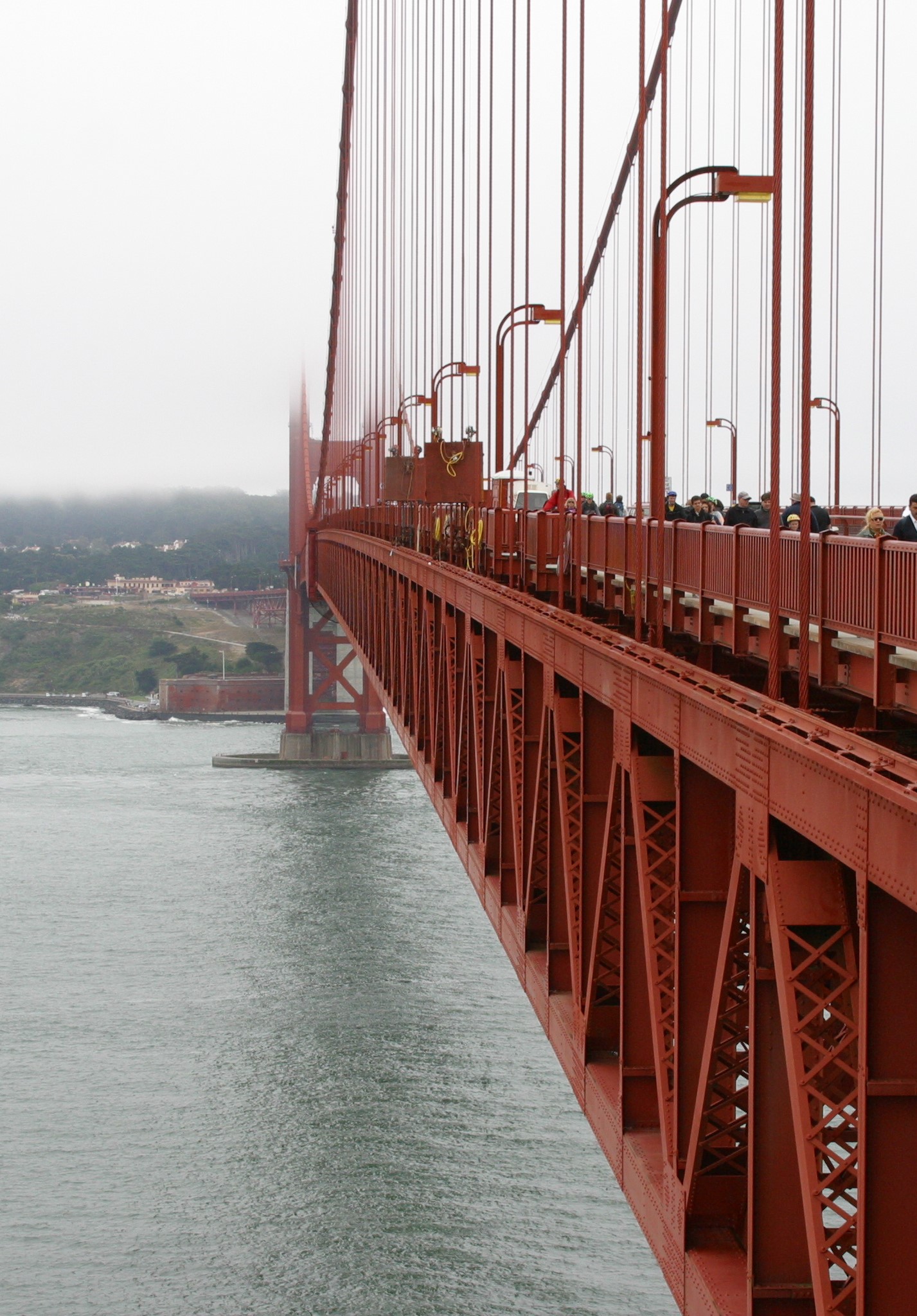
161-6167_imgLet me take you bungee jumping.  I should declare that I am not qualified to do so, unless you count an instructor’s certificate for rock-climbing and abseiling, obtained about forty years ago.  For our imaginary jump, pick a bridge with a good view and a big drop to the water below and I’ll meet you there with the ropes and safety gear.

It’s a clear early morning and the air is crisp and fresh – ideal for throwing yourself off a bridge attached to a rope.  The rope is the star of this event.  It’s brand new, which is reassuring, and arrived coiled over my shoulder.  A few days ago, I asked you how much you weigh – that’s your real weight fully clothed, at least I hope that’s the number you gave me otherwise my calculations will be wrong and you’ll get wet this morning!  I have calculated how much the rope will stretch when it arrests your free-fall from the bridge parapet; so, now I am measuring out enough rope to give you an exciting fall but to stop you short of the water.  I’m a professor of structural materials and mechanics so I feel confident of getting this bit right; but it’s a long time since I worked as an abseiling instructor so I suggest you check those knots and that harness that we’ve just tightened around you.

You’ve swung yourself over the parapet and you’re standing on the ledge that the civil engineers conveniently left for bridge jumpers.  The rope is loosely coiled ready with its end secured to a solid chunk of parapet.  As you alternate between soaking up the beautiful view and contemplating the chasm at your feet, you wonder why you agreed to come with me.  At this moment, you have a lot of potential energy due to your height above the sparkling water [potential energy is your mass multiplied by your height and gravitational acceleration], but no kinetic energy because you are standing motionless.  The rope is relaxed or undeformed and has zero strain energy.

Finally, you jump and time seems to stand still for you as the fall appears to be happening in slow motion.  The air begins to rush past your ears in a whoosh as you build up speed and gain kinetic energy [equal to one half your mass multiplied by your velocity squared].  The bridge disappeared quickly but the water below seems only to be approaching slowly as you lose height and potential energy.  In reality, your brain is playing tricks on you because you are being accelerated towards the water by gravity [at about 10 metres per second squared] but your total energy is constant [potential plus kinetic energy unchanged].  Suddenly, your speed becomes very apparent.  The water seems very close and you cry out in surprise.  But the rope is beginning to stretch converting your kinetic energy into strain energy stored by stretching its fibres [at a molecular level work is being done to move molecules apart and away from their equilibrium position].  Suddenly, you stop moving downwards and just before you hit the water surface, the rope hurls you upwards – your potential energy reached a minimum and you ran out of kinetic energy to give the rope; so now it’s giving you back that stored strain energy [and the molecules are relaxing to their equilibrium position].  You are gaining height and speed so both your kinetic and potential energy are rising with that squeal that just escaped from you.

Now, you’ve noticed that the rope has gone slack and you’re passing a loop of it as you continue upwards but more slowly.  The rope ran out of strain energy and you’re converting kinetic energy into potential energy.  Just as you work out that’s happening, you run out of kinetic energy and you start to free-fall again.

Time no longer appears to stationary and your brain is working more normally.  You begin to wonder how many times you’ll bounce [quite a lot because the energy losses due to frictional heating in the rope and drag on your body are relatively small] and why you didn’t ask me what happens at the end.  You probably didn’t ask because you were more worried about jumping and were confident that I knew what I was doing, which was foolish because, didn’t I tell you, I’ve never been bungee jumping and I have no idea how to get you back up onto the bridge.  How good were you at rope-climbing in the gym at school?

When eventually you stop oscillating, the rope will still be stretched due to the force on it generated by your weight.  However, we can show mathematically that the strain energy and deformation under this static load will be half the values experienced under the dynamic loading caused by your fall from the bridge parapet.  That means you’ll have a little less distance to climb to the parapet!

Today’s post is a preview for my new MOOC on ‘Understanding Super Structures’, which is scheduled to start on May 22nd, 2017.  This is the script for a step in week 2 of the five-week course, unless the director decides it’s too dangerous.  By the way, don’t try this home or on a bridge anywhere.

More violent storms

I made a mistake last week by initially publishing two posts.  My apologies for confusing you or tantalising you with the prospect of going bungee jumping and then postponing the trip.  We’ll go bungee jumping next week.  I postponed it because it’s a preview of the new MOOC on ‘Understanding Super Structures‘ that I am writing and there was a delay in publishing the registration page for the MOOC.

When I posted my comment about postponing the bungee jump due to rain, I didn’t realize that, the following day Liverpool would be battered by Storm Doris, with 90 miles per hour winds that closed the Port of Liverpool.  As I sat writing week 4 of the new MOOC, the wind was swirling around our house causing the windows to rattle; and, on the top storey of our narrow but tall house, you could feel the house moving in the gusts of wind.  Across the street, people visiting Liverpool Cathedral were hanging onto the railings as they made their way to the entrance, and the trees were being bent over to an angle that made you think there would be a loud cracking and splintering of wood at any moment.  Fortunately, the storm was short-lived in Liverpool and moved on to wreak havoc inland.  Bungee jumping would have been very hazardous!

The number of violent storms appears to be increasing and the graphic shows the number of storms in the Atlantic basin since 1850.  Although there is a lot of scatter in the data, there is a clear concentration in the last couple of decades of years with fifteen of more named storms, which suggests there has been more energy in the weather systems in recent years.  The primary source of this energy is the temperature of the oceans and atmosphere.  There is a good account of the development of storms cells in Manuel Delanda’s book ‘Philosophy and Simulation: The Emergence of Synthetic Reason‘, see chapter 1 – The Storm in the Computer, which is available via Google Preview.

The increased frequency of high-energy storm systems is a very apparent manifestation of climate change that is having an impact on many people.  Yet, some governments refuse to even consider the possibility that our climate is changing and that they need to lead our society in discussing and planning strategies to mitigate the impacts.  It reminds me of the saying, attributed to Henri Poincare: ‘To doubt everything, or, to believe everything, are two equally convenient solutions; both dispense with the necessity of reflection.’

Did cubism inspire engineering analysis?

Bottle and Fishes c.1910-2 Georges Braque 1882-1963 Purchased 1961 http://www.tate.org.uk/art/work/T00445

Bottle and Fishes c.1910-2 Georges Braque 1882-1963 Purchased 1961 http://www.tate.org.uk/art/work/T00445

A few weeks ago we went to the Tate Liverpool with some friends who were visiting from out of town. It was my second visit to the gallery in as many months and I was reminded that on the previous visit I had thought about writing a post on a painting called ‘Bottle and Fishes’ by the French artist, Georges Braque.  It’s an early cubist painting – the style was developed by Picasso and Braque at the beginning of the last century.  The art critic, Louis Vauxcelles coined the term ‘cubism’ on seeing some of Braque’s paintings in 1908 and describing them as reducing everything to ‘geometric outlines, to cubes’.  It set me thinking about how long it took the engineering world to catch on to the idea of reducing objects, or components and structures, to geometric outlines and then into cubes.  This is the basis of finite element analysis, which was not invented until about fifty years after cubism, but is now ubiquitous in engineering design as the principal method of calculating deformation and stresses in components and structures.  An engineer can calculate the stresses in a simple cube with a pencil and paper, so dividing a structure into a myriad of cubes renders its analysis relatively straightforward but very tedious.  Of course, a computer removes the tedium and allows us to analyse complex structures relatively quickly and reliably.

So, why did it take engineers fifty years to apply cubism?  Well, we needed computers sufficiently powerful to make it worthwhile and they only became available after the Second War World due to the efforts of Turing and his peers.  At least, that’s our excuse!  Nowadays the application of finite element analysis extends beyond stress fields to many field variables, including heat, fluid flow and magnetic fields.

Can you trust your digital twin?

Author's digital twin?

Author’s digital twin?

There is about a 3% probability that you have a twin. About 32 in 1000 people are one of a pair of twins.  At the moment an even smaller number of us have a digital twin but this is the direction in which computational biomedicine is moving along with other fields.  For instance, soon all aircraft will have digital twins and most new nuclear power plants.  Digital twins are computational representations of individual members of a population, or fleet, in the case of aircraft and power plants.  For an engineering system, its computer-aided design (CAD) is the beginning of its twin, to which information is added from the quality assurance inspections before it leaves the factory and from non-destructive inspections during routine maintenance, as well as data acquired during service operations from health monitoring.  The result is an integrated model and database, which describes the condition and history of the system from conception to the present, that can be used to predict its response to anticipated changes in its environment, its remaining useful life or the impact of proposed modifications to its form and function. It is more challenging to create digital twins of ourselves because we don’t have original design drawings or direct access to the onboard health monitoring system but this is being worked on. However, digital twins are only useful if people believe in the behaviour or performance that they predict and are prepared to make decisions based on the predictions, in other words if the digital twins possess credibility.  Credibility appears to be like beauty because it is in eye of the beholder.  Most modellers believe that their models are both beautiful and credible, after all they are their ‘babies’, but unfortunately modellers are not usually the decision-makers who often have a different frame of reference and set of values.  In my group, one current line of research is to provide metrics and language that will assist in conveying confidence in the reliability of a digital twin to non-expert decision-makers and another is to create methodologies for evaluating the evidence prior to making a decision.  The approach is different depending on the extent to which the underlying models are principled, i.e. based on the laws of science, and can be tested using observations from the real world.  In practice, even with principled, testable models, a digital twin will never be an identical twin and hence there will always be some uncertainty so that decisions remain a matter of judgement based on a sound understanding of the best available evidence – so you are always likely to need advice from a friendly engineer   🙂

Sources:

De Lange, C., 2014, Meet your unborn child – before it’s conceived, New Scientist, 12 April 2014, p.8.

Glaessgen, E.H., & Stargel, D.S., 2012, The digital twin paradigm for future NASA and US Air Force vehicles, Proc 53rd AIAA/ASME/ASCE/AHS/ASC Structures, Structural Dynamics and Materials Conference, AIAA paper 2012-2018, NF1676L-13293.

Patterson E.A., Feligiotti, M. & Hack, E., 2013, On the integration of validation, quality assurance and non-destructive evaluation, J. Strain Analysis, 48(1):48-59.

Patterson, E.A., Taylor, R.J. & Bankhead, M., 2016, A framework for an integrated nuclear digital environment, Progress in Nuclear Energy, 87:97-103.

Patterson EA & Whelan MP, 2016, A framework to establish credibility of computational models in biology, Progress in Biophysics & Molecular Biology, doi: 10.1016/j.pbiomolbio.2016.08.007.

Tuegel, E.J., 2012, The airframe digital twin: some challenges to realization, Proc 53rd AIAA/ASME/ASCE/AHS/ASC Structures, Structural Dynamics and Materials Conference.