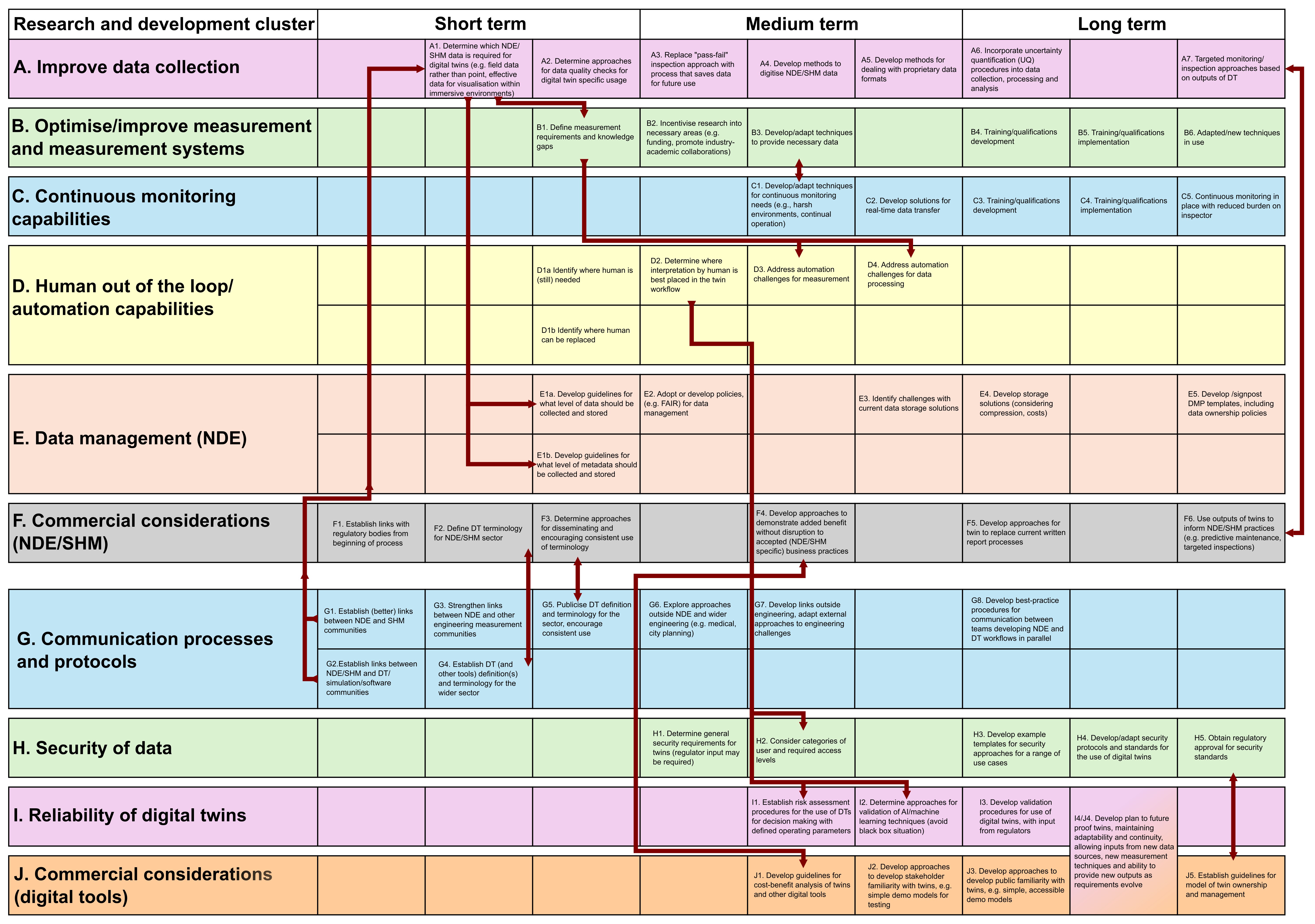
 Michael Grieves, who probably first formulated the concept of digital twins in 2002, stated that all information about a physical entity should be present in its cyber or digital twin with data flow from the physical entity to the digital twin, and information flow from the digital twin to the physical entity throughout its lifecycle [1] [see ‘Digital twins that thrive in the real-world’ on June 9th, 2021]. The realisation of data flows between cyber-physical twins has been slow and there are relatively few cases where this definition has been fully implemented. Non-destructive evaluation (NDE) is a well-established set of techniques used to assess the properties, integrity and condition of engineering components and structures that could play a significant role in supplying data to digital twins. At the moment NDE is commonly used in quality control to check for manufacturing defects, in integrity assessments to investigate damage in safety critical components during maintenance inspections, and for determining the remaining life expectancy of engineering parts. The integration of NDE in digital engineering has been slow; so, in a recent study, involving representatives from a wide range of industries, we have defined in a roadmap [2] the potential opportunity and the route to its realisation. This work represents a different approach to research for my group in that we have explored the need or the ‘pull’ from industry rather than delivering innovative technology which can result in a ‘push’ to industry [see for example, ‘Our last DIMES’ on September 22nd, 2021]. My regular readers might also detect the influence of social science, which also surfaced in our recent work on knowledge management [see ‘Opportunities lost in knowledge management using digital technology’ on October 25th, 2023 and ‘Evolutionary model of knowledge management’ on March 6th 2024]. We have used the same methods, based on semi-structured interviews and thematic analysis, across all of these studies.
Image: roadmap [© University of Liverpool] which should be read in conjunction with [2].
References:
- Grieves, M., Vickers, J. (2017). Digital Twin: Mitigating Unpredictable, Undesirable Emergent Behavior in Complex Systems. In: Kahlen, J., Flumerfelt, S., Alves, A. (eds) Transdisciplinary Perspectives on Complex Systems. Springer, Cham.
- Middleton CA, Nguyen T & Patterson EA, NDE4.0 and digital twins in industry: current user experiences and future development, J. Nondestructive Evaluation, 45:107, 2026.