Tag Archives: mechanics

Counting photons to measure stress

TSA pattern around a crack propagating from the left with its tip in the centre.

TSA pattern around a crack propagating from the left with its tip in the centre.

Some might find it strange that I am teaching thermodynamics when my research expertise is in structural materials and mechanics. However, the behaviour of structures is largely controlled by energy and how they absorb, store and release it; while thermodynamics is the study of energy flows and transformations, so there is a connection. In my research group, we exploit this connection in a technique for measuring stress fields in components by monitoring the temperature changes that occur when a component is loaded. In Thermoelastic Stress Analysis (TSA) as it is known, we use very sensitive infrared cameras to monitor the cyclic variations of temperature that occur when cyclic load is applied to a material. The temperature changes are of the order of milli-Kelvin, that’s thousandths of a degree, and are positive with negative, or compressive stress and negative with tensile stress. What we are actually measuring is the rate of change in the release of photons by atoms as they are pushed closer together in compression or pulled further apart in tension; but that’s another story and takes us into physics.

An exciting feature of this technique is that as a crack evolves new surfaces are formed which releases energy as heat. We can detect not only the stress field around the crack but also the heat released during the formation of the crack prior it being visible and its subsequent growth.

Sources:

Greene, R.J., Patterson, E.A., Rowlands, R.E., 2008, ‘Thermoelastic stress analysis’, in Handbook of Experimental Mechanics edited by W.N. Sharpe Jr., Springer, New York.

Yang, Y., Crimp, M., Tomlinson, R.A., Patterson, E.A., 2012, Quantitative measurement of plastic strain field at a fatigue crack tip, Proc. R. Soc. A., 468(2144):2399-2415.

Patki, A.S., Patterson, E.A., 2010, ‘Thermoelastic stress analysis of fatigue cracks subject to overloads’, Fatigue and Fracture of Engineering Materials and Structures, 33(12):809-821.


Emergent properties

storm over canyonPerhaps my strongest memory of being taught at school is that of the head of chemistry combining hydrogen and oxygen using an old glass drinks bottle and a burning taper.  The result was explosive, exciting and memorable.  It certainly engaged the attention of everyone in the class.  As far as I am aware, the demonstration was performed at least once per year for decades; but modern health and safety regulations would probably prevent such a demonstration today.

One of the interesting things about combining these two gases at room temperature is that the result is a liquid: water.  This could be construed as an emergent property because an examination of the properties of water would not lead you to predict that it was formed from two gases.  The philosopher C.D. Broad (1887-1971) coined the term ’emergent properties’ for those properties that emerge at a certain level of complexity but do not exist at lower levels.

Perhaps a better example of emergent properties is the pressure and temperature of steam.  We know that water molecules in a cloud of steam are whizzing around randomly,bouncing into one another and the walls of the container – this is the kinetic theory of gases.  If we add energy to the steam, for instance by heating it, then the molecules will gain kinetic energy and move around more quickly.  The properties of pressure and temperature emerge when we zoom out from the molecules and consider the system of the steam in a container.  The temperature of the steam is a measure of the average kinetic energy of the molecules and the pressure is the average force with which the molecules hit the walls of the container.

Manuel Delanda takes these ideas further in a brilliant description of modelling a thunderstorm in his book Philosophy and Simulation: The Emergence of Synthetic Reason.  There are no equations and it is written for the layman so don’t be put off by the title.  He explains that emergent properties can be established by elucidating the mechanisms that produce them at one scale and then these emergent properties become the components of a phenomenon at a much larger scale. This allows engineers to construct models that take for granted the existence of emergent properties at one scale to explain behaviour at another, so for example we don’t need to model molecular movement to predict heat transfer. This is termed ‘mechanism-independence’.

Ok, that’s deep enough for one post!  Except to mention that Capri & Luisi have proposed that life is an emergent property that is not present in the constituent parts of living things and which only appears when the parts are assembled.  Of course, it also disappears when you disassemble a living system, i.e. dissect it.

Sources:

Chapter 1 ‘The Storm in the Computer’ in Philosophy and Simulation: The Emergence of Synthetic Reason by Manuel Delanda, published by Continuum, London, 2011 (pages 7-21).

Fritjof Capra and Luigi Luisi, The Systems View of Life: A Unifying Vision, Cambridge University Press, 2014.

Forensic engineering

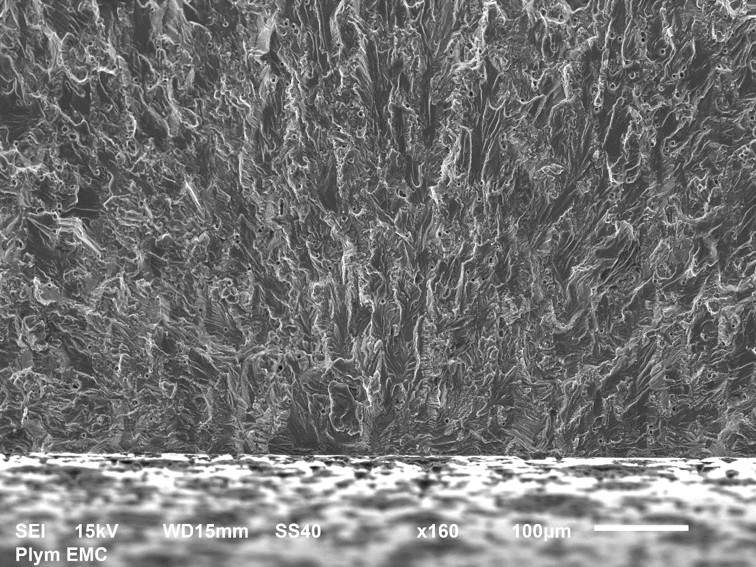
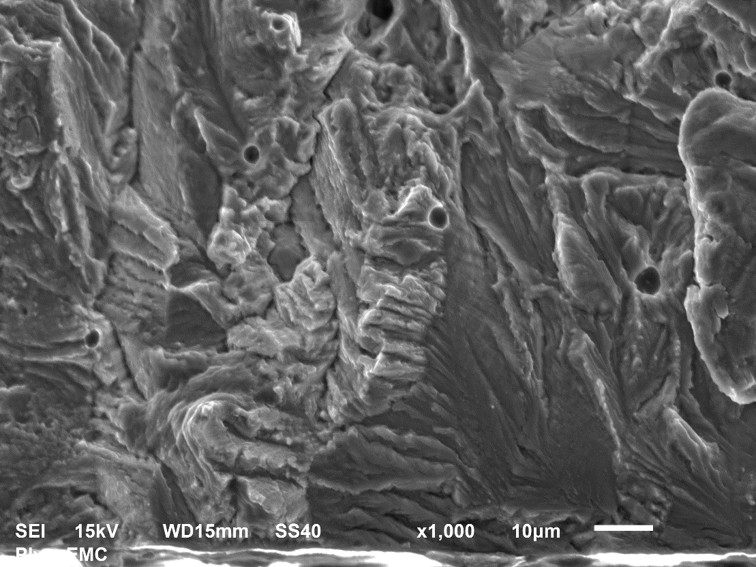
Picture1The picture above shows the fracture surface of a thin bar of aluminium alloy that had a circular hole through the middle, like the peep-hole in a front door. The photograph was taken in a Scanning Electron Microscope (SEM) at x160 magnification. There is a scale bar in the bottom right corner showing a length of 100 microns. We are looking approximately in the longitudinal direction, which was the direction of loading, and across the photograph from left to right corresponds to the direction you would look through the hole. The lower one third of the picture shows the machined surface of the hole cut or machined by the drill. The top two-thirds shows the surface created by the fatigue crack as it extended incrementally with each cycle of load. The crack started from edge of the machined surface approximately on the vertical centre-line of the picture. I can tell this because all of the features in the texture of the fracture surface point towards this point because the failure radiated out from this location. The picture below shows the crack initiation area at x1000 magnification. It is a small area at interface with hole above the letters ‘SS40’ in the top photograph; this should be enough to let you identify the common features but the interpretation of these images requires significant skill.

Fractography is the forensic study of failure surfaces such as this to establish the cause of failure. In this example, the hole in aluminium bar ensured that it will always fail with cyclic loading through the growth of a crack from somewhere around the hole. The textured form of the fracture surface occurs because the material is not homogeneous at this scale but made up of small grains. The failure of each grain is influenced by its orientation to the loading which results in the multi-faceted surface in the photographs.

I made the photographs the focus of this post because I thought they are interesting, but may be that’s because I’m an engineer, and because they are a tiny part in a fundamental research programme on which I have been spending a significant portion of my time. A goal of programme is to understand how to use these materials to build more energy-efficient structures that are cheaper and last longer without failing by, for example, fatigue.

More details:

The bar was 1.6mm thick and 38mm wide in the transverse direction and made from 2024-T3 Aluminium alloy. The hole diameter was 6.36mm. A tension load was repeatedly applied and removed in the longitudinal direction which caused the initiation and growth of a fatigue crack from the hole that after many cycles of loading led to the bar breaking in half along a plane perpendicular to the load direction. The pictures were taken at the University of Plymouth by Khurram Amjad with the assistance of Peter Bond and Roy Moate using a JEOL JSM-6610LV.

x1000

Robots with a delicate touch

whitesgroup demoCan a robot pick up an egg or a baby cactus without damaging either? If it is a conventional ‘hard’ robot then the answer is almost certainly ‘no’. But if it is a ‘soft’ robot then the answer is definitely ‘yes’. They can pick ripe tomatoes from the plant, too. And play the piano with a light touch.

These are all examples used by Professor George Whitesides to illustrate the capability of soft robots during a lecture that I attended last week. The occasion was a scientific discussion meeting on Bio-inspiration of New Technologies which was held to celebrate 350 years to publishing the Philosophical Transactions of the Royal Society. While I was in London listening live to Prof Whitesides and the other eight speakers, other people were listening via video links to Bangalore, India and Sao Paulo, Brazil.

Professor Whitesides’ ingenious robots have ‘fingers’ built from the same soft rubber that is used in implants. They are constructed with a solid layer on one face that is curled around the object being picked up by the inflation of compartments on the reverse face. The inflation of the compartments on the reverse face cause the face to lengthen and the ‘finger’ bends to accommodate the change in length. Careful design of the inflated compartments allows the fingers to conform to the shape being picked up and the use of microfluidics ensures it is not damaged.

Professor Whiteside identified star fish as the source of inspiration for the design of his soft robots. I don’t feel that this short piece has done justice to his work. If, nevertheless, you feel inspired to work for him then there’s probably a queue and since he is professor at Harvard it is almost certainly a long one. His research group has also spun out a company, Soft Robotics Inc. so you could buy some soft robots and explore their capabilities…