Tag Archives: mathematics

Sleeping on the job

Decorative image onlyAt the end of 2023, following my visit to IBM [see ‘Chirping while calculating probabilities‘ on November 22nd, 2023], I spent a significant amount of time trying to understand quantum computing and exploring its potential applications in my research.  It was really challenging because, as one article I read stated, quantum-mechanical phenomena appear to be weird and the mathematical tools used to model them are complex and abstract.  Just to make it harder you have to learn a new language or at least new terminology and mathematical notation.  I have always found that my unconscious mind is capable of solving mathematical problems given sufficient time and sleep.  However, the mathematics of quantum computing took many nights of unconscious thought to assemble into some sort of understanding and left me with mild headaches.  Around the same time I was reading one of Cormac McCarthy’s new novels, Stella Maris, which consists entirely of a psychologist interviewing a mathematician who is a patient in a hospital. They discuss that mathematical work is performed mostly in the unconscious mind and we have no notion as to how the mind goes about it.  They find it hard to avoid the conclusion that the unconscious mind does not use numbers.  I suspect that it does not use mathematical notation either; perhaps it is more a form of synaesthesia using three-dimensional shapes [see ‘Engineering synaesthesia‘ on September 21st, 2016].  A couple of pages before discussing the unconscious mind’s mathematical work, one of the protagonists comments that ‘If we were constructed with a continual awareness of how we worked we wouldn’t work’.  So, perhaps I should not probe too deeply into how I have acquired a rudimentary understanding of quantum computing.

BTW in case you missed my last post at the start of January [‘600th post and time for a change‘ on January 3rd 2024] and have been wondering what has happened to my weekly post – I have decided to switch to posting monthly on the first Wednesday of each month.

Source:

Cormac McCarthy, Stella Maris, Picador, 2022.
Reasons I became an engineer: #1

Photograph of aircraft carrier in heavy seas for decorative purposes onlyThis is the first in a series of posts in which I am going to reflect on my route to becoming an engineer.  These events happened around forty years ago so inevitably my recollections probably have more in common with folklore than reliable history.  Nevertheless, I hope they might be of interest.

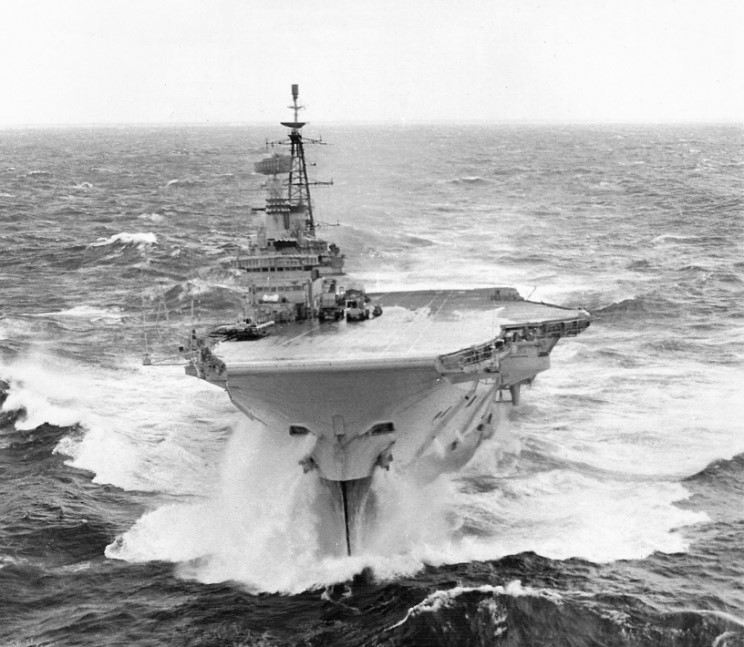
I was good at mathematics at school but also geography and when required to specialise at the age of sixteen would have preferred to study mathematics, geography and perhaps economics.  However, my parents and my school, had other ideas and decided that partnering chemistry and physics with mathematics would give me more opportunities in terms of university courses and careers.  Physics was manageable but Chemistry was a complete mystery to me.  I left school shortly before my eighteenth birthday and joined the Royal Navy as a midshipman.  I went to Dartmouth Naval College where, as part of my training to become a seaman officer, I was taught to march, navigate, fight fires, sail yachts, drive motor launches and fly helicopters as well as spending time with the Royal Marines.  After my basic naval training, which included time at sea on HMS Hermes, I went to University sponsored by the Royal Navy with a free choice of subject to study.  So, I chose Mechanical Engineering because I thought as an officer on the bridge of a ship, perhaps eventually in command of a ship, it would be useful to understand what the engineers were talking about when they asked for a change in operations due to technical difficulties.  At that stage in my life, I had no intention of becoming an engineer, but with hindsight it was my first step in that direction.

Walking and reading during a staycation

I am on vacation this week though, due to the restrictions on our movement imposed to prevent the spread of the coronavirus, it will a be staycation in our house.  We usually go to the Lake District at this time of year to walk and read; so, I might make another virtual expedition [see: ‘Virtual ascent of Moel Famau‘ on April 8th, 2020], perhaps to climb Stickle Pike and Great Stickle this time.  I was asked recently about books I would recommend prospective science and engineering students to read in preparation for to going to university.  It is not the first time that I have been asked the question.  This time I thought I should respond via this blog since the disruption brought about by the pandemic probably means that many prospective students will have more time and less preparation prior to starting their university course.  So, here are six books that are all available as ebooks, and might be of interest to anyone who is staying home to counter the spread of coronavirus and has time to fill:

[1] It is hard to find good novels either written by an engineer or about engineering [see ‘Engineering novelist‘ on August 5th, 2015]; however, Nevil Shute’s novel ‘Trustee from the toolroom‘ [Penguin Books, 1960] satisfies all of these criteria.

I have more than 40 years experience of engineering science so I am not the best person to ask about books that will appeal to young people just starting their journey in the field; however two books that have been popular recently are: [2] ‘Storm in a teacup: the physics of everyday life‘ by Helen Czerski [Penguin Books, 2016] and [3] ‘Think like an engineer‘ by Guru Madhavan [One World Publications, 2016]

Regular readers of this blog might have spotted some of my favourite science books in the lists of sources at the end of posts. Perhaps my top three at the moment are:

[4] Max Tegmark, Our Mathematical Universe, Penguin Books Ltd, 2014. [see: ‘Converting wealth into knowledge and back to wealth‘ on January 6th, 2016; ‘Trees are made of air‘ on April 1st, 2015; ‘Is the Earth a closed system? Does it matter?‘ on December 10th, 2014 & ‘Tidal energy‘ on September 17th, 2014]

[5] Susan Greenfield, A Day in the Life of the Brain, London: Allen Lane, 2016 [see: ‘Digital hive mind‘ on November 30th, 2016; ‘Gone walking‘ on April 19th, 2017 & ‘Walking through exams‘ on May 17th, 2017].

[6] Carlo Rovelli, The Order of Time, Penguin, 2019 [see: ‘We inhabit time as fish inhabit water’ on July 24th, 2019 and ‘Only the name of the airport changes‘ on June 12th, 2019].

Of course, I should not omit the books that I ask students to read for my own first year module in thermodynamics:

Peter Atkins, A very short introduction to thermodynamics, Oxford: OUP, 2010.

Manuel Delanda ‘Philosophy and Simulation: The Emergence of Synthetic Reason‘, London: Continuum Int. Pub. Group, 2011 [see: ‘More violent storms‘ on March 1st, 2017; ‘Emergent properties‘ on September 16th, 2015 & ‘Emerging inequality‘ on March 5th, 2014].


Citizens of the world

Last week in Liverpool, we hosted a series of symposia for participants in a dual PhD programme involving the University of Liverpool and National Tsing Hua University, in Taiwan, that has been operating for nearly a decade.  On the first day, we brought together about dozen staff from each university, who had not met before, and asked them to present overviews of their research and explore possible collaborations using as a theme: UN Sustainable Development Goal No.11: Sustainable Cities and Communities.  The expertise of the group included biology, computer science, chemistry, economics, engineering, materials science and physics; so, we had wide-ranging discussions.  On the second and third day, we connected a classroom on each campus using a video conferencing system and the two dozen PhD students in the dual programme presented updates on their research from whichever campus they are currently resident.  Each student has a supervisor in each university and divides their time between the two universities exploiting the expertise and facilities in the two institutions.

The range of topics covered in the student presentations was probably even wider than on the first day; extending from deep neural networks, through nuclear reactor technology, battery design and three-dimensional cell culturing to policy impacts on households.  One student spoke about the beauty of mathematical equations she is working on that describe the propagation of waves in lattice structures; while, another told us about his investigation of the causes of declining fertility rates across the world.  Data from the UN DESA Population Division show that live births per woman in the Americas & Europe have already fallen below the 2.1 required to sustain the population, while it is projected to fall below this level in south-east Asia within the next five years and in the world by 2060.  This made me think that perhaps the Gaia principle, proposed by James Lovelock, is operating and that human population is self-regulating as it interacts with constraints imposed by the Earth though perhaps not in a fashion originally envisaged.