Blind to complexity

fruit fly nervous system Albert Cardona HHMI Janelia Research Campus Welcome Image Awards 2015When faced with complexity, we tend to seek order and simplicity.  Most of us respond negatively to the uncertainty associated with complex systems and their apparent unpredictability.  Complex systems can be characterised as large networks operating using simple rules but without central control which results in self-organising behaviour and non-trivial emergent behaviour.  Emergent behaviour is the behaviour of the system that is not apparent or expected from the behaviour of its constituent parts [see ‘Emergent properties‘ on September 16th, 2015].

The philosopher, William Wimsatt observed that we tend to ignore phenomena whose complexity exceeds our predictive capability and our detection apparatus.  This is problematic because we try to over-simplify our descriptions of complex systems.  Occam’s razor is often mis-interpreted to mean that simple explanations are better ones, whereas in reality ‘everything should be made as simple as possible, but not simpler’, (which is often attributed to Einstein).  This implies that our explanation and any mathematical model of a complex system, such as the nervous system in the image, will need to be complex.  In mathematical terms, this will probably mean a non-linear dynamic model with a solution in the form of a phase portrait.  ‘Non-linear’ because the response of the system not proportional to the stimulus inducing the response; ‘dynamic’ because the system changes with time; and a ‘phase portrait’ because the system can exist in many states, some stable and some unstable, dependent on its prior history; so, for instance for a pendulum, its phase portrait is a plot of all of its possible positions and velocities.

If all this sounds too hard, then you see why people shy away from using complex models to describe a complex system even when it is obvious that the system is complex and extremely unlikely to be adequately described by a linear model, such as for the nervous system in the image.

In other words, if we can’t see it and its too hard to think about it, then we pretend it’s not happening!


The thumbnail shows an image of a fruit-fly’s nervous system taken by Albert Cardona from HHMI Janelia Research Campus.  The image won a Wellcome Image Award in 2015.

William C. Wimsatt, Randomness and perceived randomness in evolutionary biology, Synthese, 43(2):287-329, 1980.

For more on this topic see: ‘Is the world comprehensible?‘ on March 15th, 2017.
 

Industrial uncertainty

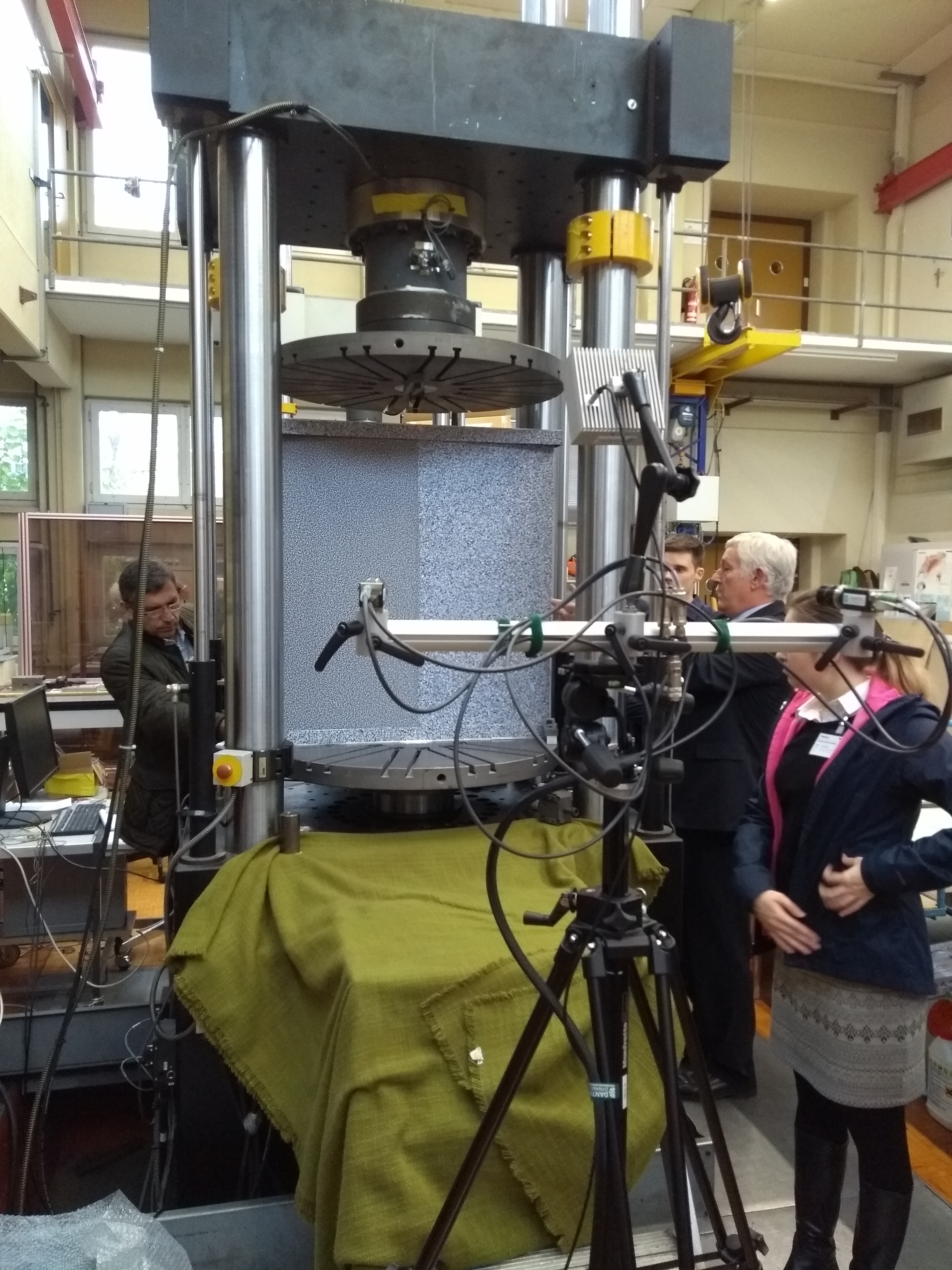
Last month I spent almost a week in Zurich.  It is one of our favourite European cities [see ‘A reflection of existentialism‘ on December 20th, 2017]; however, on this occasion there was no time for sight-seeing because I was there for the mid-term meeting of the MOTIVATE project and to conduct some tests and demonstrations in the laboratories of our host, EMPA, the Swiss Federal Laboratories for Materials Science and Technology.  Two of our project partners, Dantec Dynamics GmbH based in Ulm, Germany, and the Athena Research Centre in Patras, Greece, have developed methods for quantifying the uncertainty present in measurements of deformation made in an industrial environment using digital image correlation (DIC) [see ‘256 shades of grey‘ on January 22, 2014].  Digital image correlation is a technique in which we usually apply a random speckle pattern to the object which allows us to track the movement of the object surface over time by searching for the new position of the speckles in the photographs of the object.  If we use a pair of cameras in a stereoscopic arrangement, then we can measure in-plane and out-of-plane displacements.  Digital image correlation is a well-established measurement technique that has become ubiquitous in mechanics laboratories. In previous EU projects, we have developed technology for quantifying uncertainty in in-plane [SPOTS project] and out-of-plane [ADVISE project] measurements in a laboratory environment.  However, when you take the digital image correlation equipment into an industrial environment, for instance an aircraft hangar to make measurements during a full-scale test, then additional sources of uncertainty and error appear. The new technology demonstrated last month allows these additional uncertainties to be quantified.  As part of the MOTIVATE project, we will be involved in a full-scale test on a large section of an Airbus aircraft next year and so, we will be able to utilise the new technology for the first time.

The photograph shows preparations for the demonstrations in EMPA’s laboratories.  In the foreground is a stereoscopic digital image correlation system with which we are about to make measurements of deformation of a section of aircraft skin, supplied by Airbus, which has a speckle pattern on its surface and is about to be loaded in compression by the large servo-hydraulic test machine.

References:

From SPOTS project:

Patterson EA, Hack E, Brailly P, Burguete RL, Saleem Q, Seibert T, Tomlinson RA & Whelan M, Calibration and evaluation of optical systems for full-field strain measurement, Optics and Lasers in Engineering, 45(5):550-564, 2007.

Whelan MP, Albrecht D, Hack E & Patterson EA, Calibration of a speckle interferometry full-field strain measurement system, Strain, 44(2):180-190, 2008.

From ADVISE project:

Hack E, Lin X, Patterson EA & Sebastian CM, A reference material for establishing uncertainties in full-field displacement measurements, Measurement Science and Technology, 26:075004, 2015.

Where have all the insects gone?

I remember when our children were younger, and we went on our summer holidays by car, that the car windscreen would be splattered with the remains of dead insects.  This summer my wife and I drove to Cornwall and back for our holidays almost without a single insect hitting our windscreen.  Where have all of the insects gone?  It would appear that we, the human species, have wiped them out as a consequence of the way we exploit the planet for our own comfort and convenience.  Insecticides and monocultures aided by genetically-modified crops make a direct contribution but our consumption of fossil fuels and intensive production of everything from beef [see ‘A startling result‘ on May 18th, 2016] to plastics is changing the environment [see ‘Productive cheating?‘ on November 27th, 2013]. The biologist, Edward O. Wilson observed that ‘If all humankind were to disappear, the world would regenerate back to the rich state of equilibrium that existed 10,000 years ago. If insects were to vanish, the environment would collapse into chaos.’  It looks like we are on the cusp of that collapse.

Cristiana Pașca Palmer, the executive secretary of the UN Convention on Biological Diversity has highlighted the impact of our actions as a species on the other species with which we share this planet.  We are making the planet uninhabitable for an increasing number of species to the extent that the rate of extinct is perhaps the fastest ever seen and we might be the first species to catalogue its own demise.  Our politicians have demonstrated their inability to act together over climate change even when it leads to national disasters in many countries; so, it seems unlikely that they will agree on significant actions to arrest the loss of bio-diversity.  We need to act as individuals, in whatever way we can, to reduce our ecological footprints – that impact that we have on the environment [see ‘New Year Resolution‘ on December 31st, 2014] .  As the Roman poet Horace wrote: ‘You are also affected when your neighbour’s house is on fire’; so, we should not think that none of this affect us.

See also:

Man, the Rubbish Maker

Are we all free-riders?

Epistemic triage

A couple of weeks ago I wrote about epistemic dependence and the idea that we need to trust experts because we are unable to verify everything ourselves as life is too short and there are too many things to think about.  However, this approach exposes us to the risk of being misled and Julian Baggini has suggested that this risk is increasing with the growth of psychology, which has allowed more people to master methods of manipulating us, that has led to ‘a kind of arms race of deception in which truth is the main casualty.’  He suggests that when we are presented with new information then we should perform an epstemic triage by asking:

  • Is this a domain in which anyone can speak the truth?
  • What kind of expert is a trustworthy source of truth in that domain?
  • Is a particular expert to be trusted?

The deluge of information, which streams in front of our eyes when we look at the screens of our phones, computers and televisions, seems to leave most of us grasping for a hold on reality.  Perhaps we should treat it all as fiction until have performed Baggini’s triage, at least on the sources of the information streams, if not also the individual items of information.

Source:

Julian Baggini, A short history of truth: consolations for a post-truth world, London: Quercus Editions Ltd, 2017.