Category Archives: Engineering

Chirping while calculating probabilities

Decorative image of a pink roseA couple of weeks ago, I visited the London headquarters of IBM in the UK and Ireland for discussions about possible areas of collaboration in research and education.  At the end of our meeting, we were taken to see some of their latest developments, one of which was their Quantum System One computer.  We had seen its casing, a shiny silver cylinder about half metre in diameter and a metre and half long with a hemispherical lower end, hanging in a sealed glass cube in the lobby of the building.  The computer we viewed was also suspended from the ceiling of a sealed glass cube in order to isolate it from vibration, but was without its cylindrical cover so that we could see its innards which need to be cooled to cryogenic temperatures.  The room in which it was displayed was darkened and a soundtrack of the computer operating added to the atmosphere – it sounded like birds chirping.  IBM are already operating quantum computers, starting in 2019 with a 27-qubit processor and achieving 433 qubits last year with plans for 4,158+ qubits in 2025 in their roadmap.  There are about 80 companies focussed on quantum computing worldwide, including Universal Quantum who are working on a million qubit computer.  Qubit is short for quantum bit and is the quantum mechanical analogue of a classical computer bit.  A computer bit works in binary and can only have a value of 0 or 1.  Whereas a qubit holds information about the probability amplitudes for 0 and 1 which will always have a sum of 1.  The use of probability amplitudes allows complex systems to be described more efficiently and larger solution spaces to be explored.  IBM’s quantum processors are thin wafers about the same size as the one in your laptop but their need for cryogenic temperatures and vibration isolation means we will not be using them at home any time soon.

Opportunities lost in knowledge management using digital technology

Decorative imageRegular readers of this blog will know that I occasionally feature publications from my research group.  The most recent was ‘Predicting release rates of hydrogen from stainless steel’ on September 13th, 2023 and before that ‘Label-free real-tracking of individual bacterium’ on January 25th 2023 and ‘A thermal emissions-based real-time monitoring system for in situ detection of cracks’ in ‘Seeing small changes is a big achievement’ on October 26th 2023.  The subject of these publications might seem a long way apart but they are linked by my interest in trying to measure events in the real-world and use the data to develop and validate high-fidelity digital models.  Recently, I have stretched my research interests still further through supervising a clutch of PhD students with a relatively new collaborator working in the social sciences.  Two of the students have had their first papers published by the ASME (American Society of Mechanical Engineers) and the IEEE (Institute of Electrical and Electronics Engineers).  Their papers are not directly connected but they both explore the use of published information to gain new insights on a topic.  In the first one [1], we have explored the similarities and differences between safety cases for three nuclear reactors: a pair of research reactors – one fission and one fusion reactor; and a commercial fission reactor.  We have developed a graphical representation of the safety features in the reactors and their relationships to the fundamental safety principles set out by the nuclear regulators. This has allowed us to gain a better understanding of the hazard profiles of fission and fusion reactors that could be used to create the safety case for a commercial fusion reactor.  Fundamentally, this paper is about exploiting existing knowledge and looking at it in a new way to gain fresh insights, which we did manually rather than automating the process using digital technology.  In the second paper [2], we have explored the extent to which digital technologies are being used to create, collate and curate knowledge during and beyond the life-cycle of an engineering product.  We found that these processes were happening but generally not in a holistic manner.  Consequently, opportunities were being lost through not deploying digital technology in knowledge management to undertake multiple roles simultaneously, e.g., acting as repositories, transactive memory systems (group-level knowledge sharing), communication spaces, boundary objects (contact points between multiple disciplines, systems or worlds) and non-human actors.  There are significant challenges, as well as competitive advantages and organisational value to be gained, in deploying digital technology in holistic approaches to knowledge management.  However, despite the rapid advances in machine learning and artificial intelligence [see ‘Update on position of AI on hype curve: it cannot dream’ on July 26th 2023] that will certainly accelerate and enhance knowledge management in a digital environment, a human is still required to realise the value of the knowledge and use it creatively.

References

  1. Nguyen, T., Patterson, E.A., Taylor, R.J., Tseng, Y.S. and Waldon, C., 2023. Comparative maps of safety features for fission and fusion reactors. Journal of Nuclear Engineering and Radiation Science, pp.1-24
  2. Yao, Y., Patterson, E.A. and Taylor, R.J., 2023. The Influence of Digital Technologies on Knowledge Management in Engineering: A Systematic Literature Review. IEEE Transactions on Knowledge and Data Engineering.

Inconvenient data about electricity generation

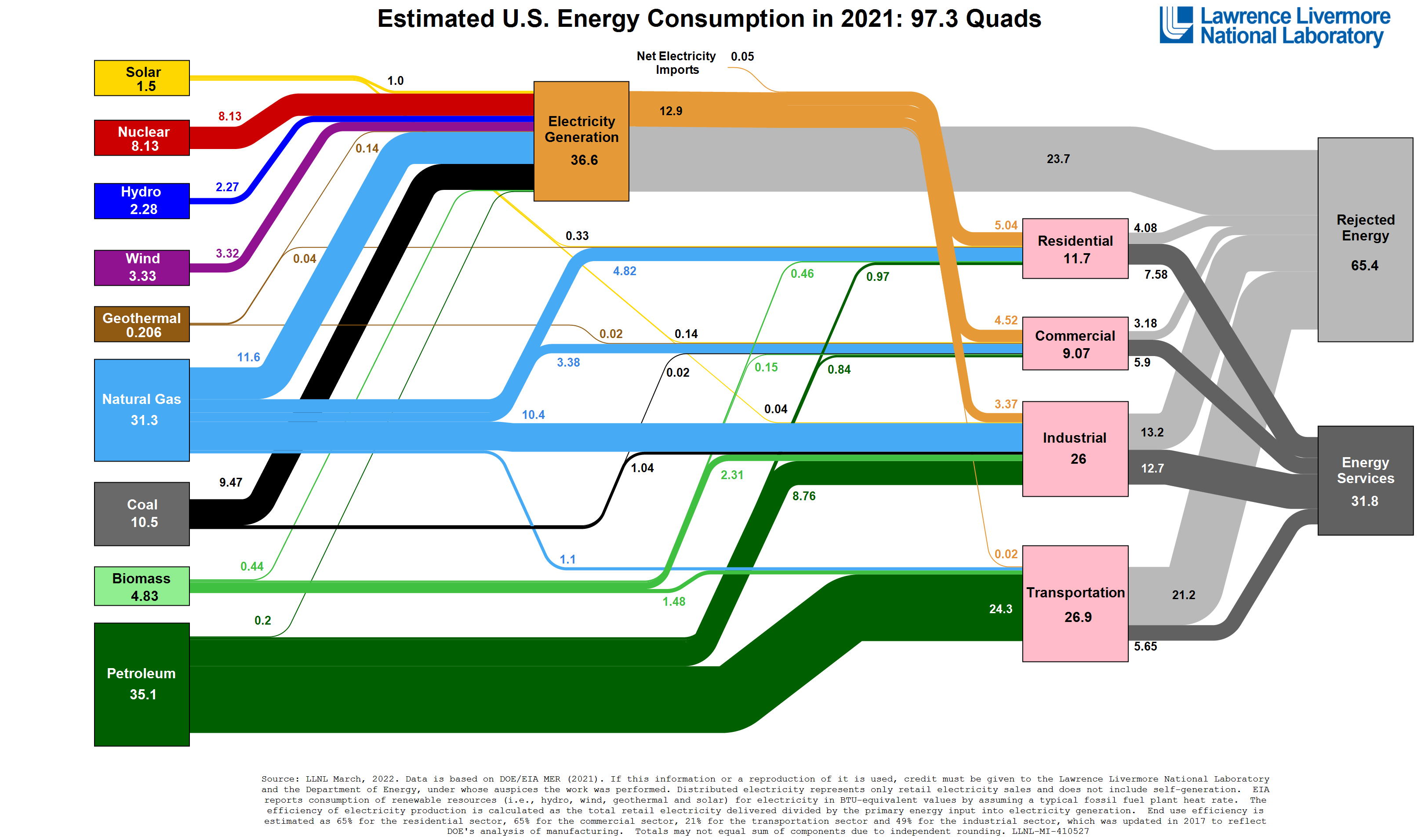
Decorative infographicI like a good infographic and this one showing annual energy flows for a country  is one of my favourites [see ‘Energy blending’ on May 22nd 2013].  Some governments produce them annually.  The image shows the latest one for the UK [2021]. It makes interesting but perhaps depressing reading.  Transportation using fossil fuels accounts for 31% (41.6/134.1 million tonnes oil equivalent) of the UK energy consumption while electricity output accounts for only 21% (28.6/134.1 million tonnes oil equivalent).  This implies that if all vehicles were powered by electricity then the output of our power stations would need to increase to 70.2 million tonnes oil equivalent or between two- and three-fold (excluding conversion & transmission losses).  You can perform a similar analysis for the USA [see 2021 Energy flow chart from LLNL].  Fossil-fuelled transportation accounted for 25%  (24.3/97.3 Quads) and electricity output 13% (12.9/97.3 Quads) so converting all transportation to be electrically powered requires a three-fold increase in electrical output from power stations. It is more difficult to find equivalent data for Japan; however, in 2014 [see Energy flow chart from I2CNER Kyushu University] fossil-fuelled transportation accounted for 32% (3.03/9.52 EJ) and electricity output 38% (3.66/9.52 EJ) so converting all transportation to be electrically powered requires a two-fold increase in electrical output from power stations.  None of the above takes account of space heating mainly via fossil fuel or that many existing power stations are fossil-fuelled and need to be replaced in order to achieve net zero carbon emissions.  Hence, the required scale of construction of power stations using renewable sources, including nuclear, solar and wind, is enormous and in most countries it is barely discussed let alone planned or started; leading to the conclusion that there is little chance of achieving net zero carbon emissions by 2050 as called for by the Paris agreement.

Work, rest and play in Smallville

Decorative imageI am comfortable with the lack of certainty about us not being in a simulation [see ‘Are we in a simulation?‘ on September 28, 2022].  However, I know that some of you would prefer not to consider this possibility.  Unfortunately, recently published research has likely increased the probability that we are in a simulation because the researchers set up a simulation of a community of human-like agents called Smallville [Park et al, 2023].  The generative agents fuse large language models used in artificial intelligence with computational, interactive agents who eat, sleep, work and play just like humans and coalesce into social groups.  The simulation was created as a research tool for studying human interactions and emergent social behaviour which completely concurs with the argument for us already being part of a simulation created to study social behaviour.  Smallville only had 25 virtual inhabitants but the speed of advances in artificial intelligence and computational tools perhaps implies that a simulation of billions of agents (people) is not as far in the future as we once thought thus making it more credible that we are in a simulation.  The emergent social behaviour observed in Smallville suggests that our society is essentially a self-organising complex system that cannot be micro-managed from the centre.

Sources:

Oliver Roeder, Keeping up with the ChatGPT neighbours, FT Weekend, August 26/27 2023.

Camilla Cavendish, Charities could lead new age of community spirit, FT Weekend, August 26/27 2023.

Park JS, O’Brien JC, Cai CJ, Morris MR, Liang P, Bernstein MS. Generative agents: Interactive simulacra of human behavior. arXiv preprint arXiv:2304.03442. 2023.

Image: Ceramic tile by Pablo Picasso in museum in Port de Sóller Railway Station, Mallorca.