Category Archives: Engineering

Recognizing strain

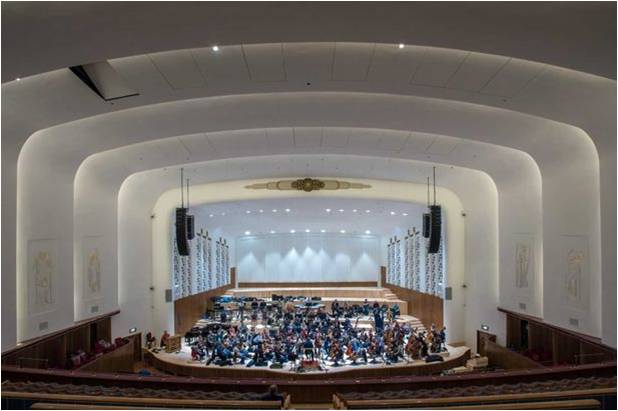
rlpoYou can step off an express train but you can’t speed up a donkey. This is paraphrased from ‘The Fly Trap’ by Fredrik Sjöberg in the context of our adoption of faster and faster technology and the associated life style. Last week we stepped briefly off the ‘express train’ and lowered our strain levels by going to a concert given by the Royal Liverpool Philharmonic Orchestra, including pieces by Dvorak, Chopin and Tchaikovsky. I am not musical at all and so I am unable to tell you much about the performances or compositions, except to say that I enjoyed the performances as did the rest of the audience to judge from the enthusiastic applause. A good deal of my enjoyment arose from the energy of the orchestra and my ability to recognise the musical themes or acoustic features in the pieces. The previous sentence was not intended as a critic’s perspective on the concert but a tenuous link…

Recognising features is one aspect of my recent research, though in strain data rather than music. Modern digital technology allows us to acquire information-rich data maps with tens of thousands of individual data values arranged in arrays or matrices, in which it can be difficult to spot patterns or features. We treat our strain data as images and use image decomposition to compress a data matrix into a feature vector. The diagram shows the process of image decomposition, in which a colour image is converted to a map of intensity in the image. The intensity values can be stored in a matrix and we can fit sets of polynomials to them by ‘tuning’ the coefficients in the polynomials. The coefficients are gathered together in a feature vector. The original data can be reconstructed from the feature vector if you know the set of polynomials used in the decomposition process, so decomposition is also a form of data compression. It is easier to recognise features in the small number of coefficients than in the original data map, which is why we use the process and why it was developed to allow computers to perform pattern recognition tasks such as facial recognition.

decompositionSources:

Wang W, Mottershead JE, Patki A, Patterson EA, Construction of shape features for the representation of full-field displacement/strain data, Applied Mechanics and Materials, 24-25:365-370, 2010.

Patki, A.S., Patterson, E.A, Decomposing strain maps using Fourier-Zernike shape descriptors, Exptl. Mech., 52(8):1137-1149, 2012.

Nabatchian A., Abdel-Raheem E., and Ahmadi M., 2008, Human face recognition using different moment invariants: a comparative review. Congress on Image and Signal Processing, 661-666.


Hype cycle

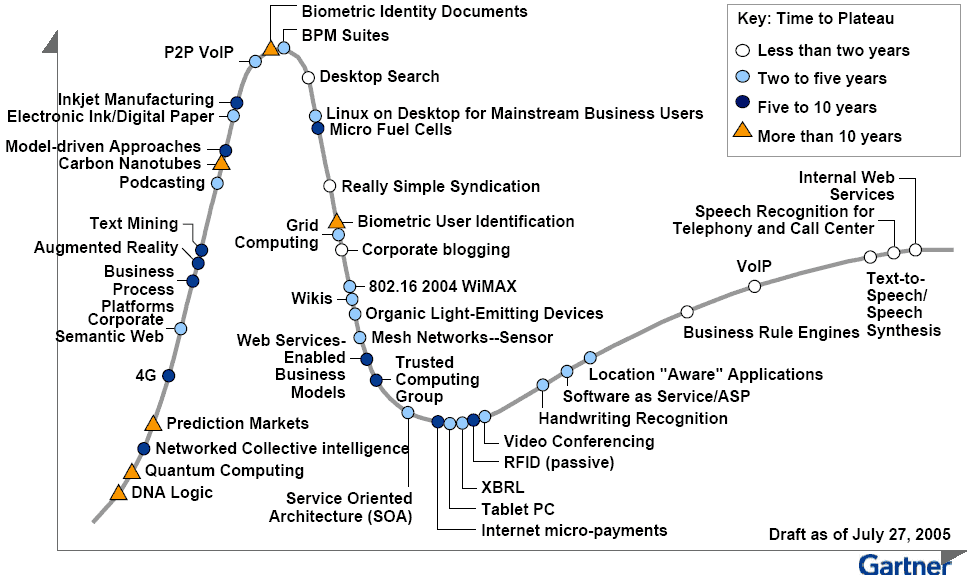
gartner_hype_cycle_2005It is easy to become cynical about the latest innovation and the claims for its future success.  The tendency becomes worse with age and the feeling that you’ve seen it all before.  The IT consultancy firm, Gartner Inc. have invented a graph to describe the cycle of enthusiam, despondency and maybe ultimate productivity of new inventions.  They call it the hype curve.  For most new ideas the plateau of productivity is 5 to 10 years after the peak of inflated expectations and separated from it by a deep trough of disillusionment.

Gartner Inc publish an annual analysis of the status of new technology in the form of a single hype curve.  It’s interesting to see what’s in the trough [cloud computing, mobile health monitoring] and what’s on or near the peak of inflated expectations [consumable 3D printing and autonomous vehicles] today.  You might have noticed from your smart phone that speech recognition has just reached the plateau of productivity.  The thumb-nail shows a historic hype curve for ten years ago.

Forensic engineering

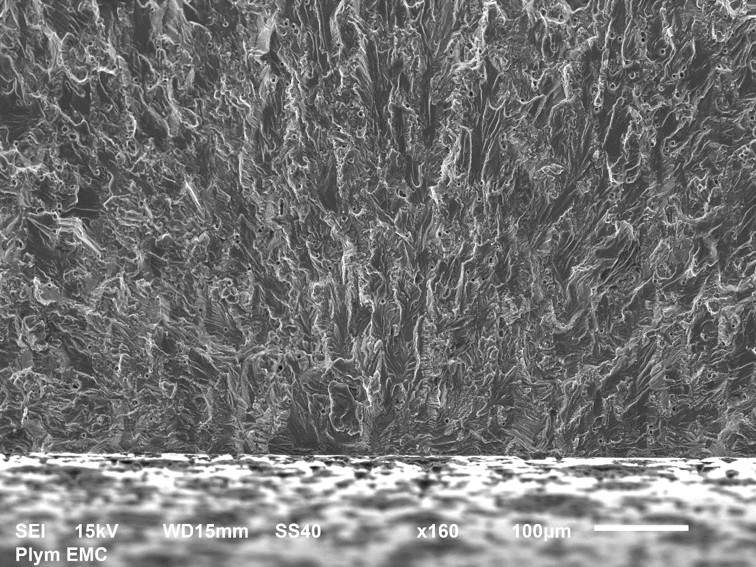
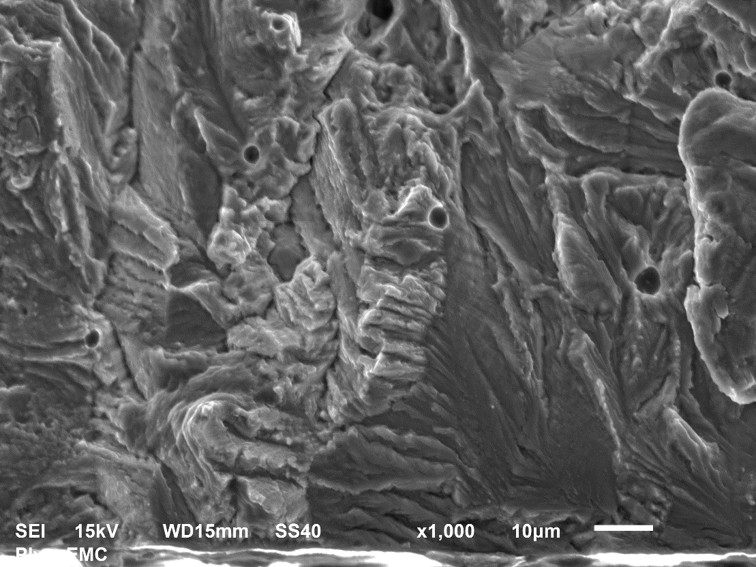
Picture1The picture above shows the fracture surface of a thin bar of aluminium alloy that had a circular hole through the middle, like the peep-hole in a front door. The photograph was taken in a Scanning Electron Microscope (SEM) at x160 magnification. There is a scale bar in the bottom right corner showing a length of 100 microns. We are looking approximately in the longitudinal direction, which was the direction of loading, and across the photograph from left to right corresponds to the direction you would look through the hole. The lower one third of the picture shows the machined surface of the hole cut or machined by the drill. The top two-thirds shows the surface created by the fatigue crack as it extended incrementally with each cycle of load. The crack started from edge of the machined surface approximately on the vertical centre-line of the picture. I can tell this because all of the features in the texture of the fracture surface point towards this point because the failure radiated out from this location. The picture below shows the crack initiation area at x1000 magnification. It is a small area at interface with hole above the letters ‘SS40’ in the top photograph; this should be enough to let you identify the common features but the interpretation of these images requires significant skill.

Fractography is the forensic study of failure surfaces such as this to establish the cause of failure. In this example, the hole in aluminium bar ensured that it will always fail with cyclic loading through the growth of a crack from somewhere around the hole. The textured form of the fracture surface occurs because the material is not homogeneous at this scale but made up of small grains. The failure of each grain is influenced by its orientation to the loading which results in the multi-faceted surface in the photographs.

I made the photographs the focus of this post because I thought they are interesting, but may be that’s because I’m an engineer, and because they are a tiny part in a fundamental research programme on which I have been spending a significant portion of my time. A goal of programme is to understand how to use these materials to build more energy-efficient structures that are cheaper and last longer without failing by, for example, fatigue.

More details:

The bar was 1.6mm thick and 38mm wide in the transverse direction and made from 2024-T3 Aluminium alloy. The hole diameter was 6.36mm. A tension load was repeatedly applied and removed in the longitudinal direction which caused the initiation and growth of a fatigue crack from the hole that after many cycles of loading led to the bar breaking in half along a plane perpendicular to the load direction. The pictures were taken at the University of Plymouth by Khurram Amjad with the assistance of Peter Bond and Roy Moate using a JEOL JSM-6610LV.

x1000

Fields of flowers

It’s not often that someone presents you with a completely new way of looking at the world around us but that’s what Dr Gregory Sutton did a few weeks ago at a Royal Society Regional Networking Event in Bristol where he is a University Research Fellow funded by the Royal Society. He told us that every flower is a conductor sticking out of the ground which on a sunny day has an electric field around it of the order of 100 volts per metre. Bees can identify the type of flower that they are approaching based on the interaction between this field and the electrostatic field generated around them as they fly. Bees are covered in tiny hairs and he believes that they use these to sense the electric field around them. The next research question that he is tackling is how bees are affected by the anthropogenic electric fields from power lines, mobile phones etc.

The plots of the electric field around a flower really caught my attention. You can see one in the thumbnail photo. I walked across Brandon Hill in Bristol after the talk to meet a former PhD student for dinner. I kept stopping on the way to try to detect this field with the hairs on the back of my hand. It was a beautiful sunny day but I was not sensitive enough to feel anything. Or maybe I was sensing it but my brain is not programmed to recognise the sensation. We discussed it over dinner and marvelled at the bees’ ability to process the information from its multiple sensors in the light of our knowledge of the computing power required to handle what it is fashionable to call ‘Big Data’ from man-made sensors.

Once again Nature humbles us with its ingenuity and makes our efforts look clumsy if not feeble. Dr Sutton’s insights have given me a whole new way to attempt to connect with Nature while I am on deep vacation.

Sorry about the pun in the title. I couldn’t resist it.

Source:

Clarke D, Whitney H, Sutton G & Robert D, Detection and Learning of Floral Electric Fields by Bumblebee, Science, 5 April 2013: 66-69. [DOI:10.1126/science.1230883].