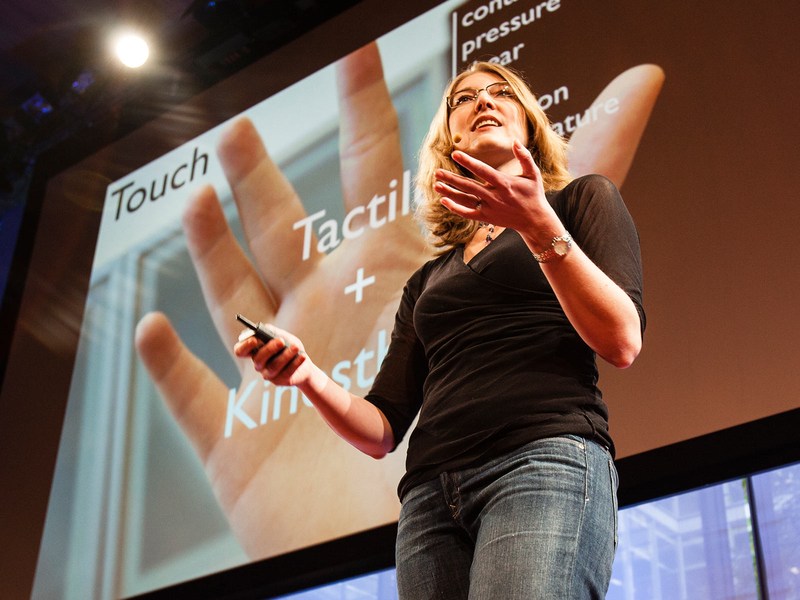
Some months ago I wrote about soft robots that could delicately pick up fragile objects [see my post entitled ‘Robots with a delicate touch’ on June 3rd, 2015]. These robots, developed by George Whiteside’s research group, went some way towards mimicking the function of our hands. However, these robots are numb because they have no sense of touch. Think about how hard it would be to strike a match or pick up an egg without your sense of touch. Katherine Kuchenbecker from the University of Pennsylvania is working on robots with tactile sensors that detect pressure and vibrations. This sensitivity transforms their ability to perform delicate tasks such as picking up an egg, or perhaps more significantly perform surgery. I listened to Professor Kuchenberger speak at a meeting at the Royal Society on ‘Robotics and Autonomous Systems’ where she put us off our lunch with some gory videos on robot-assisted surgery. You can watch them at her website. Her vision is of robots that connect vision and touch, which is of course what we do effortlessly most of the time.
Category Archives: Engineering
Insidious damage
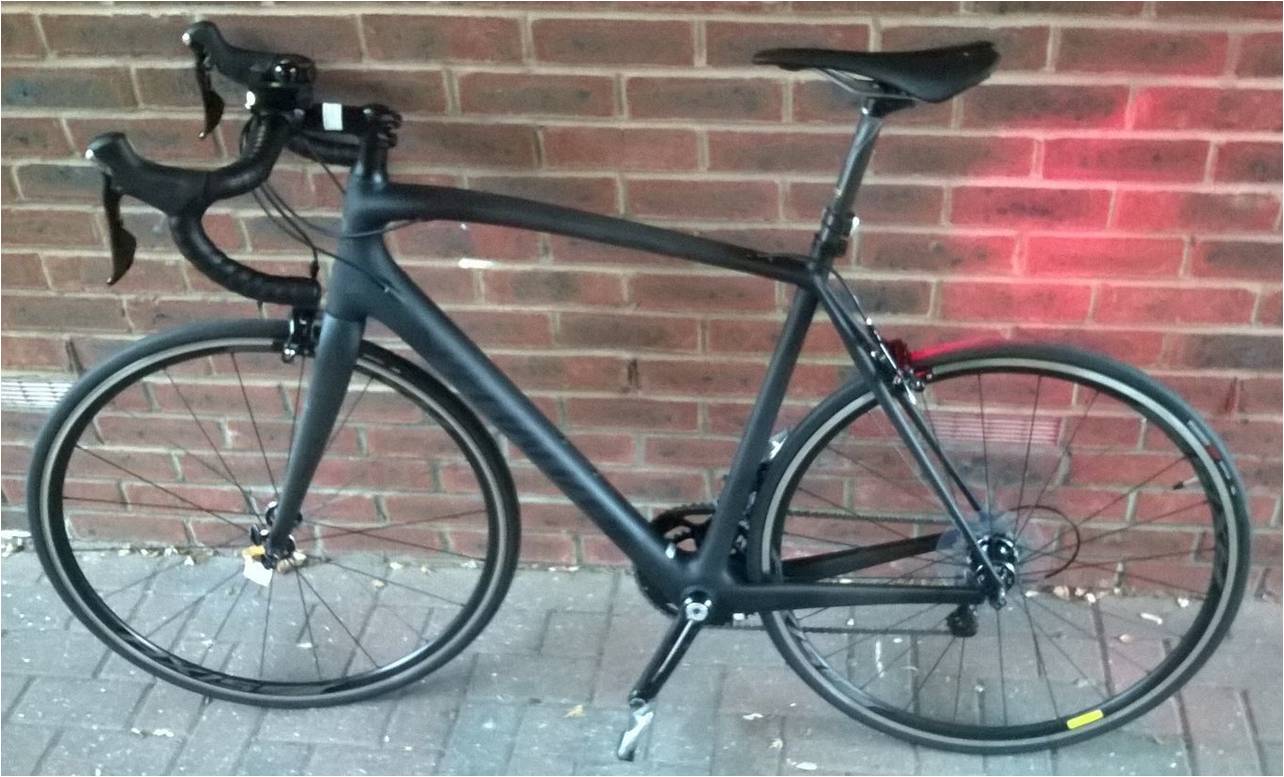
Recently, my son bought a carbon-fibre framed bike for his commute to work. He talked to me about it before he made the decision to go ahead because he was worried about the susceptibility of carbon-fibre to impact damage. The aircraft industry worries about barely visible impact damage (BVID) because while the damage might be barely visible on the accessible face that received the impact, within the carbon-fibre component there can be substantial life-shortening damage. I reassured my son that it is unlikely a road bike would receive impacts of sufficient energy to induce life-shortening damage, at least in ordinary use. However, such impacts are not unusual in aircraft structures which means that they have to be inspected for hidden, insidious damage. The most common method of inspection is based on ultrasound that is reflected preferentially by the damaged areas so that the shape and extent of damage can be mapped. It is difficult to predict the effect on the structural performance of the component from this morphology information so that, when damage is found, the component is usually repaired or replaced immediately. In my research group we have been exploring the use of strain measurements to locate and assess damage by comparing the strain distributions in as-manufactured and in-service components. We can measure the strain fields in components using a number of techniques including digital image correlation (see my post entitled ‘256 shades of grey’) and thermoelastic stress analysis (see my post entitled ‘Counting photons to measure stress‘). The comparison is performed using feature vectors that represent the strain fields, see my post of a few weeks ago entitled ‘Recognising strain’. The guiding principle is that if damage is present but does not change the strain field then the structural performance of the component is unchanged; however when the strain field is changed then it is easier to predict remanent life from strain data than from morphology data. We have demonstrated that these new concepts work in glass-fibre reinforced laminates and are in the process of reproducing the results in carbon-fibre composites.
Sources
Unexpected bad news for turkeys
Risk is defined as the probability of something happening multiplied by consequences of its occurrence. Engineers expend considerable time and effort in reducing the consequences of the quite probable such as ensuring the passenger compartment of a car will remain largely intact during a crash. The installation of automatic breaking systems on some cars is also an attempt to reduce the probability of an impact, i.e. the occurrence of a crash. It is difficult to anticipate the very low probability event with catastrophic consequences and so cars are not designed to deal with meteors dropping out the sky or even elevated highways collapsing in an earthquake. These are what Nassim Taleb, labels Black Swan events but would perhaps be better named after another bird, the more humble turkey. An American turkey is fed daily by a friendly human and has no idea in November that Thanksgiving is about happen with fatal consequences, or substitute December and Christmas for a British turkey. From the turkey’s perspective everything is fine down on the farm until it isn’t; in other words, the very low probability event with catastrophic consequences occurs. From the farmer’s perspective, turkey for dinner at Thanksgiving is close to a certainty, i.e. a probability of one. The problem for engineers designing machines is to have the perspective of the farmer and not the turkey.
Happy Thanksgiving to my American readers!
Source:
Counting photons to measure stress
Some might find it strange that I am teaching thermodynamics when my research expertise is in structural materials and mechanics. However, the behaviour of structures is largely controlled by energy and how they absorb, store and release it; while thermodynamics is the study of energy flows and transformations, so there is a connection. In my research group, we exploit this connection in a technique for measuring stress fields in components by monitoring the temperature changes that occur when a component is loaded. In Thermoelastic Stress Analysis (TSA) as it is known, we use very sensitive infrared cameras to monitor the cyclic variations of temperature that occur when cyclic load is applied to a material. The temperature changes are of the order of milli-Kelvin, that’s thousandths of a degree, and are positive with negative, or compressive stress and negative with tensile stress. What we are actually measuring is the rate of change in the release of photons by atoms as they are pushed closer together in compression or pulled further apart in tension; but that’s another story and takes us into physics.
An exciting feature of this technique is that as a crack evolves new surfaces are formed which releases energy as heat. We can detect not only the stress field around the crack but also the heat released during the formation of the crack prior it being visible and its subsequent growth.
Sources: