 Earlier this summer, when we were walking the South West Coastal Path [see ‘The Salt Path‘ on August 14th, 2019], we frequently saw kestrels hovering above the path ahead of us. It is an enthralling sight watching them use the air currents around the cliffs to soar, hang and dive for prey. Their mastery of the air looks effortless. What you cannot see from the ground is the complex motion of their wing feathers changing the shape and texture of their wing to optimise lift and drag. The base of their flight feathers are covered by small flexible feathers called ‘coverts’ or ‘tectrix’, which in flight reduce drag by providing a smooth surface for airflow. However, at low speed, such as when hovering or landing, the coverts lift up and the change the shape and texture of the wing to prevent aerodynamic stalling. In other words, the coverts help the airflow to follow the contour of the wing, or to remain attached to the wing, and thus to generate lift. Aircraft use wing flaps on their trailing edges to achieve the same effect, i.e. to generate sufficient lift at slow speeds, but birds use a more elegant and lighter solution: coverts. Coverts are deployed passively to mitigate stalls in lower speed flight, as in the picture. When I was in the US last month [see ‘When upgrading is downgrading‘ on August 21st, 2019], one of the research reports was by Professor Aimy Wissa of the Department of Mechanical Science & Engineering at the University of Illinois Urbana-Champaign, who is working on ‘Spatially distributed passively deployable structures for stall mitigation‘ in her Bio-inspired Adaptive Morphology laboratory. She is exploring how flaps could be placed over the surface of aircraft wings to deploy in a similar way to a bird’s covert feathers and provide enhanced lift at low speeds. This would be useful for drones and other unmanned air vehicles (UAVs) that need to manoeuvre in confined spaces, for instance in cityscapes.
I must admit that I had occasionally noticed the waves of fluttering small feathers across the back of a bird’s wing but, until I listened to Aimy’s presentation, I had not realised their purpose; perhaps that lack of insight is why I specialised in structural mechanics rather than fluid mechanics with the result that I was worrying about the fatigue life of the wing flaps during her talk.
The picture is from a video available at Kestrel Hovering and Hunting in Cornwall by Paul Dinning.
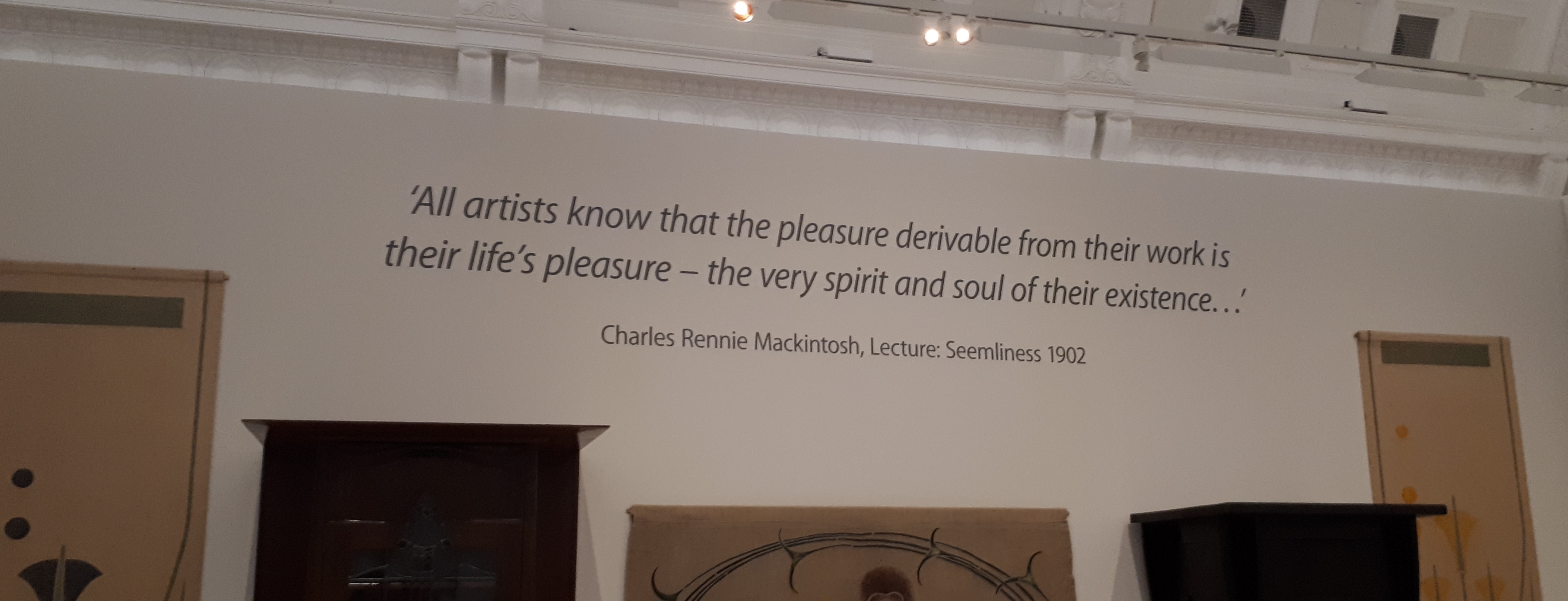 I wrote some weeks ago about art challenging the way we think and artists being spokespeople for society [see ‘Spokesperson for society’ on August 28th, 2019] and also about ‘Taking a sketch instead of snapping a photo’ [on September 3rd, 2019]. My photo of the sketch taken by Rennie Mackintosh was snapped at an exhibition in Walker Art Gallery in Liverpool; and, on the wall of the gallery was a quote from Rennie Mackintosh: ‘All artists know that pleasure derivable from their work is their life’s pleasure – the very spirit and soul of their existence’. I feel the same way about my work as an engineer and I think that many of my colleagues would agree with me. In my welcome talk to new engineering undergraduate students last week, I used this quote and tried to convey the extent to which science and engineering is a part of my existence and how I hoped it would become a part of their life. I am not sure that I convinced very many of them.


 Realize Engineering