Author Archives: Eann Patterson

Out and about

butterfly-with-branched-scrolls-vaseI have been away from Liverpool a lot in the last few weeks. Teaching in Manchester and London but also visiting Taiwan. In the capital, Taipei they have yellow cabs and a succession of black limos pick up visitors from the airport. I even saw a baseball pro shop but despite the strong American influence, the culture is definitely Chinese so ordering meals and buying train tickets is a challenge if you don’t speak or read Mandarin. I am a Visiting Professor at the National Tsing Hua University and was there to meet with some PhD students and participate in a research workshop on computational modelling [see my post on Can you trust your digital twins?on November 22nd, 2016]. It wasn’t my first trip to Taiwan [see my post entitled ‘Crash in Taipei: an engineer’s travelogue?’ on November 19th, 2014] but I visited a high school for the first time. I spent half a day meeting teachers and pupils at the Taipei European School. I gave a talk based on my post entitled ‘Happenstance, not engineering?’ [see my post on November 9th, 2016] to several groups of science pupils in an attempt to explain what engineers do. The reception was enthusiastic and we had some good question and answer sessions. It was a first for me to do this in any school and the first time in the memory of the teachers that a professional engineer had visited the school. A while ago I wrote about nurturing the spirit through the exchange of gifts in the form of knowledge [see my post entitled ‘Knowledge spheres’ on March 9th, 2016]. My spirits were lifted by talking to the pupils and maybe one or two of them will have been persuaded to think about becoming an engineer. We also exchanged material gifts so that I have a beautiful vase to stand on my shelf and remind me of an enjoyable visit and hopefully prompt me to go again. Lots of young people have no idea what engineers do and are looking for a career that will allow them to contribute to society, so they are surprised and excited when they realise engineering offers that opportunity. So, we should get out more and tell them about it.

Digital hive mind

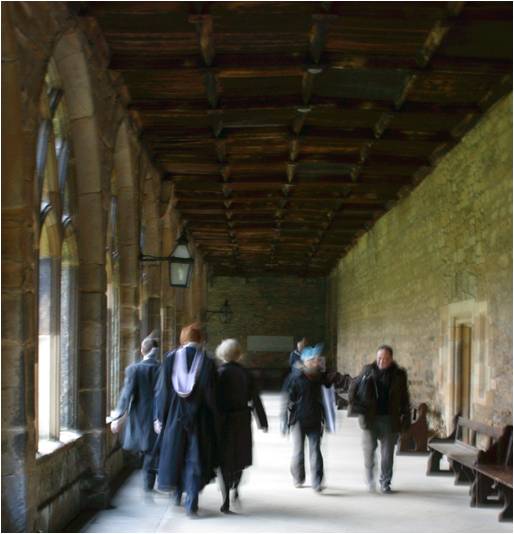
durham-cloistersFor many people Durham Cathedral will be familiar as a location in the Harry Potter movies.  However, for me it triggers memories of walking around the cloisters discussing Erwin Schrodinger’s arithmetical paradox: there seems to be a great number of conscious egos creating their own worlds but only one world.  Each of us appears to construct our own domain of private consciousness and Schrodinger identifies the region where they all overlap as the ‘real world around us’.  However, he raises questions such as, is my world really the same as yours?  Schrodinger proposes two solutions to the paradox: either there are a multitude of worlds with no communication between them or a unification of minds or consciousness.

Schrodinger found ‘it utterly impossible to form an idea about’ how his ‘own conscious mind should have originated by the integration of the consciousness of the cells (or some of them)’ that formed his body.  Recently this has been addressed by Susan Greenfield, who has proposed that short-lived coalitions of millions of neurons are responsible for consciousness.  These ‘neuronal assemblies’, which last for fractions of a second, link local events in individual cells with large scale events across the brain and many of ‘these assemblies flickering on and off somehow come together to provide a collective continuous experience of consciousness’.  In other words, our consciousness arises as an emergent behaviour of the myriad of interacting networks in our brain.  It seems no less fanciful that our individual minds networked together to generate a further level of emergent behaviour equivalent to the unified mind that Schrodinger conceived though, like Schrodinger, I find it utterly impossible to form an idea about how this might happen.

Perhaps, at some level we are creating a unified mind via the digital hive mind being formed by the digital devices to which we delegate some of the more mundane aspects of modern life [see my post entitled ‘Thinking out of the skull‘ on 18th March, 2015].  However, Greenfield worries about a very sinister potential impact of our digital devices, which is associated with the stimulation they provide to millions of the younger generation.  She thinks it could lead to small-scale neuronal assemblies becoming ‘the default setting in the consciousness of the digital native, to an extent it has never been in previous generations’.  In other words we might be losing the ability to create the emergent behaviour required for consciousness and shifting it to our digital devices.

Perhaps we are closer than we think to the vision in Maria Lassnig’s painting of the lady with her half of her brain outside her skull? [see my post entitled ‘Science fiction becomes virtual reality‘ on October 6th, 2016.

Sources:

Erwin Schrodinger, ‘Mind and Matter – the Tarner Lectures’ in What is Life?, Cambridge: Cambridge University Press, 1967.

Susan Greenfield, A day in the life of the brain: the neuroscience of consciousness from dawn to dusk, Allen Lane, 2016.

Clive Cookson, Know your own mind, FT Weekend, 15/16 October 2016, reviewing Greenfield’s book.

Nilanjana Roy ‘What it means to be human’ FT Weekend, 17/18 September 2016.

Can you trust your digital twin?

Author's digital twin?

Author’s digital twin?

There is about a 3% probability that you have a twin. About 32 in 1000 people are one of a pair of twins.  At the moment an even smaller number of us have a digital twin but this is the direction in which computational biomedicine is moving along with other fields.  For instance, soon all aircraft will have digital twins and most new nuclear power plants.  Digital twins are computational representations of individual members of a population, or fleet, in the case of aircraft and power plants.  For an engineering system, its computer-aided design (CAD) is the beginning of its twin, to which information is added from the quality assurance inspections before it leaves the factory and from non-destructive inspections during routine maintenance, as well as data acquired during service operations from health monitoring.  The result is an integrated model and database, which describes the condition and history of the system from conception to the present, that can be used to predict its response to anticipated changes in its environment, its remaining useful life or the impact of proposed modifications to its form and function. It is more challenging to create digital twins of ourselves because we don’t have original design drawings or direct access to the onboard health monitoring system but this is being worked on. However, digital twins are only useful if people believe in the behaviour or performance that they predict and are prepared to make decisions based on the predictions, in other words if the digital twins possess credibility.  Credibility appears to be like beauty because it is in eye of the beholder.  Most modellers believe that their models are both beautiful and credible, after all they are their ‘babies’, but unfortunately modellers are not usually the decision-makers who often have a different frame of reference and set of values.  In my group, one current line of research is to provide metrics and language that will assist in conveying confidence in the reliability of a digital twin to non-expert decision-makers and another is to create methodologies for evaluating the evidence prior to making a decision.  The approach is different depending on the extent to which the underlying models are principled, i.e. based on the laws of science, and can be tested using observations from the real world.  In practice, even with principled, testable models, a digital twin will never be an identical twin and hence there will always be some uncertainty so that decisions remain a matter of judgement based on a sound understanding of the best available evidence – so you are always likely to need advice from a friendly engineer   🙂

Sources:

De Lange, C., 2014, Meet your unborn child – before it’s conceived, New Scientist, 12 April 2014, p.8.

Glaessgen, E.H., & Stargel, D.S., 2012, The digital twin paradigm for future NASA and US Air Force vehicles, Proc 53rd AIAA/ASME/ASCE/AHS/ASC Structures, Structural Dynamics and Materials Conference, AIAA paper 2012-2018, NF1676L-13293.

Patterson E.A., Feligiotti, M. & Hack, E., 2013, On the integration of validation, quality assurance and non-destructive evaluation, J. Strain Analysis, 48(1):48-59.

Patterson, E.A., Taylor, R.J. & Bankhead, M., 2016, A framework for an integrated nuclear digital environment, Progress in Nuclear Energy, 87:97-103.

Patterson EA & Whelan MP, 2016, A framework to establish credibility of computational models in biology, Progress in Biophysics & Molecular Biology, doi: 10.1016/j.pbiomolbio.2016.08.007.

Tuegel, E.J., 2012, The airframe digital twin: some challenges to realization, Proc 53rd AIAA/ASME/ASCE/AHS/ASC Structures, Structural Dynamics and Materials Conference.

More on white dwarfs and existentialism

Image by Sarah

Image by Sarah

When I was writing about cosmic heat death a couple of weeks ago [see ‘Will it all be over soon?’ posted on November 2nd, 2016], I implied that our sun would expire on a shorter timescale of about 4 to 5 billion years but without mentioning what we expect to happen.  The gravitational field associated with every piece of matter is proportional to the mass of the piece of matter and inversely proportional to distance from its centre.  The size of the sun implies it should collapse under its own gravitational forces, except that the fusion of hydrogen in its core causes an outwards heat transfer, which prevents this from happening. The sun remains a sphere of hot gases with diameter of about 864,000 miles by ‘burning’ hydrogen.  When the hydrogen runs out, the gravitational field will take over and the sun is expected to collapse to a 30,000 mile diameter ball of atoms and free electrons, or a white dwarf.

These are all spontaneous processes and so the total entropy must increase although there are some local reductions.  The heat dissipated following the fusion of two hydrogen nuclei generates more entropy in the surroundings than the local reduction caused by the fusion.  The collapse to white dwarf would appear to represent a substantial reduction of entropy of the sun because the atomic particles are crushed together. However, this is countered by the release of photons to the surroundings which ensures that the entropy of the surroundings increases sufficiently to satisfy the second law of thermodynamics.

Source:

Isaac Asimov, The roving mind: a panoramic view of fringe science, technology, and the society of the future, London: Oxford University Press, 1987.

An extract is available in John Carey (editor), The Faber Book of Science, London: Faber & Faber, 2005.