Category Archives: Uncategorized

Slow moving nanoparticles

Random track of a nanoparticle superimposed on its image generated in the microscope using a pin-hole and narrowband filter.

A couple of weeks ago I bragged about research from my group being included in a press release from the Royal Society [see post entitled ‘Press Release!‘ on November 15th, 2017].  I hate to be boring but it’s happened again.  Some research that we have been performing with the European Union’s Joint Research Centre in Ispra [see my post entitled ‘Toxic nanoparticles‘ on November 13th, 2013] has been published this morning by the Royal Society Open Science.

Our experimental measurements of the free motion of small nanoparticles in a fluid have shown that they move slower than expected.  At low concentrations, unexpectedly large groups of molecules in the form of nanoparticles up to 150-300nm in diameter behave more like an individual molecule than a particle.  Our experiments support predictions from computer simulations by other researchers, which suggest that at low concentrations the motion of small nanoparticles in a fluid might be dominated by van der Waals forces rather the thermal motion of the surrounding molecules.  At the nanoscale there is still much that we do not understand and so these findings will have potential implications for predicting nanoparticle transport, for instance in drug delivery [e.g., via the nasal passage to the central nervous system], and for understanding enhanced heat transfer in nanofluids, which is important in designing systems such as cooling for electronics, solar collectors and nuclear reactors.

Our article’s title is ‘Transition from fractional to classical Stokes-Einstein behaviour in simple fluids‘ which does not reveal much unless you are familiar with the behaviour of particles and molecules.  So, here’s a quick explanation: Robert Brown gave his name to the motion of particles suspended in a fluid after reporting the random motion or diffusion of pollen particles in water in 1828.  In 1906, Einstein postulated that the motion of a suspended particle is generated by the thermal motion of the surrounding fluid molecules.  While Stokes law relates the drag force on the particle to its size and fluid viscosity.  Hence, the Brownian motion of a particle can be described by the combined Stokes-Einstein relationship.  However, at the molecular scale, the motion of individual molecules in a fluid is dominated by van der Waals forces, which results in the size of the molecule being unimportant and the diffusion of the molecule being inversely proportional to a fractional power of the fluid viscosity; hence the term fractional Stokes-Einstein behaviour.  Nanoparticles that approach the size of large molecules are not visible in an optical microscope and so we have tracked them using a special technique based on imaging their shadow [see my post ‘Seeing the invisible‘ on October 29th, 2014].

Source:

Coglitore D, Edwardson SP, Macko P, Patterson EA, Whelan MP, Transition from fractional to classical Stokes-Einstein behaviour in simple fluids, Royal Society Open Science, 4:170507, 2017. doi:
Getting it wrong

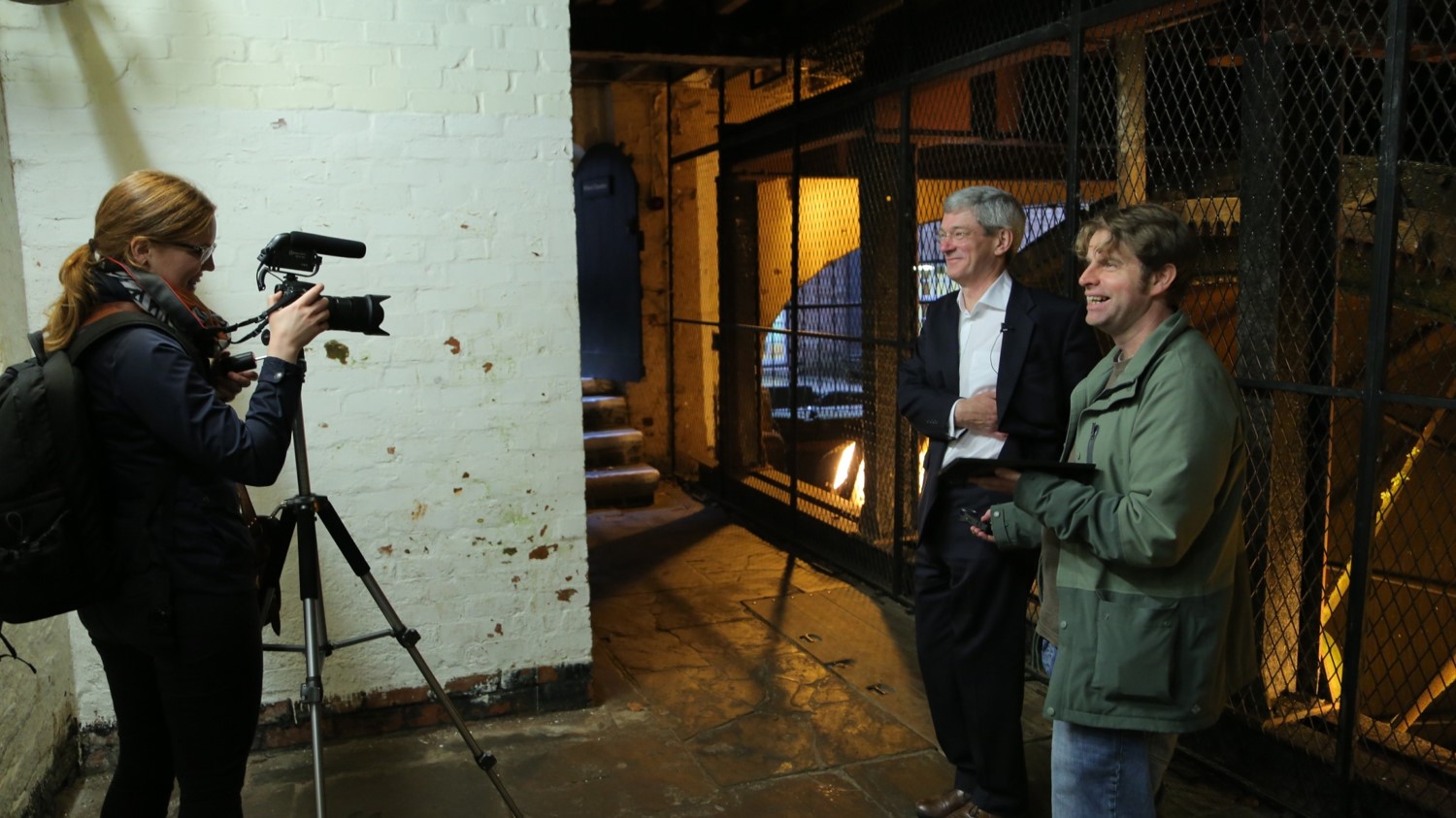
Filming for the MOOC Energy: Thermodynamics in Everyday Life

Last week’s post was stimulated by my realisation that I had made a mistake in a lecture [see ‘Amply sufficiency of solar energy?‘ on October 25th, 2017]. During the lecture, something triggered a doubt about a piece of information that I used in talking about the world as a thermodynamic system. It caused me to do some more research on the topic afterwards which led to the blog post.  The students know this already, because I sent an email to them as the post was published.  It was not an error that impacted on the fundamental understanding of the thermodynamic principles, which is fortunate because we are at a point in the course where students are struggling to understand and apply the principles to problems.  This is a normal process from my perspective but rather challenging and uncomfortable for many students.  They are developing creative problem-solving skills – becoming comfortable with the slow and uncertain process of creating representations and exploring the space of possible solutions [Martin & Schwartz, 2009 & 2014].  This takes extensive practice and most students want a quick fix: usually looking at a worked solution, which might induce the feeling that some thermodynamics has been understood but does nothing for problem-solving skills [see my post on ‘Meta-representational competence‘ on May 13th, 2015].

Engineers don’t like to be wrong [see my post on ‘Engineers are slow, error-prone‘ on April 29th, 2014].  The reliability of our solutions and designs is a critical ingredient in the social trust of engineering [Madhaven, 2016].  So, not getting it wrong is deeply embedded in the psyche of most engineers.  It is difficult to persuade most engineers to appear in front of a camera because we worry, not just about not getting it wrong, but about telling the whole truth.  The whole truth is often inconvenient for those that want to sensationalize issues for their own purposes, such as to sell news or gain votes, and this approach is anathema to many engineers.  The truth is also often complicated and nuanced, which can render an engineer’s explanation cognitively less attractive than a simple myth, or in other words less interesting and boring.  Unfortunately, people mainly pass on information that will cause an emotional response in the recipient, which is perhaps why engineering blogs are not as widely read as many others! [Lewandowsky et al 2012].


This week’s lecture was about energy flows, and heat transfer in particular; so, the following posts from the archive might be interest: ‘On the beach‘ on July 24th, 2013, ‘Noise transfer‘ on April 3rd, 2013, and ‘Stimulating students with caffeine‘ on December 17th, 2014

Sources:

Martin L & Schwartz DL, Prospective adaptation in the use of external representations, Cognition and Instruction, 27(4):370-400, 2009.

Martin L & Schwartz DL, A pragmatic perspective on visual representation and creative thinking, Visual Studies, 29(1):80-93, 2014.

Madhaven G, Think like an engineer, London: One World Publications, 2016.

Lewandowsky S, Ecker UKH, Seifert CM, Schwarz N & Cook J, Misinformation and its correction: continued influence and successful debiasing, Psychological Science in the Public Interest, 13(3):106-131, 2012.

Pebbles – where are yours?

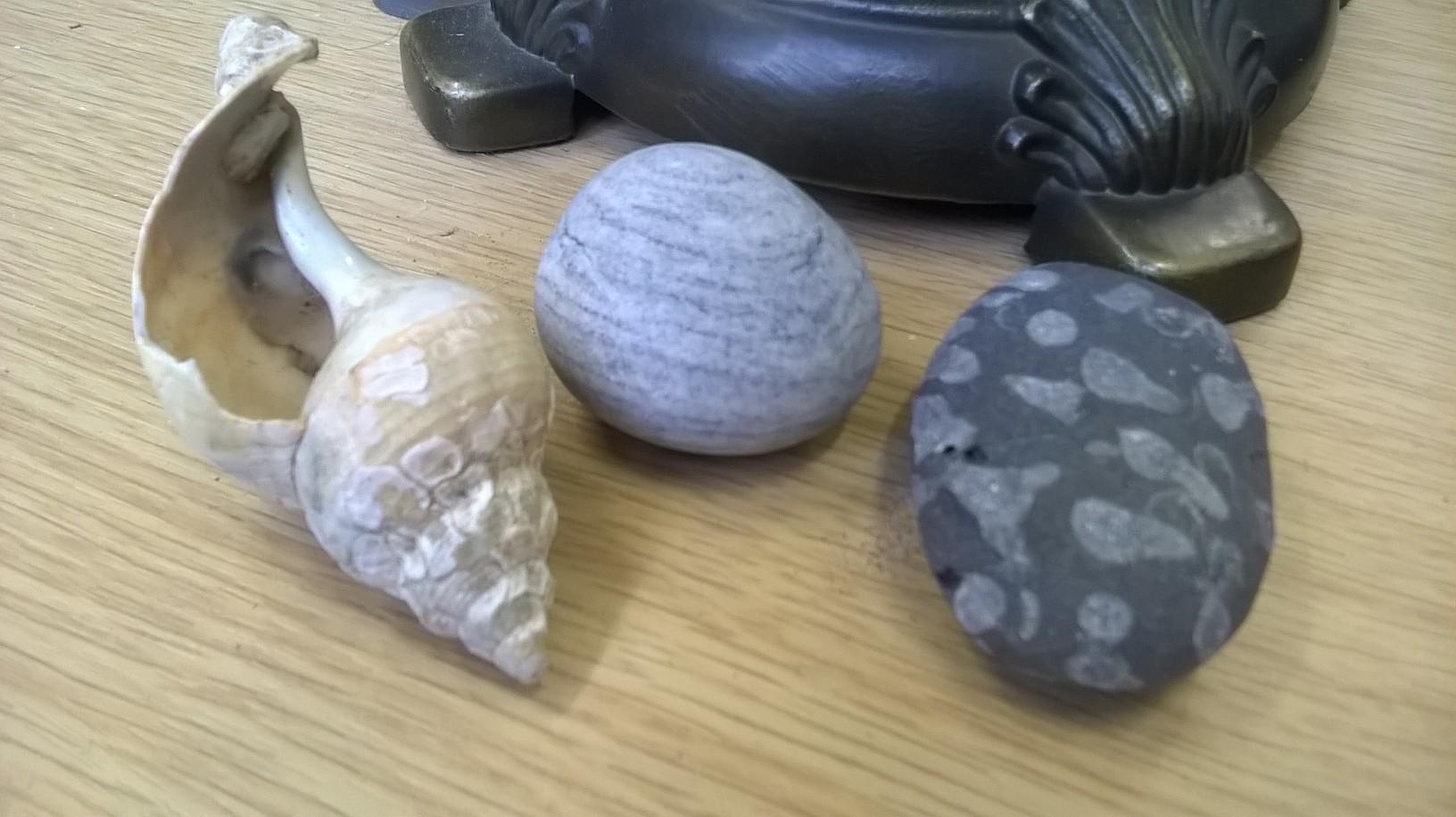
The picture shows a little collection of pebbles and a shell that sits on the desk in my office.  There are similar collections in various locations at home and some of my coats have a pebble permanently in one pocket – there’s even a shell on the dashboard of our car.  They have all been picked up during walks on beaches [see my post entitled ‘Take a walk on the wild side‘ on 26th August 2015] and serve as reminders of the ‘slowness’ enjoyed on vacation [see my post ‘Slow down, breathe your own air‘ on December 23rd, 2015].  Barbara Hepworth owned a similar collection of stones that you can see in the Hepworth Wakefield.  On the subject of this habit she wrote in 1961: ‘Many people select a stone or a pebble to carry for the day.  The weight and form and texture felt in our hands relates us to the past and gives us a sense of a universal force.  The beautifully shaped stone, washed up by the sea, is a symbol of continuity, a silent image of our desire for survival, peace and security.’  I could not express it better so I didn’t try.

The quote is from a contribution to the film Barbara Hepworth directed by John Read, BBC TV, 1961 and can be found in Barbara Hepworth: Writings and Conversations, edited by Sophie Bowness, London: Tate Publishing, 2015.

Anything other than lager, stout or porter!

While we were sitting in the Red Deer in Sheffield enjoying a couple of pints of Iron & Steel Bitter from the Chantry Brewery in Rotherham, my long-time Swiss collaborator, and sometime correspondent on this blog, asked me: what’s the difference between an ale and a beer?  And, I had to admit that I couldn’t provide a definitive answer to satisfy his curiosity.  So, I am going to have another go, now.  Beer is an alcoholic drink made from a cereal grain and, according to the Oxford English Dictionary, ale is any beer other than lager, stout, or porter!

However, ‘real ale is a beer brewed from traditional ingredients (malted barley, hops water and yeast), matured by secondary fermentation in the container from which it is dispensed, and served without the use of extraneous carbon dioxide‘ according to CAMRA, the Campaign for Real Ale.  So the Iron & Steel Bitter that we enjoyed at the Red Deer was a real ale.

My digital detox during July [see my post entitled ‘In digital detox‘ on July 19th, 2017] included  sampling bottled ales from local West Country breweries and the photograph shows my favorites ranked from left to right.  Many were enjoyed while overseeing the BBQ in the picture below; however, the time in the Red Deer involved some rather more productive brain-storming for the MOTIVATE project [see my post entitled ‘Getting smarter‘ on June 21st, 2017].

Details of beers in photograph: Pirates Gold from Wooden Hand Brewery; Jail Ale from Dartmoor Brewery; Original Beer from Butcombe Breweries; Rebel Red from Rebel Brewing and Summer Lightening Hop Back Brewery