Category Archives: sustainability

Citizens of the world

Last week in Liverpool, we hosted a series of symposia for participants in a dual PhD programme involving the University of Liverpool and National Tsing Hua University, in Taiwan, that has been operating for nearly a decade.  On the first day, we brought together about dozen staff from each university, who had not met before, and asked them to present overviews of their research and explore possible collaborations using as a theme: UN Sustainable Development Goal No.11: Sustainable Cities and Communities.  The expertise of the group included biology, computer science, chemistry, economics, engineering, materials science and physics; so, we had wide-ranging discussions.  On the second and third day, we connected a classroom on each campus using a video conferencing system and the two dozen PhD students in the dual programme presented updates on their research from whichever campus they are currently resident.  Each student has a supervisor in each university and divides their time between the two universities exploiting the expertise and facilities in the two institutions.

The range of topics covered in the student presentations was probably even wider than on the first day; extending from deep neural networks, through nuclear reactor technology, battery design and three-dimensional cell culturing to policy impacts on households.  One student spoke about the beauty of mathematical equations she is working on that describe the propagation of waves in lattice structures; while, another told us about his investigation of the causes of declining fertility rates across the world.  Data from the UN DESA Population Division show that live births per woman in the Americas & Europe have already fallen below the 2.1 required to sustain the population, while it is projected to fall below this level in south-east Asia within the next five years and in the world by 2060.  This made me think that perhaps the Gaia principle, proposed by James Lovelock, is operating and that human population is self-regulating as it interacts with constraints imposed by the Earth though perhaps not in a fashion originally envisaged.

 

Planetary Emergency

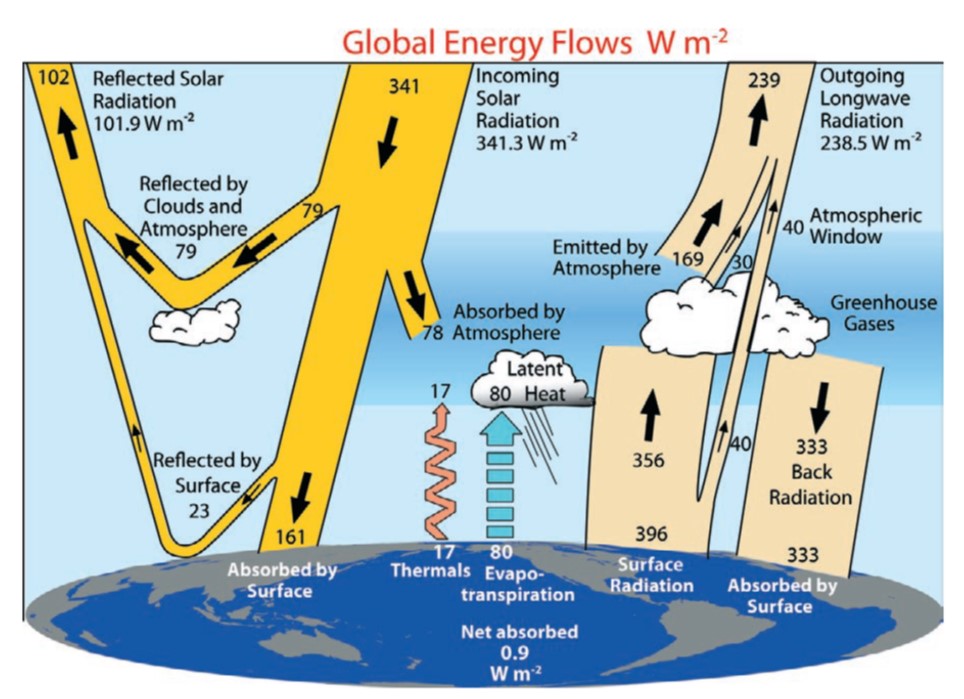
Global energy budget from Trenberth et al 2009

This week’s lecture in my thermodynamics course for first-year undergraduate students was about thermodynamic systems and the energy flows in and out of them. I concluded the lecture by talking about our planet as a thermodynamic system using the classic schematic in the thumbnail [see ‘Ample sufficiency of solar energy‘ on October 25th, 2017 for more discussion on this schematic].  This is usually a popular lecture but this year it had particular resonance because of the widely publicised strikes by students for action on climate change.  I have called before for individuals to take responsibility given the intransigence of governments [see ‘Are we all free riders‘ on June 6th, 2016 or ‘New Year Resolution‘ on December 31st, 2014]; so, it is good to see young people making their views and feelings known.

Weather-related events, such as widespread flooding and fires, are reported so frequently in the media that perhaps we have started to ignore them as portents of climate change.  For me, three headlines events have reinforced the gravity of the situation:

  1. The publication earlier this month of a joint report by UNICEF and the Royal College of Paediatrics and Child Health that air pollution in the UK so high that it is infringing the fundamental rights of children to grow up in a clean and safe environment; and, under the Government’s current plans, air pollution in the UK is expected to remain at dangerous levels for at least another 10 years.
  2. The warning earlier this month from the Meteorological Office in London that global warming could exceed 1.5C above pre-industrial levels within five years.  In my lecture, I highlighted that a 2C rise would be equal to the temperature 3 million years ago when sea levels were 25 to 35m high; and, a 1m rise in sea level would displace 145 million people globally [according to Blockstein & Weigmann, 2010].
  3. The suspension of construction of the new nuclear power station on Anglesey by Hitachi, which leaves the UK Government’s energy strategy in disarray with only one of the six planned new power stations under construction.  This leaves the UK unable to switch from fossil-fuelled to electric vehicles and dependent on fossil fuel to meet current electricity demand.

I apologise for my UK focus this week but whereever you are reading this blog you could probably find similar headlines in your region.  For instance, the 2016 UNICEF report states that one in seven children worldwide live in toxic air and air pollution is a major contributing factor in the deaths of around 600,000 children under five every year.  These three headlines illustrate that there is a planetary emergency because climate change is rapidly and radically altering the ecosystem with likely dire consequences for all living things; that despite a near-existential threat to the next generation as a consequence of air pollution most governments are effectively doing nothing; and that in the UK we are locked into a fossil-fuel dependency for the foreseeable future due to a lack of competent planning and commitment from the government which will compound the air pollution and climate change problems.

Our politicians need to stop arguing about borders and starting worrying about the whole planet.  We are all in this together and no man-made border will protect us from the impact of making the planet a hostile environment for life.

Where have all the insects gone?

I remember when our children were younger, and we went on our summer holidays by car, that the car windscreen would be splattered with the remains of dead insects.  This summer my wife and I drove to Cornwall and back for our holidays almost without a single insect hitting our windscreen.  Where have all of the insects gone?  It would appear that we, the human species, have wiped them out as a consequence of the way we exploit the planet for our own comfort and convenience.  Insecticides and monocultures aided by genetically-modified crops make a direct contribution but our consumption of fossil fuels and intensive production of everything from beef [see ‘A startling result‘ on May 18th, 2016] to plastics is changing the environment [see ‘Productive cheating?‘ on November 27th, 2013]. The biologist, Edward O. Wilson observed that ‘If all humankind were to disappear, the world would regenerate back to the rich state of equilibrium that existed 10,000 years ago. If insects were to vanish, the environment would collapse into chaos.’  It looks like we are on the cusp of that collapse.

Cristiana Pașca Palmer, the executive secretary of the UN Convention on Biological Diversity has highlighted the impact of our actions as a species on the other species with which we share this planet.  We are making the planet uninhabitable for an increasing number of species to the extent that the rate of extinct is perhaps the fastest ever seen and we might be the first species to catalogue its own demise.  Our politicians have demonstrated their inability to act together over climate change even when it leads to national disasters in many countries; so, it seems unlikely that they will agree on significant actions to arrest the loss of bio-diversity.  We need to act as individuals, in whatever way we can, to reduce our ecological footprints – that impact that we have on the environment [see ‘New Year Resolution‘ on December 31st, 2014] .  As the Roman poet Horace wrote: ‘You are also affected when your neighbour’s house is on fire’; so, we should not think that none of this affect us.

See also:

Man, the Rubbish Maker

Are we all free-riders?

Some changes to Realize Engineering

The advertising industry is becoming a pervasive influence on us – telling us how we should eat, dress, travel, vacation, borrow, bank, insure, think and vote.  We are constantly bombarded with messages designed to induce us to buy goods or services that we don’t really need and that undermine progress towards a sustainable society [see my post ‘Old is beautiful‘ on May 1st, 2015].

Many services are offered to us for free in order to expose us to advertisements and to collect data about our habits and interests that are put to uses about which we know little.  These issues became prominent last week with the allegations about the inappropriate use of data from Facebook by Cambridge Analytica [see for example the The Guardian on March 25th, 2016].  A number of organisations have reacted by closing down their Facebook pages [see for example Reuters on March 23rd, 2018] and a #deletefacebook movement has started [see for example The Guardian on March 25th, 2016, again].  I have joined them and deleted my Facebook page as well as disconnecting this blog from Facebook.  Also, in a couple of weeks I plan to stop using Twitter to disseminate this blog; so, if you receive this blog via Twitter then please start to follow it directly.

Finally, the advertisements at the bottom of my blog posts will disappear because I am paying to use WordPress instead of allowing advertising to cover the costs.  A side-effect of this change is a new url: realizeengineering.blog/ So please update your bookmarks,if it doesn’t happen automatically!