Author Archives: Eann Patterson

Brave New World

OLYMPUS DIGITAL CAMERATerm has started, and our students are preparing for end-of-semester examinations; so, I suspect that they would welcome the opportunity to deploy the sleeping-learning that Aldous Huxley envisaged in his ‘Brave New World’ of 2540.  In the brave new world of digital engineering, some engineers are attempting to conceive of a world in which experiments have become obsolete because we can rely on computational modelling to simulate engineering systems.  This ambitious goal is a driver for the MOTIVATE project [see my post entitled ‘Getting smarter‘ on June 21st, 2017]; an EU-project that kicked-off about six months ago and was the subject of a brainstorming session in the Red Deer in Sheffield last September [see my post entitled ‘Anything other than lager, stout or porter!‘ on September 6th, 2017.  The project has its own website now at www.engineeringvalidation.org

A world without experiments is almost unimaginable for engineers whose education and training is deeply rooted in empiricism, which is the philosophical approach that requires assumptions, models and theories to be tested against observations from the real-world before they can be accepted.  In the MOTIVATE project, we are thinking about ways in which fewer experiments can provide more and better measured data for the validation of computational models of engineering systems.   In December, under the auspices of the project, experts from academia, industry and national labs from across Europe met near Bristol and debated how to reshape the traditional flow-chart used in the validation of engineering models, which places equal weight on experiments and computational models [see ASME V&V 10-2006 Figure 2].  In a smaller follow-up meeting in Zurich, just before Christmas [see my post ‘A reflection of existentialism‘ on December 20th, 2017], we blended the ideas from the Bristol session into a new flow-chart that could lead to the validation of some engineering systems without conducting experiments in parallel.  This is not perhaps as radical as it sounds because this happens already for some evolutionary designs, especially if they are not safety-critical.  Nevertheless, if we are to achieve the paradigm shift towards the new digital world, then we will have to convince the wider engineering community about our novel approach through demonstrations of its successful application, which sounds like empiricism again!  More on that in future updates.

Image by Erwin Hack: Coffee and pastries awaiting technical experts debating behind the closed door.
Not much change

A Happy and Prosperous New Year to all of my readers!

At this time of year, it is traditional in the media to review the previous year and comment on what lies ahead in the new year.  However, not much has changed in my blog during 2017: I wrote and published 52 posts that attracted about 20,000 views through the WordPress site, which is pretty much the same as 2016.  Although, there was a growth in readers via LinkedIn, Tumblr and Twitter.  This is not enough traffic to achieve a place in the UK’s Top 50 Blogs according to Vuelio, but then neither the title nor the content of this blog is designed to attract the mass-markets to which most of these high-volume sites appeal.  Instead, I suspect that I am writing for a small bubble of like-minded people [see my post ‘You’re all weird‘ on February 8th, 2017]; nevertheless, it would be nice to feel that the bubble will continue to expand.  Maybe the small face-lift will help though the Latin verse below will likely not help!

It is tempting at this point to ramble on further about the lack of interest in scholarship in modern society; however, to do so would be to follow a tradition that is at least 800 years old.  In the thirteenth century manuscript, Carmina Burana there is a poem called ‘Florebat olim studium’.  Its first lines are

Florebat olim studium

nunc vertitude in tedium,

iam scire diu viguit,

sed ludere prevaluit.


These translate as ‘Scholarship once flourished, now it is turned into boredom; for a long time knowledge was esteemed, but now playing is preferred.’  This seems to have been echoed by generations of professors and, as my editor says, is part of the human condition.

I read about the Carmina Burana in a beautiful book: ‘Meetings with Remarkable Manuscripts‘ by Christopher de Hamel who takes the reader on a series of visits to twelve of the most important medieval manuscripts starting with the sixth century Gospels of Saint Augustine in the library of Corpus Christi College, Cambridge and finishing with the sixteenth century Spinola Hours in the J. Paul Getty Museum, Los Angeles.  It is part history book tracing the advent of literacy in Western Europe from the sixth century, when only the clergy could read and write, through to start of printing when 30,000 titles were issued in the last fifty years of the fifteen century; and part travelogue as de Hamel describes his visits to the museums and libraries where the twelve manuscripts are preserved.  Book reviews are not a regular feature of this blog but this is a book worth reading that might not otherwise be on your list.

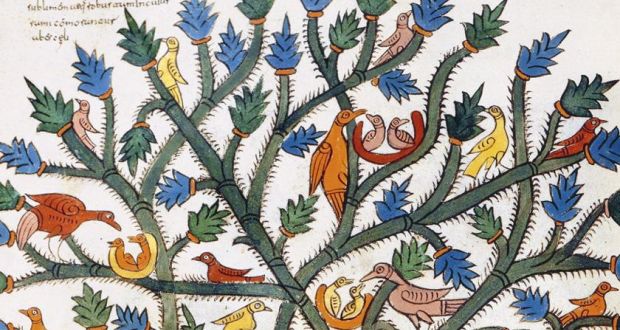
Image: from front cover of Meetings with Remarkable Manuscripts by Christopher de Hamel showing detail from the Morgan Beatus M644, folio 252v © The Morgan Library & Museum/Art Resource, NY/Scala, Florence.


Season’s greeting

zurich christmas tree

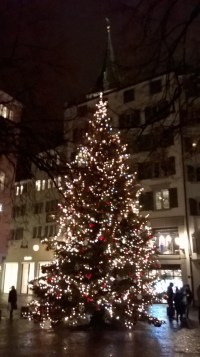
Christmas tree in Weinplatz, Zurich

Best wishes during the holiday season to all my readers.  I’m in digital detox over the Christmas and New Year holidays.  So no post today.  If you’re having withdrawal symptoms or want to know more about digital detox then read ‘Digital detox with a deep vacation‘ posted on August 10th, 2016. Otherwise ‘Slow down, breathe your own air‘ [see my post on December 23rd, 2015].

A reflection on existentialism

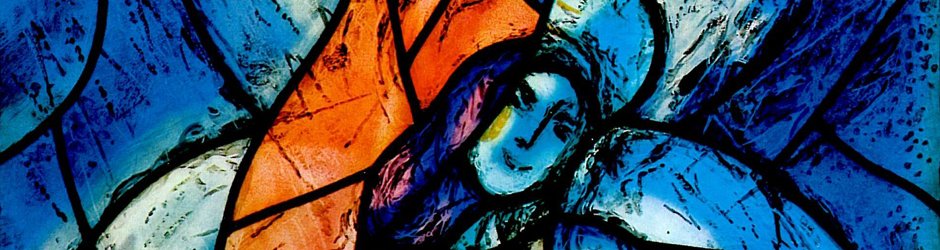
Detail from stained glass window by Marc Chagall in Fraumunster Zurich from http://www.fraumuenster.ch

I was in Zürich last weekend.  We visited the Fraumünster with its magnificent stained glass windows by Marc Chagall [see my post entitled ‘I and the village‘ on August 14th, 2013] and by Augusto Giacometti (1877-1947).  The Kunsthaus Zürich has a large collection of sculptures by another Giacometti, Alberto (1901-1966), a Swiss sculptor, who is famous for his slender statues of people which portray individuals alone in the world.  He was part of the existentialist movement in modern art that examined ideas about self-consciousness and our relationship to other people.  For me, this echoed a lecture that I contributed last week to a module on Scientific Impact and Reputation as part of our CPD programme [see my post entitled ‘WOW projects, TED talks and indirect reciprocity‘ on August 31st, 2016.  In the lecture, I talked about our relationship with other professional people and the development of our technical reputation in their eyes as a result of altruistic sharing of knowledge. This involves communicating with others, building relationships and understanding our place in the community.  The post-course assignment is to write a reflective essay on leadership and technical quality; and we know, from past experience, that our delegates will find it difficult to reflect on their experiences and the impact of those experiences on their life and behaviour.  Maybe we should help them by including a viewing of existential art in one of the Liverpool art galleries as part of our CPD programme on Science and Technology Leadership?