Author Archives: Eann Patterson

Designing for damage

Eighteen months ago I wrote about an insight on high-speed photography that Clive Siviour shared during his 2016 JSA Young Investigator Lecture [see my post entitled ‘Popping balloons‘ on June 15th, 2016].  Clive is interested in high-speed photography because he studies the properties of materials when they are subject to very high rates of deformation, in particular polymers used in mobile phones and cycle helmets – the design requirements for these two applications are very different.  The polymer used in the case of your mobile phone needs to protect the electronics inside your phone by absorbing the kinetic energy when you drop the phone on a tiled floor and it needs to be able to do this repeatedly because you are unlikely to replace the case after each accidental drop. A cyclist’s helmet also needs to protect what is inside it but it only needs to do this once because you will replace your helmet after an accident.  So, the kinetic energy resulting from an impact can be dissipated through the propagation of damage in the helmut; but in the phone case, it has to be absorbed temporarily as strain energy and then released, like in a spring.

Of course there is at least an order of magnitude difference in the consequences associated with the design of a phone case and a cycle helmet.  We can step up the consequences, at least another order of magnitude, by considering the impact performance of the polycarbonate used in the cockpit windows of airplanes.  These need to able absorb the energy associated with impacts by birds, runway debris and other objects, as well as withstanding the cycles of pressurisation associated with take-off, cruising at altitude and landing.  They can be replaced after an event but only once the plane as landed safely.  Consequently, an in-depth understanding of the material behaviour under these different loading conditions is needed to produce a successful design.  Of course, we also need a detailed knowledge of the loading conditions, which are influenced not just by the conditions and events during flight but also the way in which the window is attached to the rest of the airplane.  A large and diverse team is needed to ensure that all of this knowledge and understanding is effectively integrated in the design of the cockpit window.  The team is likely to include experts in materials, damage mechanics, structural integrity, aerodynamic loading as well as manufacturing and finance, since the window has to be made and fitted into the aircraft at an acceptable cost.  A similar team will be needed to design the mobile phone casing with the addition of product design and marketing expertise because it is a consumer product.  In other words, engineering is team activity and engineers must be able to function as team members and leaders.

I wrote this post shortly after Clive’s lecture but since then it is has languished in my drafts folder – in part because I thought it was too long and boring.  However, my editor encourages me to write about engineering more often and so, I have dusted it off and shortened it (slightly!).

Image: https://commons.wikimedia.org/wiki/File:Airbus_A350_cockpit_windows_(14274972354).jpg

Creating an evolving learning environment

A couple of weeks ago, I wrote about marking examinations and my tendency to focus on the students that I had failed to teach rather than those who excelled in their knowledge of problem-solving with the laws of thermodynamics [see my post ‘Depressed by exams‘ on January 31st, 2018].  One correspondent suggested that I shouldn’t beat myself up because ‘to teach is to show, to learn is to acquire‘; and that I had not failed to show but that some of my students had failed to acquire.  However, Adams and Felder have stated that the ‘educational role of faculty is not to impart knowledge; but to design learning environments that support knowledge acquisition‘.  My despondency arises from my apparent inability to create a learning environment that supports and encourages knowledge acquisition for all of my students.  People arrive in my class with a variety of formative experiences and different ways of learning, which makes it challenging to generate a learning environment that is effective for everyone.   It’s an on-going challenge due to the ever-widening cultural gap between students and their professors, which is large enough to have warranted at least one anthropological study (see My Freshman Year by Rebekah Nathan). So, my focus on the weaker exam scripts has a positive outcome because it causes me to think about evolving the learning environment.

Sources:

Adams RS, Felder RM, Reframing professional development: A systems approach to preparing engineering educators to educate tomorrow’s engineers. J. Engineering Education, 97(3):230-240, 2008.

Nathan R, My freshman year: what a professor learned by becoming a student, Cornell University Press, Ithaca, New York, 2005

Logarithmic view of the world

Politicians and the media are fond of dazzling us with big numbers: $62m, £35bn, $1.1 tn.  All of these are unimaginable sums of money – uncountable and, for most us, unspendable.  They are respectively: the launch cost for SpaceX’s Falcon 9 rocket, the anticipated ‘divorce cost’ to the UK for leaving the EU and the predicted US government annual deficit for next year based on the additional spending approved in the budget bill early this month.  For most of us, winning $62m in a lottery would be a life-changing event that we might dream about but there’s only about a 1 in 14 million chance of it happening – oops, there’s another unimaginable number.

We seem quite happy handling numbers over a limited interval, from perhaps 1 in 100 [1% or 0.01] to maybe 100,000 but beyond this range our perspective ceases to be linear and probably becomes logarithmic (as in the graphic), or something similar.  In other words, we don’t perceive £35bn as being about 500 times larger than $62m, or $1.1tn being about 18 million times larger.  Instead, we concertina our mental picture into something more manageable, such as the image shown in the graphic.  Does this have the side-effect of lessening the impact of large numbers so that we are less alarmed by costs of £35bn or deficits of $1.1tn? Maybe we would take more notice of a cost of £500 per person in the UK or a deficit of $3600 per person per year in the USA?

At the other end of the scale, something similar happens.  Nanotechnology is a popular buzz word at the moment but few people can conceive of something 2.5 nanometres in diameter – that’s the diameter of a strand of DNA.  It doesn’t help much to tell you that a human hair is 40,000 times thicker!

Maybe, all of this only applies to those of us who ‘see’ numbers in pictorial patterns, and to the rest of you it is nonsensical.  See my post on Engineering Synaesthesia on September 21st, 2016.

Sources:

http://time.com/money/5135565/elon-musk-falcon-heavy-rocket-launch-cost/

https://www.theguardian.com/politics/2017/dec/31/tough-2017-what-does-next-year-hold-theresa-may

Financial Times, Weekend 10 February/11 February 2018.

An expanding universe

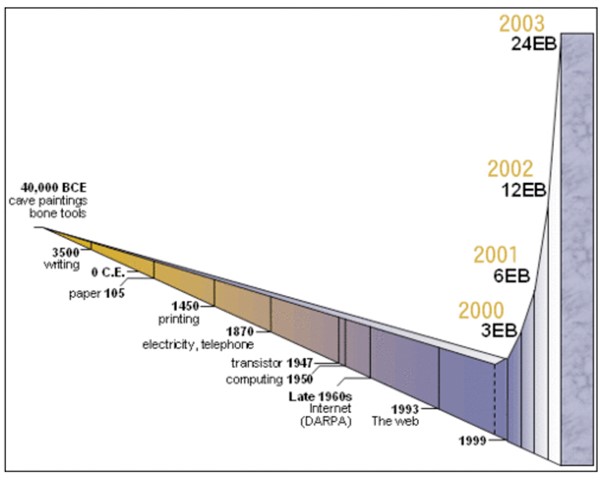
I attended a workshop last month at which one of the speakers showed us this graphic.  It illustrates that the volume of information available to us has been approximately doubling every year.  In 2005, the digital universe was 130 Exabytes (billions of gigabytes) and by 2020 it is expected to have grown to about 40,000 Exabytes.  The second law of thermodynamics tells us that entropy or disorder of the physical universe is always increasing; so, is this also true for the digital universe?  Claude Shannon proposed that information is negentropy, which implies that an increasing growth in information represents a decrease in entropy and this seems to contradict the second law [see my post ‘Entropy on the brain‘ on November 29th, 2017].  Perhaps the issue is the definition of information – the word comes from the Latin: informare, which means to inform or to give someone knowledge.  I suspect that much of what we view on our digital screens does not inform and is data rather than information.  Our digital screens are akin to telescopes used to view the physical universe – they let us see what’s out there, but we have to do some processing of the data in order to convert it into knowledge.  It’s that last bit that can be stressful if we don’t have some control mechanisms available to limit the amount of disorder that we ask our brains to cope with – we are back to Gadget Stress [see my post on April 9th, 2014] and Digital Detox [see my post on August 10th, 2016].

Source: Atsufumi Hirohata, Department of Electronics, University of York www-users.york.ac.uk/~ah566/lectures/adv01_introduction.pps

Image: http://japan.digitaldj.network.com/articles/9538.html