Author Archives: Eann Patterson

Creating an evolving learning environment

A couple of weeks ago, I wrote about marking examinations and my tendency to focus on the students that I had failed to teach rather than those who excelled in their knowledge of problem-solving with the laws of thermodynamics [see my post ‘Depressed by exams‘ on January 31st, 2018].  One correspondent suggested that I shouldn’t beat myself up because ‘to teach is to show, to learn is to acquire‘; and that I had not failed to show but that some of my students had failed to acquire.  However, Adams and Felder have stated that the ‘educational role of faculty is not to impart knowledge; but to design learning environments that support knowledge acquisition‘.  My despondency arises from my apparent inability to create a learning environment that supports and encourages knowledge acquisition for all of my students.  People arrive in my class with a variety of formative experiences and different ways of learning, which makes it challenging to generate a learning environment that is effective for everyone.   It’s an on-going challenge due to the ever-widening cultural gap between students and their professors, which is large enough to have warranted at least one anthropological study (see My Freshman Year by Rebekah Nathan). So, my focus on the weaker exam scripts has a positive outcome because it causes me to think about evolving the learning environment.

Sources:

Adams RS, Felder RM, Reframing professional development: A systems approach to preparing engineering educators to educate tomorrow’s engineers. J. Engineering Education, 97(3):230-240, 2008.

Nathan R, My freshman year: what a professor learned by becoming a student, Cornell University Press, Ithaca, New York, 2005

Logarithmic view of the world

Politicians and the media are fond of dazzling us with big numbers: $62m, £35bn, $1.1 tn.  All of these are unimaginable sums of money – uncountable and, for most us, unspendable.  They are respectively: the launch cost for SpaceX’s Falcon 9 rocket, the anticipated ‘divorce cost’ to the UK for leaving the EU and the predicted US government annual deficit for next year based on the additional spending approved in the budget bill early this month.  For most of us, winning $62m in a lottery would be a life-changing event that we might dream about but there’s only about a 1 in 14 million chance of it happening – oops, there’s another unimaginable number.

We seem quite happy handling numbers over a limited interval, from perhaps 1 in 100 [1% or 0.01] to maybe 100,000 but beyond this range our perspective ceases to be linear and probably becomes logarithmic (as in the graphic), or something similar.  In other words, we don’t perceive £35bn as being about 500 times larger than $62m, or $1.1tn being about 18 million times larger.  Instead, we concertina our mental picture into something more manageable, such as the image shown in the graphic.  Does this have the side-effect of lessening the impact of large numbers so that we are less alarmed by costs of £35bn or deficits of $1.1tn? Maybe we would take more notice of a cost of £500 per person in the UK or a deficit of $3600 per person per year in the USA?

At the other end of the scale, something similar happens.  Nanotechnology is a popular buzz word at the moment but few people can conceive of something 2.5 nanometres in diameter – that’s the diameter of a strand of DNA.  It doesn’t help much to tell you that a human hair is 40,000 times thicker!

Maybe, all of this only applies to those of us who ‘see’ numbers in pictorial patterns, and to the rest of you it is nonsensical.  See my post on Engineering Synaesthesia on September 21st, 2016.

Sources:

http://time.com/money/5135565/elon-musk-falcon-heavy-rocket-launch-cost/

https://www.theguardian.com/politics/2017/dec/31/tough-2017-what-does-next-year-hold-theresa-may

Financial Times, Weekend 10 February/11 February 2018.

An expanding universe

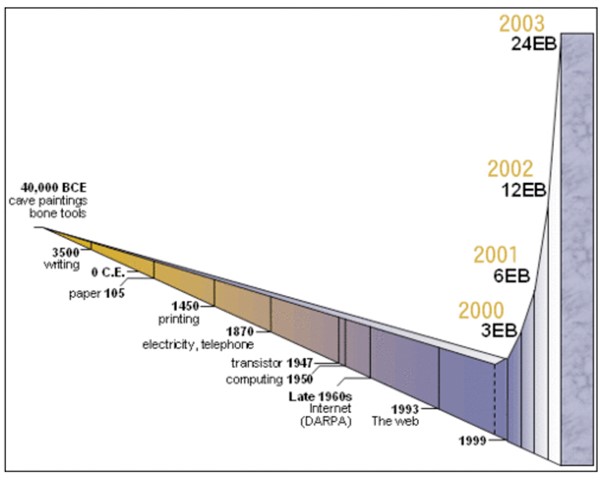
I attended a workshop last month at which one of the speakers showed us this graphic.  It illustrates that the volume of information available to us has been approximately doubling every year.  In 2005, the digital universe was 130 Exabytes (billions of gigabytes) and by 2020 it is expected to have grown to about 40,000 Exabytes.  The second law of thermodynamics tells us that entropy or disorder of the physical universe is always increasing; so, is this also true for the digital universe?  Claude Shannon proposed that information is negentropy, which implies that an increasing growth in information represents a decrease in entropy and this seems to contradict the second law [see my post ‘Entropy on the brain‘ on November 29th, 2017].  Perhaps the issue is the definition of information – the word comes from the Latin: informare, which means to inform or to give someone knowledge.  I suspect that much of what we view on our digital screens does not inform and is data rather than information.  Our digital screens are akin to telescopes used to view the physical universe – they let us see what’s out there, but we have to do some processing of the data in order to convert it into knowledge.  It’s that last bit that can be stressful if we don’t have some control mechanisms available to limit the amount of disorder that we ask our brains to cope with – we are back to Gadget Stress [see my post on April 9th, 2014] and Digital Detox [see my post on August 10th, 2016].

Source: Atsufumi Hirohata, Department of Electronics, University of York www-users.york.ac.uk/~ah566/lectures/adv01_introduction.pps

Image: http://japan.digitaldj.network.com/articles/9538.html


Depressed by exams

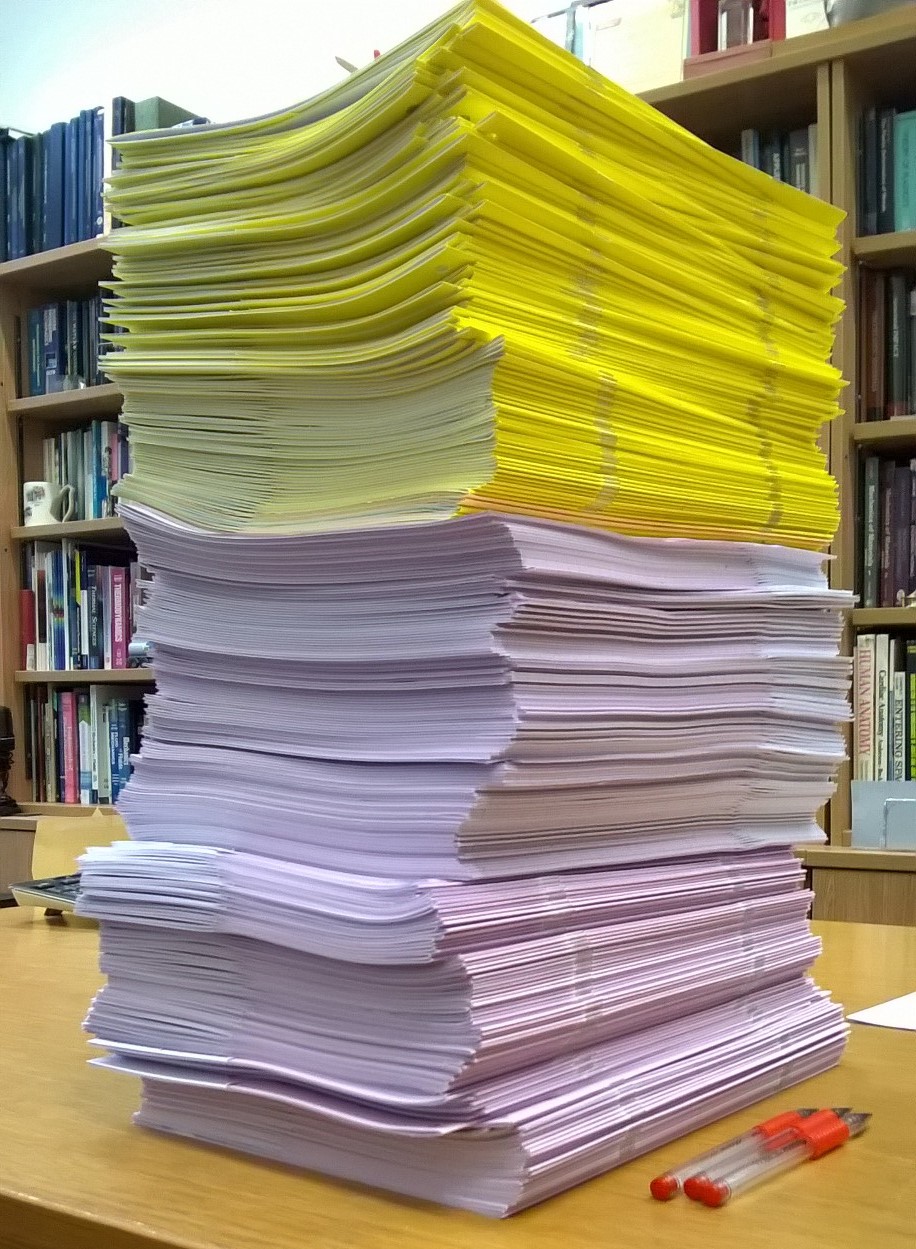
I am not feeling very creative this week, because I am in middle of marking examination scripts; so, this post is going to be short.  I have 20 days to grade at least 1100 questions and award a maximum of 28,400 marks – that’s a lot of decisions for my neurons to handle without being asked to find new ways to network and generate original thoughts for this blog [see my post on ‘Digital hive mind‘ on November 30th, 2016].

It is a depressing task discovering how little I have managed to teach students about thermodynamics, or maybe I should say, how little they have learned.  However, I suspect these feelings are a consequence of the asymmetry of my brain, which has many more sites capable of attributing blame and only one for assigning praise [see my post entitled ‘Happenstance, not engineering‘ on November 9th, 2016].  So, I tend to focus on the performance of the students at the lower end of the spectrum rather than the stars who spot the elegant solutions to the exam problems.

Sources:

Ngo L, Kelly M, Coutlee CG, Carter RM , Sinnott-Armstrong W & Huettel SA, Two distinct moral mechanisms for ascribing and denying intentionality, Scientific Reports, 5:17390, 2015.

Bruek H, Human brains are wired to blame rather than to praise, Fortune, December 4th 2015.