Tag Archives: nanoparticles

More uncertainty about matter and energy

woodlandvalley

When I wrote about wave-particle duality and an electron possessing the characteristics of both matter and energy [see my post entitled ‘Electron uncertainty’ on July 27th, 2016], I dodged the issue of what are matter and energy.  As an engineer, I think of matter as being the solids, liquids and gases that are both manufactured and occur in nature.  We should probably add plasmas to this list, as they are created in an increasing number of engineering processes, including power generation using nuclear fission.  But maybe plasmas should be classified as energy, since they are clouds of unbounded charged particles, often electrons.   Matter is constructed from atoms and atoms from sub-atomic particles, such as electrons that can behave as particles or waves of energy.  So clearly, the boundary between matter and energy is blurred or fuzzy.  And, Einstein’s famous equation describes how energy and matter can be equated, i.e. energy is equal to mass times the speed of light squared.

Engineers tend to define energy as the capacity to do work, which is fine for manufactured or generated energy, but is inadequate when thinking about the energy of sub-atomic particles, which probably is why Feynman said we don’t really know what energy is.  Most of us think about energy as the stuff that comes down an electricity cable or that we get from eating a banana.  However, Evelyn Pielou points out in her book, The Nature of Energy, that energy in nature surrounds us all of the time, not just in the atmosphere or water flowing in rivers and oceans but locked into the structure of plants and rocks.

Matter and energy are human constructs and nature does not do rigid classifications, so perhaps we should think about a plant as a highly-organised localised zone of high density energy [see my post entitled ‘Fields of flowers‘ on July 8th, 2015].  We will always be uncertain about some things and as our ability to probe the world around us improves we will find that we are no longer certain about things we thought we understood.  For instance, research has shown that Bucky balls, which are spherical fullerene molecules containing sixty carbon atoms with a mass of 720 atomic mass units, and so seem to be quite substantial bits of matter, exhibit wave-particle duality in certain conditions.

We need to learn to accept uncertainty and appreciate the opportunities it presents to us rather than seek unattainable certainty.

Note: an atomic mass unit is also known as a Dalton and is equivalent to 1.66×10⁻²⁷kg

Sources:

Pielou EC, The Energy of Nature, Chicago: The University of Chicago Press, 2001.

Arndt M, Nairz O, Vos-Andreae J, Keller C, van der Zouw G & Zeilinger A, Wave-particle duality of C60 molecules, Nature 401, 680-682 (14 October 1999).

 

Mass produced nuclear power plants?

A slightly weird picture of the rather unusual House of Porcelain in Tianjin, which is slowly turning black in the smog.

Porcelain House in Tianjin, which is slowly turning black in the smog.

In the pocket of my coat I have a peculiar souvenir of my recent visit to China. It’s a white face-mask with a little filter built-in to one side. It cost 2 Yuan, or about £0.2, and was given to me by a research student in Tianjin, who worked in my lab in Liverpool for a year. She bought it for me one Saturday when we were going out sightseeing in Tianjin because the air quality was so poor it caught on the back of your throat. The smog was so thick you could not see the tops of even modestly tall buildings.

This is a daily reality for millions of people in many of China’s cities. I reported in my blog entitled ‘Year of the Air: 2013’ [November 20th, 2013] about the number of deaths from pollution.  PM2.5 that’s particles with a diameter less than 2.5 microns are damaging to human health. While I was in Beijing the level of PM2.5 was 144 micrograms per cubic metre, compared to 13 at home in Liverpool.  My student’s mother had visited her while she was in Liverpool and I asked what she liked most during her visit – the fresh air was her reply.

I can’t really remember smog in England though I do remember buildings in the city centres being gradually cleaned because the smog had turned them black. And I remember shortly after I finished my PhD, being shown by a collaborator in the Pathology Department, the lungs from a recent post-mortem – they were grey-black from the smog!

The scale of the problem is difficult to grasp. Tianjin is a provincial city about 30 minutes by bullet train south-east of Beijing with a population of 14 million people, almost twice that of London, and 2.4 million cars.  The smog is generated by pollution from factories, power-stations and cars.  Hybrid cars could make a difference but there are none because they are too expensive, a Beijing colleague told me as he drove me in his brand new Volkswagen Passat. Plug-in cars would not solve the problem because the electricity would come mainly from coal-fired power stations, so the pollution would be simply moved elsewhere.

China needs clean energy, fast and lots of it.  In 2011 China’s installed electricity generating capacity was  about 1TW (Tera Watts or 1 with 12 noughts after it), of which about 2% comes from China’s 21 operating nuclear power plants.  Typical modern nuclear power plants take years to build and generate around 1,000 MW; perhaps we should be considering the small-scale mass production of medium-size modular power plants.  Huge, complex, reliable aeroplanes are made in this way, for instance the current Airbus A380 is production rate is about 25 per year.  So why not medium-size nuclear power plants?  Mass-production would also make decommissioning cheaper since it not be a bespoke process for each plant.

Maybe now that the Lockheed Martin’s Skunk Works have turned their attention to developing a fusion reactor, power-stations will be produced like airliners before I retire.

Sources:

Porcelain House, Tianjin

http://blogs.wsj.com/chinarealtime/2014/10/27/desperate-measures-as-world-leaders-visit-beijing-tries-to-reduce-pollution-by-40/

http://aqicn.org/city/united-kingdom/liverpool-speke/

BTW – My pathology colleague and I were interested in whether people with osteoporosis could break their hips and fall, rather than the usual assumption of falling and break their hips. See:

Wilkinson JM, Cotton DWK, Harris SC & Patterson EA, Assessment of osteoporosis at autopsy: mechanical methods compared to radiological and histological techniques, Medicine, Science & the Law, 31(1):19-24, 1991.

Cotton DWK, Whitehead CL, Vyas S, Cooper C & Patterson EA, Are hip fractures caused by falling and breaking or breaking and falling? Forensic Science Int., 65(2):105-112, 1994.


Seeing the invisible

Track of the Brownian motion of a 50 nanometre diameter particle

Track of the Brownian motion of a 50 nanometre diameter particle in a fluid.

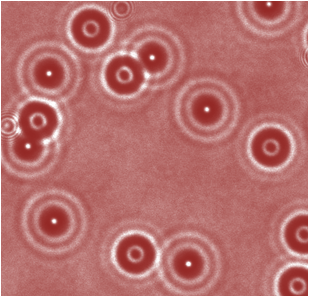
Nanoparticles are being used in a myriad of applications including sunscreen creams, sports equipment and even to study the stickiness of snot!  By definition, nanoparticles should have one dimension less than 100 nanometres, which is one thousandth of the thickness of a human hair.  Some nanoparticles are toxic to humans and so scientists are studying the interaction of nanoparticles with human cells.  However, a spherical nanoparticle is smaller than the wavelength length of visible light and so is invisible in a conventional optical microscope used by biologists.  We can view nanoparticles using a scanning electron microscope but the electron beam damages living cells so this is not a good solution.  An alternative is to adjust an optical microscope so that the nanoparticles produce caustics [see post entitled ‘Caustics’ on October 15th, 2014] many times the size of the particle.  These ‘adjustments’ involve closing an aperture to produce a pin-hole source of illumination and introducing a filter that only allows through a narrow band of light wavelengths.  An optical microscope adjusted in this way is called a ‘nanoscope’ and with the addition of a small oscillator on the microscope objective lens can be used to track nanoparticles using the technique described in last week’s post entitled ‘Holes in liquid‘.

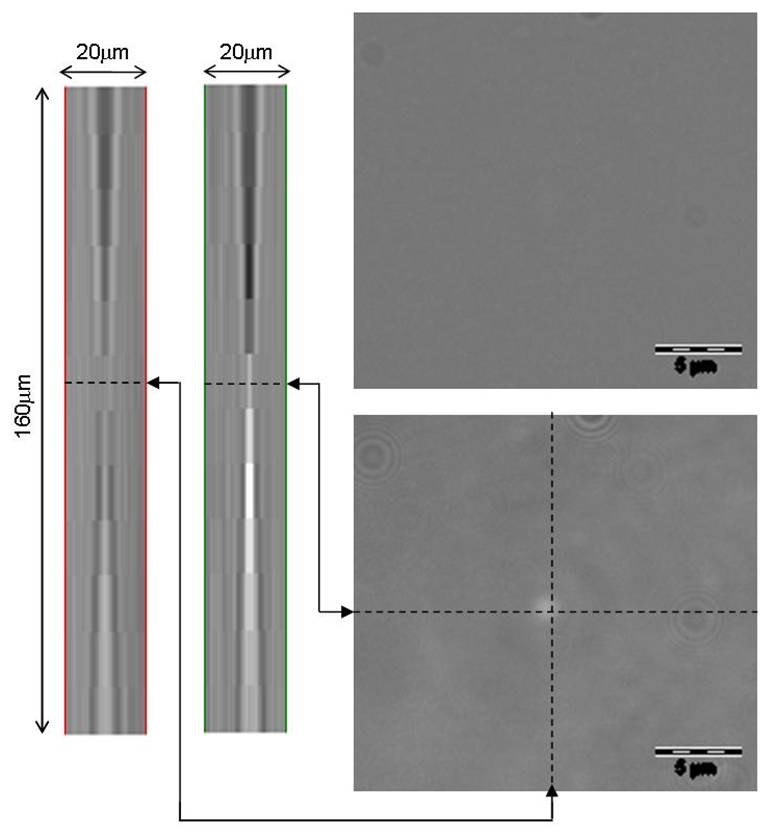
The smallest particles that we have managed to observe using this technique were gold particles of diameter 3 nanometres , or about 1o atoms in diameter dispersed in a liquid.


Image of 3nm diameter gold particle in a conventional optical microscope (top right), in a nanoscope (bottom right) and composite images in the z-direction of the caustic formed in the nanoscope (left).

Image of 3nm diameter gold particle in a conventional optical microscope (top right), in a nanoscope (bottom right) and composite images in the z-direction of the caustic formed in the nanoscope (left).

Sources:

http://ihcp.jrc.ec.europa.eu/our_activities/nanotechnology/jrc-scientists-develop-a-technique-for-automated-three-dimensional-nanoparticle-tracking-using-a-conventional-microscope

‘Scientists use gold nanoparticles to study the stickiness of snot’ by Rachel Feldman in the Washington Post on October 9th, 2014.

J.-M. Gineste, P. Macko, E.A. Patterson, & M.P. Whelan, Three-dimensional automated nanoparticle tracking using Mie scattering in an optical microscope, Journal of Microscopy, Vol. 243, Pt 2 2011, pp. 172–178

Patterson, E.A., & Whelan, M.P., Optical signatures of small nanoparticles in a conventional microscope, Small, 4(10): 1703-1706, 2008.

Hot particles

diffraction pattern from nanoparticlesHave you ever wondered why people visiting the site of the Fukushima nuclear accident are only dressed up in coveralls and masks?  In my post on December 18th entitled ‘Hiding in the Basement’, I explained that gamma radiation requires a sheet of lead to stop it so the coveralls are clearly not protecting Fukushima visitors against radiation.

Our bodies cope with low levels of radiation everyday because we absorb about 0.024 Sieverts per year from the natural environment and the same amount is absorbed during a full-body scan in hospital.  One Sievert is equivalent to 1 Joule absorbed per kilogram of body mass. If you hold a tennis ball as high above your head as you can reach and let it fall to the ground, then the ball hits the ground with about 1 Joule of kinetic energy.  Your heart uses about 1 Joule of energy per beat.

The estimated maximum dose received by residents living close to Fukushima was 0.068 Sieverts or about three annual doses.  The visitors’ coveralls and mask are protecting them from ‘hot’ particles that are often produced during a nuclear accident. ‘Hot’ particles can be inhaled or ingested and continue to emit radiation when inside the body thus delivering a large concentrated dose to a relatively small number of surrounding cells, which are disrupted and destroyed by the high-levels of energy.  ‘Hot’ particles are small pieces of radioactive material and vary in size from tens of nanometres to a few millimetres, so that they don’t have high penetrating power and can be detected using a Geiger counter.