Tag Archives: entropy

Disruptive change required to avoid existential threats

Decorative ink drawing by Zahrah Resh 2005It is easy for ideas or plans for transformational change to transition into transactional processes that deliver only incremental change.  Transformational change is about major shifts in culture, strategy or technology that causes substantial alterations in structure, organisation, behaviour and performance; whereas transactional changes occur within the existing structure and organisation.  Leading transformational change is hard and requires courage, vision, a willingness to listen to all stakeholders, decisiveness and communication, i.e. procedural justice and fair processes [see ‘Advice to abbots and other leaders‘ on November 13th, 2019].  If any of these components are absent, especially courage, vision and decisiveness, then transformational change can transition to a transactional process with incremental outcomes.  When the need to change becomes urgent due to existential threats, the focus should be on disruptive change [see ‘The disruptive benefit of innovation‘ on May 23rd 2018] but there is a tendency to avoid  such transformations and retreat into transactional processes that provide the illusion of progress.  Perhaps this is because transformational change requires leaders to be selfless, courageous and to do the right thing not just the easy thing [see ‘Inspirational leadership‘ on March 22nd, 2017]; whereas transactional processes occur within existing frameworks and hence minimise psychological entropy and stress [see ‘Psychological entropy increased by ineffectual leaders‘ on February 10th, 2021].  This tendency to avoid disruptive change happens at all levels in society from individual decisions about lifestyle, through product development in companies, to global conferences on climate change [see ‘Where we are and what we have‘ on November 24th, 2021].

Image: Ink drawing by Zahrah Resh, 2005. See ‘Seasons Greetings in 2020‘ on December 23rd, 2020.

Acknowledgement: thank you to a regular reader of this blog for the stimulating this post with a comment about transformational change left to the last minute becoming transactional.

 

Follow your gut

Decorative image of a fruit fly nervous system Albert Cardona HHMI Janelia Research Campus Welcome Image Awards 2015Data centres worldwide consume about 1% of global electricity generation, that’s 200-250 TWh (Masenet et al, 2020), and if you add in mining of cryptocurrencies then consumption jumps by about 50% (Gallersdörfer et al, 2020). Data transmission consumes about 260-340 TWh or at least another 1% of global energy consumption (IEA, 2020).  The energy efficiency of modern computers has been improving; however, their consumption is still many millions times greater than the theoretical limit defined by Landauer’s principle which was verified in 2012 by Bérut et al.  According to Landauer’s principle, a computer operating at room temperature would only need 3 zJ (300 billion billionths of a Joule) to erase a bit of information.  The quantity of energy used by modern computers is many millions times the Landauer limit.  Of course, progress is being made almost continuously, for example a team at EPFL in Lausanne and ETH Zurich recently described a new technology that uses only a tenth of the energy of current transistors (Oliva et al 2020).  Perhaps we need turn to biomimetics because Escherichia Coli, which are bacteria that live in our gut and have to process information to reproduce, have been found to use ten thousand times less energy to process a bit of information than the average human-built device for processing information (Zhirnov & Cavin, 2013).  So, E.coli are still some way from the Landauer limit but demonstrate that there is considerable potential for improvement in engineered devices.

References

Bérut A, Arakelyan A, Petrosyan A, Ciliberto S, Dillenschneider R & Lutz E. Experimental verification of Landauer’s principle linking information and thermodynamics. Nature, 483: 187–189, 2012.

IEA (2021), Data Centres and Data Transmission Networks, IEA, Paris https://www.iea.org/reports/data-centres-and-data-transmission-networks

Gallersdörfer U, Klaaßen L, Stoll C. Energy consumption of cryptocurrencies beyond bitcoin. Joule. 4(9):1843-6, 2020.

Masanet E, Shehabi A, Lei N, Smith S, Koomey J. Recalibrating global data center energy-use estimates. Science. 367(6481):984-6, 2020.

Oliva N, Backman J, Capua L, Cavalieri M, Luisier M, Ionescu AM. WSe 2/SnSe 2 vdW heterojunction Tunnel FET with subthermionic characteristic and MOSFET co-integrated on same WSe 2 flake. npj 2D Materials and Applications. 4(1):1-8, 2020.

Zhirnov VV, Cavin RK. Future microsystems for information processing: limits and lessons from the living systems. IEEE Journal of the Electron Devices Society. 1(2):29-47, 2013.

Boltzmann’s brain

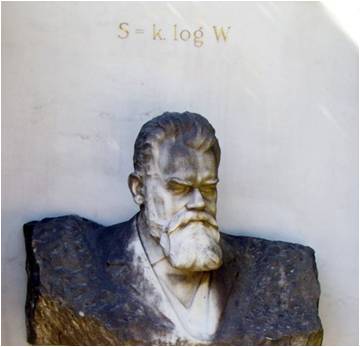
Ludwig Boltzmann developed a statistical explanation of the second law of thermodynamics by defining entropy as being proportional to the logarithm of the number ways in which we can arrange a system [see ‘Entropy on the brain‘ on November 29th 2017].  The mathematical expression of this definition is engraved on his head-stone.  The second law states that the entropy of the universe is always increasing and Boltzmann argued it implies that the universe must have been created in a very low entropy state.  Four decades earlier, in 1854, William Thomson concluded the dissipation of heat arising from the second law would lead to the ‘death’ of the universe [see ‘Cosmic heat death‘ on February 18th, 2015] while the big bang theory for the creation of the universe evolved about twenty years after Boltzmann’s death.  The probability of a very low entropy state required to bring the universe into existance is very small because it implies random fluctuations in energy and matter leading to a highly ordered state.  One analogy would be the probability of dead leaves floating on the surface of a pond arranging themselves to spell your name.  It is easy to think of fluctuations that are more likely to occur, involving smaller systems, such as one that would bring only our solar system into existence, or progressively more likely, only our planet, only the room in which you are sitting reading this blog, or only your brain.  The last would imply that everything is in your imagination and ultimately that is why Boltzmann’s argument is not widely accepted although we do not have a good explanation for the apparent low entropy state at the start of the universe.  Jean-Paul Sartre wrote in his book Nausea ‘I exist because I think…and I cannot stop myself from thinking.  At this very moment – it’s frightful – if I exist, it is because I am horrified at existing.’  Perhaps most people would find horrifying the logical extension of Boltzmann’s arguments about the start of the universe to everything only existing in our mind.  Boltzmann’s work on statistical mechanics and the second law of thermodynamics is widely accepted and support the case for him being genius; however, his work raised more questions than answers and was widely criticised during his lifetime which led to him taking his own life in 1906.

Sources:

Paul Sen, Einstein’s fridge: the science of fire, ice and the universe.  London: Harper Collins, 2021.

Jean-Paul Sartre, Nausea.  London: Penguin Modern Classics, 2000.

Fridges slow down time

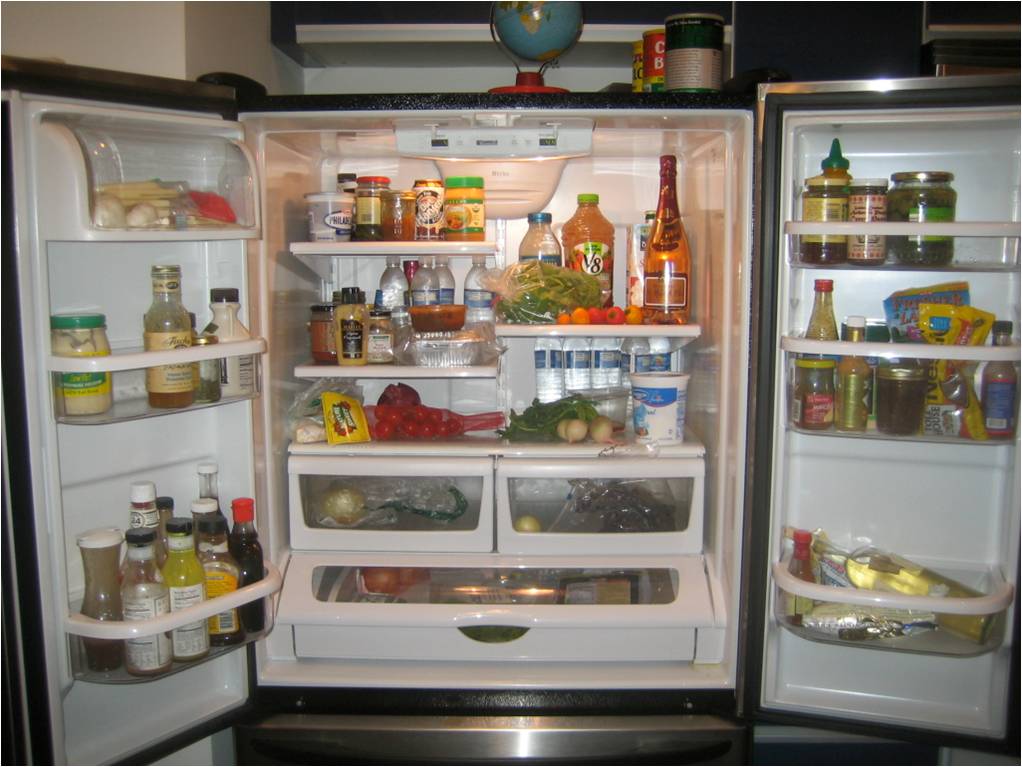
Photograph of the interior of a large domestic fridgeWe sense the passage of time by the changes that occur around us (see ‘We inhabit time as fish live in water‘ on July 24th, 2019) and these changes are brought about by processes that generate entropy.   Entropy is often referred to as the arrow of time because forwards in time is always the direction in which the entropy of the universe increases, as demanded by the second law of thermodynamics (see for example ‘Subtle balance of sustainable orderliness‘ on June 22nd, 2016).  The temperature in a refrigerator is sufficiently low that it slows down the processes of decay in the food stored in it (see’ Life-time battle‘ on January 30th, 2013) which effectively slows down time locally in the fridge.  However, there is a price to pay because the process of creating of the cold zone in the fridge increases the entropy in the universe and moves the universe infinitesimally closer to cosmic heat death (see ‘Will it all be over soon?‘ on November 2nd, 2016).  So, cooling the food in your fridge slows down time locally but brings the end of the universe a tiny bit closer.  Perhaps that’s not worth worrying about until you start thinking about how many fridges there are in the world (about half a billion are sold every year) and how many other devices are generating entropy.  The end of the universe might still be billions of years away but all that anthropogenic entropy is contributing to the increase in the temperature of the Earth’s ecosystem.