 Eighteen months ago I wrote about an insight on high-speed photography that Clive Siviour shared during his 2016 JSA Young Investigator Lecture [see my post entitled ‘Popping balloons‘ on June 15th, 2016]. Clive is interested in high-speed photography because he studies the properties of materials when they are subject to very high rates of deformation, in particular polymers used in mobile phones and cycle helmets – the design requirements for these two applications are very different. The polymer used in the case of your mobile phone needs to protect the electronics inside your phone by absorbing the kinetic energy when you drop the phone on a tiled floor and it needs to be able to do this repeatedly because you are unlikely to replace the case after each accidental drop. A cyclist’s helmet also needs to protect what is inside it but it only needs to do this once because you will replace your helmet after an accident. So, the kinetic energy resulting from an impact can be dissipated through the propagation of damage in the helmut; but in the phone case, it has to be absorbed temporarily as strain energy and then released, like in a spring.
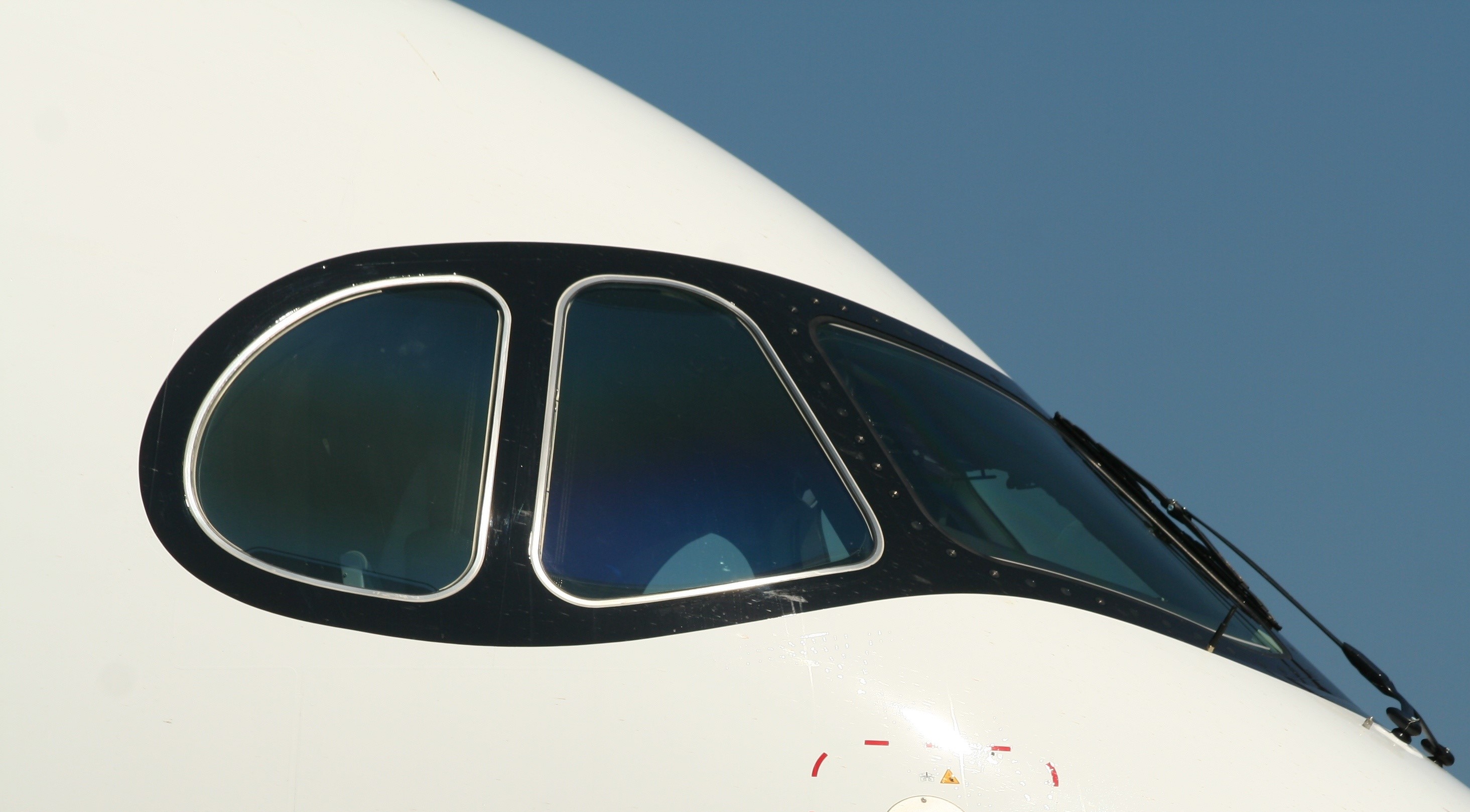
Of course there is at least an order of magnitude difference in the consequences associated with the design of a phone case and a cycle helmet. We can step up the consequences, at least another order of magnitude, by considering the impact performance of the polycarbonate used in the cockpit windows of airplanes. These need to able absorb the energy associated with impacts by birds, runway debris and other objects, as well as withstanding the cycles of pressurisation associated with take-off, cruising at altitude and landing. They can be replaced after an event but only once the plane as landed safely. Consequently, an in-depth understanding of the material behaviour under these different loading conditions is needed to produce a successful design. Of course, we also need a detailed knowledge of the loading conditions, which are influenced not just by the conditions and events during flight but also the way in which the window is attached to the rest of the airplane. A large and diverse team is needed to ensure that all of this knowledge and understanding is effectively integrated in the design of the cockpit window. The team is likely to include experts in materials, damage mechanics, structural integrity, aerodynamic loading as well as manufacturing and finance, since the window has to be made and fitted into the aircraft at an acceptable cost. A similar team will be needed to design the mobile phone casing with the addition of product design and marketing expertise because it is a consumer product. In other words, engineering is team activity and engineers must be able to function as team members and leaders.
I wrote this post shortly after Clive’s lecture but since then it is has languished in my drafts folder – in part because I thought it was too long and boring. However, my editor encourages me to write about engineering more often and so, I have dusted it off and shortened it (slightly!).
Image: https://commons.wikimedia.org/wiki/File:Airbus_A350_cockpit_windows_(14274972354).jpg


 Realize Engineering
.jpg)