Category Archives: sustainability

Greed overwhelms ethics

My car but not my house!

My car but not my house!

The scandal about Volkswagen emissions has already caused journalists and others to wring their hands or to preach sermons, or both, about the ethical standards of the engineering profession, see for example the Editor’s blog in Professional Engineer where he reminds us that professional engineers should conduct their professional work and relationships with “integrity and objectivity and with due regard for the welfare of the people, the organisations and the environment with which they interact”. The quotation is from the Royal Charter of the Institution of Mechanical Engineers. Fine words written to induce good intentions that rarely survive in the face of greed or simply the need to keep your job so that you can feed and house your family.

In my view, the emissions scandal seems to have parallels with the banking scandals of the past decade, in which corporate greed has trampled over ethics and morals in the pursuit of ever larger profits while government regulators through incompetence or acquiescence have allowed it to continue. Volkswagen were wrong to design a device to cheat the Government emission tests, but Government regulators were naive to design a test in which it was so easy to cheat. Senior executives at Volkswagen have blamed their employees following other recent examples.  These company leaders were paid gigantic salaries to provide both leadership and management and, in my opinion, they have failed in both by blaming the people they are supposed to be leading and by allowing the scandals to happen in the first place.

The evidence would suggest that we can trust neither corporations nor governments to take care of the environment. One solution is for all vehicles to provide real-time information on the dashboard about NOX and Carbon emissions as well fuel consumption then we can make our own choices. When I moved to the US more than a decade ago, I was surprised to find that fuel consumption data was not available on the dashboard of most cars as it was already commonplace in Europe. Perhaps its presence was a factor in the development of fuel efficient cars in Europe although clearly higher fuel prices play a large role.  However, in the absence of a tax on emissions, real-time emission data on the dashboard would motivate engineering ingenuity to compete to produce lower emission designs instead of wasting creativity on cheating in useless Government tests.

Here are some of facts to support my statements above about large profits and gigantic salaries:

Volkswagen profits rose 21% in 2014 to more than $12billion on an annual turnover of $230 billion which is comparable to the GDP of Portugal.

The CEO of Volkswagen was paid almost $18million per year which is about 250 times the average salary of a Volkswagen engineer.

Sources:

Hibbert, L., Editor’s comment: October 2015 The Volkswagen emissions testing scandal has put the issue of professional ethics in the spotlight, Professional Engineer, October 07, 2015.

Wall Street Journal, Feb 27th, 2015

Volkswagen AG Annual Report 2014

World Bank Data Bank

Reuters, March 12th, 2012

glassdoor.com


The ‘other’ CO2 problem

163-6306_IMGMost of us are aware of the rising levels of anthropogenic carbon dioxide in the atmosphere and its impact on climate change but what about the potential loss of our oxygen supply? Far fewer of us are aware of what is sometimes referred to as the ‘other’ carbon dioxide problem, which is the acidification of the oceans. Carbon dioxide dissolves in the surface of the ocean when the concentration in the water is lower than in the atmosphere. Joanne Hopkins of the National Oceanography Centre in Liverpool describes this as the reverse of bubbles escaping when you open a fizzy drink, because the concentration of carbon dioxide in the air is less than in the drink. Carbon dioxide is also taken up in the ocean by tiny marine plants, known as phytoplankton, which convert it into organic matter and oxygen. Tiny marine animals, known as zooplankton, eat the phytoplankton and in turn are eaten and so on. Phytoplankton are important not just because they are the bottom of the food chain but also because they produce about half the oxygen that we breathe. The problem is that dissolved carbon dioxide is shifting the pH balance of the oceans which is beginning to cause demineralisation of microorganisms the ocean. At a recent Royal Society Regional Meeting in Bristol, Professor Daniela Schmidt described this as analogous to osteoporosis, a ‘brittle’ bone disease suffered by humans. Many years ago, my research group worked with a pathologist, Dr Dennis Cotton to examine whether it was possible that osteoporosis sufferers could break their leg and fall over rather than fall over and break their leg. In other words, could osteoporosis change the material properties of bone so dramatically that the structural integrity was insufficient for everyday activities such as getting out of bed or walking upstairs? Our answers at the time were inconclusive, at least in the generic case. Professor Schmidt is working with another team of engineers to examine the structural integrity of microorganisms in the oceans and the impact of demineralisation. The concern is that they could become structurally unstable and die and this could lead to a major reduction in our oxygen supply.

Ok, there is a lot of uncertainty about the series of interactions described above, about the magnitude of the effects and about the ability of ecosystems to adapt to the new conditions. However, the potential consequences are so catastrophic that we should not ignore them. Urgent action is needed to reduce our production of carbon dioxide, and since our governments appear incapable of action we have to take individual responsibilty as advocated by Kofi Annan and reported in my post entitled ‘New Year Resolution’ on December 31st, 2014.

By the way, look out for the announcement of the $2M Wendy Schmidt Ocean Health XPrize on July 20th to one of five teams of scientists for the best sensor for making real-time measurements of ocean acidity.

Sources:

Bell R, The removal of a service we can’t do without’, The Observer, 25.01.15.

Schmidt D, Some don’t like it hot, Geology, 42(9):831-832, 2014.

Brodie et al, The future of the northeast Atlantic benthic flora in a high CO2 world, Ecology and Evolution, 4(13):2787-2798, 2014.

Cotton DWK, Whitehead CL, Vyas S, Cooper C & Patterson EA, Are hip fractures caused by falling and breaking or breaking and falling? Photoelastic stress analysis, Forensic Science Int. 65: 105-112, 1994.

Limitless energy

neil hunterThe Sun supplies approximately 100,000 TeraWatts (TW) of energy to the Earth continuously. To put this into perspective the entire generating capacity of China is 1TW and the global population as a whole uses 15TW. Plants use about 100TW via photosynthesis. Most our energy consumption is derived from biomass created millions of years ago by photosynthesis and stored as coal, gas or oil when the plant died and was crushed by geological processes.

I am stealing and paraphrasing from Professor Neil Hunter’s presentation at the Royal Society’s Scientific Discussion Meeting on Bio-inspiration for New Technologies. Of course, as Neil pointed out, the energy from the Sun arrives across a range of wavelengths some of which are damaging to our health. So fortunately for us the Earth’s atmosphere filters out a number of wavelengths but nevertheless a broad band of wavelengths still arrives at the Earth’s surface. Photosynthesis only makes use of two relatively narrowbands of light….

Mankind’s efforts to use solar energy look pathetic alongside Nature’s performance and should be humbling to any engineer or scientist. But it is also an inspiration to do better. We need cheap clean energy for everyone. It is being delivered everyday but we don’t know how to use it.

Where there is muck there is an engineer

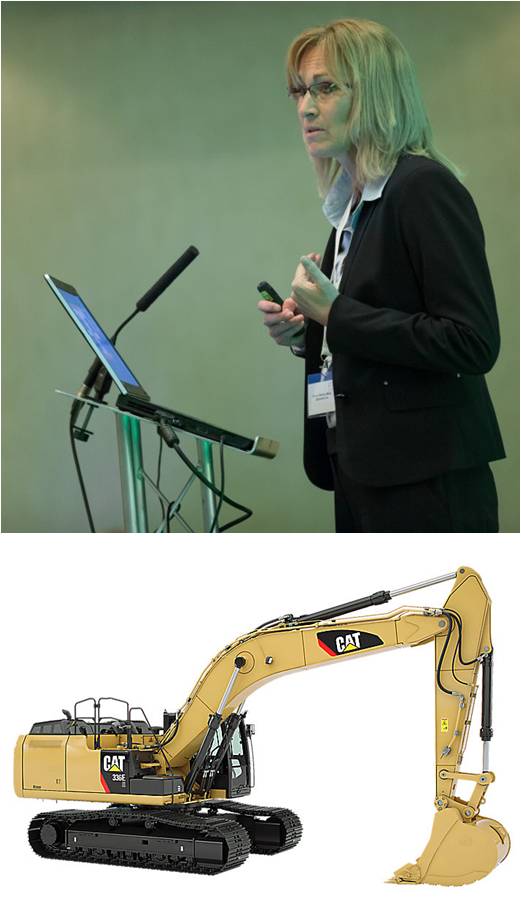
Dr Lou Balmer-Millar at the FPC 2015 & the CAT 366E

Dr Lou Balmer-Millar at the FPC 2015 & the CAT 366E

Here’s a second post on what engineers do [see my post entitled ‘Press button for exciting ride‘ on March 25th, 2015].

Dr Lou Balmer-Millar leads a team that develops new technology for off-road vehicles.  She is Director of Research and Advanced Engineering at Caterpillar Inc. and she gave a keynote talk at the  Future Powertrains Conference, which I wrote about a couple of weeks ago.  She talked about the innovations that Caterpillar are developing to increase the efficiency of their vehicles.  This includes driverless giant trucks.  If you are worried about driverless cars then what about driverless 226 tonnes trucks?  It is already a reality –   watch the Caterpillar video.

However, what stuck in my mind from her presentation was not the enormous mining trucks but the way in which Caterpillar measure the efficiency of their diggers, such as the CAT 366E Hybrid.  They are not so much interested in miles per gallon as tonnes of dirt (or muck) shifted per gallon.  Efficiency is defined as what you want out of a machine divided by what you have to put in to a machine, or work done for energy supplied [see post entitled ‘Energy efficiency‘ on June 18th, 2014].  So for a passenger car, miles travelled divided by energy used is a reasonable measure of efficiency.  But for digger, tonnes of earth moved is what you are want done, so tonnes moved per gallon is the right measure of efficiency.   The machine in the picture does not look like anything special but Caterpillar claim it is 30% more efficient than its competitors.

So there is money to be made in shifting earth more efficiently than your competitors.  If you enjoy watching machines move earth the watch this video.

Photo credit: Joshua Tucker http://www.apcuk.co.uk/2015/03/future-powertrain-conference-2015-report/