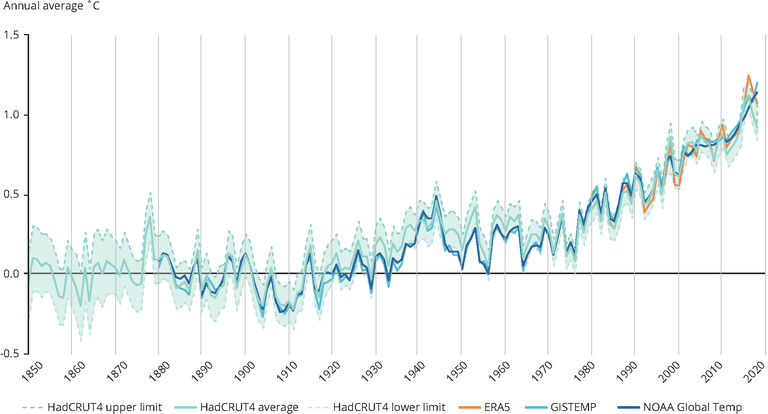
 According to Raj Patel and Jason W Moore, in his treatise ‘Das Kapital’ Karl Marx defined capitalism as combining labour power, machines and raw materials to produce commodities that are sold for profit which is re-invested in yet more labour power, machines and raw materials. In other words, capitalism involves processes that produce profit from an economic perspective, and from a thermodynamic perspective produce entropy because the second law of thermodynamics demands that all real processes produce entropy. Thermodynamically, entropy usually takes the form of heat dissipated into the environment which raises the temperature of the environment; however, it can also be interpreted as an increase in the disorder of a system [see ‘Will it all be over soon?’ on November 2nd, 2016]. The ever-expanding cycle of profit being turned into capital implies that the processes of producing commodities must also become ever larger. The ever-expanding processes of production implies that the rate of generation of entropy also increases with time. If no profit were reinvested in economic processes then the processes would still increase the entropy in the universe but when profit is re-invested and expands the economic processes then the rate of entropy production increases and the entropy in the universe increases exponentially – that’s why the graphs of atmospheric temperature curve upwards at an increasing rate since the industrial revolution. As if that is not bad enough, the French social economist, Thomas Piketty has proposed that the rate of return on capital, “r” is always greater than the rate of growth of the economy, “g” in his famous formula “r>g”. Hence, even with zero economic growth, the rate of return will be above zero and the level of entropy will rise exponentially. Piketty identified inequality as a principal effect of his formula and suggested that only cataclysmic events, such as world wars or revolutions, can reduce inequality. The pessimistic thermodynamicist in me would conclude that an existential cataclysmic event might be the only way that this story ends.
Sources
Raj Patel & Jason W. Moore, A history of the world in seven cheap things, London: Verso, 2018.
Thomas Piketty, A brief history of equality, translated by Steven Rendall, Harvard: Belknap, 2022.
Diane Coyle, Piketty the positive, FT Weekend, 16 April/17 April 2022.
Image: Global average near surface temperature since the pre-industrial period from www.eea.europa.eu/data-and-maps/figures/global-average-near-surface-temperature



 Realize Engineering