Category Archives: MyResearch

Counting photons to measure stress

TSA pattern around a crack propagating from the left with its tip in the centre.

TSA pattern around a crack propagating from the left with its tip in the centre.

Some might find it strange that I am teaching thermodynamics when my research expertise is in structural materials and mechanics. However, the behaviour of structures is largely controlled by energy and how they absorb, store and release it; while thermodynamics is the study of energy flows and transformations, so there is a connection. In my research group, we exploit this connection in a technique for measuring stress fields in components by monitoring the temperature changes that occur when a component is loaded. In Thermoelastic Stress Analysis (TSA) as it is known, we use very sensitive infrared cameras to monitor the cyclic variations of temperature that occur when cyclic load is applied to a material. The temperature changes are of the order of milli-Kelvin, that’s thousandths of a degree, and are positive with negative, or compressive stress and negative with tensile stress. What we are actually measuring is the rate of change in the release of photons by atoms as they are pushed closer together in compression or pulled further apart in tension; but that’s another story and takes us into physics.

An exciting feature of this technique is that as a crack evolves new surfaces are formed which releases energy as heat. We can detect not only the stress field around the crack but also the heat released during the formation of the crack prior it being visible and its subsequent growth.

Sources:
Greene, R.J., Patterson, E.A., Rowlands, R.E., 2008, ‘Thermoelastic stress analysis’, in Handbook of Experimental Mechanics edited by W.N. Sharpe Jr., Springer, New York.

Yang, Y., Crimp, M., Tomlinson, R.A., Patterson, E.A., 2012, Quantitative measurement of plastic strain field at a fatigue crack tip, Proc. R. Soc. A., 468(2144):2399-2415.

Patki, A.S., Patterson, E.A., 2010, ‘Thermoelastic stress analysis of fatigue cracks subject to overloads’, Fatigue and Fracture of Engineering Materials and Structures, 33(12):809-821.


Recognizing strain

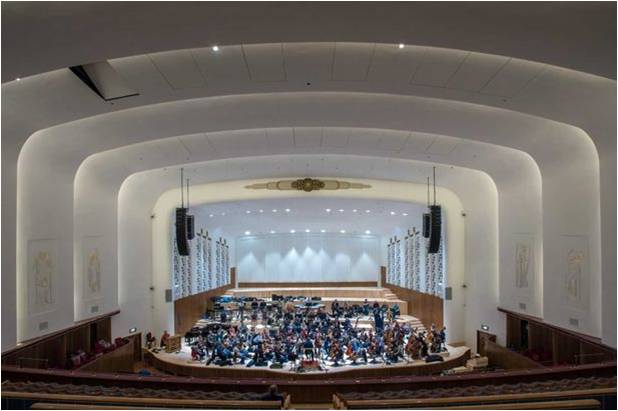
rlpoYou can step off an express train but you can’t speed up a donkey. This is paraphrased from ‘The Fly Trap’ by Fredrik Sjöberg in the context of our adoption of faster and faster technology and the associated life style. Last week we stepped briefly off the ‘express train’ and lowered our strain levels by going to a concert given by the Royal Liverpool Philharmonic Orchestra, including pieces by Dvorak, Chopin and Tchaikovsky. I am not musical at all and so I am unable to tell you much about the performances or compositions, except to say that I enjoyed the performances as did the rest of the audience to judge from the enthusiastic applause. A good deal of my enjoyment arose from the energy of the orchestra and my ability to recognise the musical themes or acoustic features in the pieces. The previous sentence was not intended as a critic’s perspective on the concert but a tenuous link…

Recognising features is one aspect of my recent research, though in strain data rather than music. Modern digital technology allows us to acquire information-rich data maps with tens of thousands of individual data values arranged in arrays or matrices, in which it can be difficult to spot patterns or features. We treat our strain data as images and use image decomposition to compress a data matrix into a feature vector. The diagram shows the process of image decomposition, in which a colour image is converted to a map of intensity in the image. The intensity values can be stored in a matrix and we can fit sets of polynomials to them by ‘tuning’ the coefficients in the polynomials. The coefficients are gathered together in a feature vector. The original data can be reconstructed from the feature vector if you know the set of polynomials used in the decomposition process, so decomposition is also a form of data compression. It is easier to recognise features in the small number of coefficients than in the original data map, which is why we use the process and why it was developed to allow computers to perform pattern recognition tasks such as facial recognition.

decompositionSources:

Wang W, Mottershead JE, Patki A, Patterson EA, Construction of shape features for the representation of full-field displacement/strain data, Applied Mechanics and Materials, 24-25:365-370, 2010.

Patki, A.S., Patterson, E.A, Decomposing strain maps using Fourier-Zernike shape descriptors, Exptl. Mech., 52(8):1137-1149, 2012.

Nabatchian A., Abdel-Raheem E., and Ahmadi M., 2008, Human face recognition using different moment invariants: a comparative review. Congress on Image and Signal Processing, 661-666.


Forensic engineering

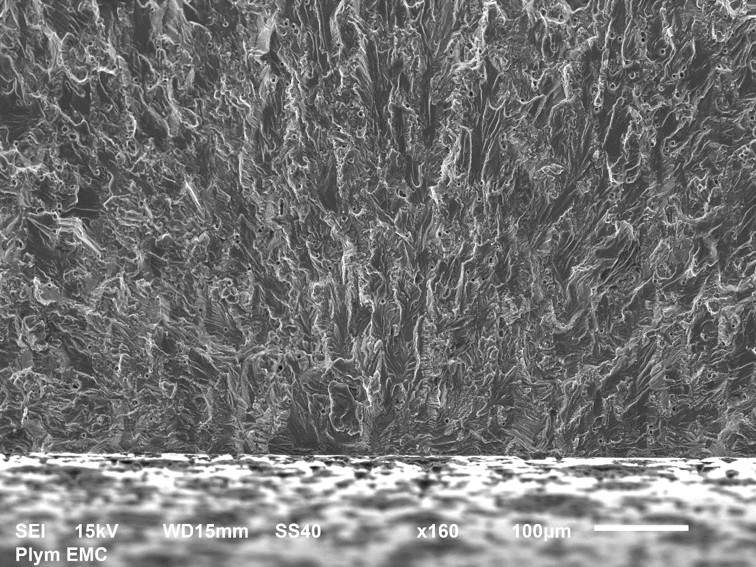
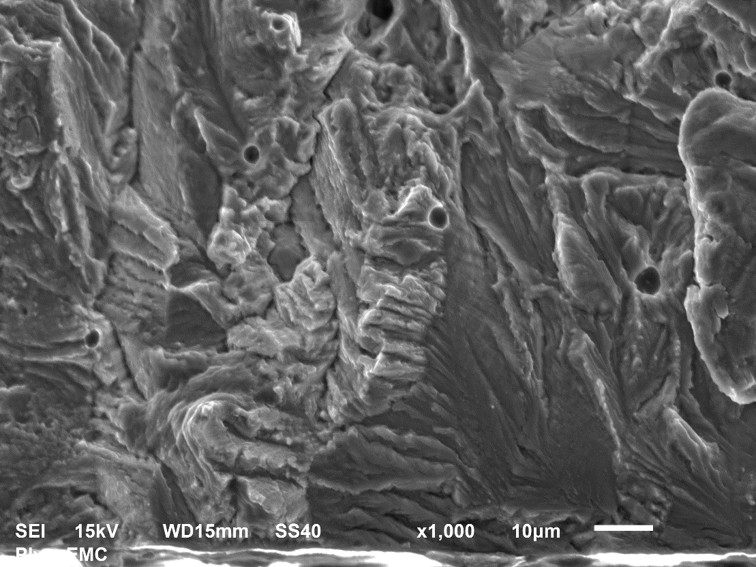
Picture1The picture above shows the fracture surface of a thin bar of aluminium alloy that had a circular hole through the middle, like the peep-hole in a front door. The photograph was taken in a Scanning Electron Microscope (SEM) at x160 magnification. There is a scale bar in the bottom right corner showing a length of 100 microns. We are looking approximately in the longitudinal direction, which was the direction of loading, and across the photograph from left to right corresponds to the direction you would look through the hole. The lower one third of the picture shows the machined surface of the hole cut or machined by the drill. The top two-thirds shows the surface created by the fatigue crack as it extended incrementally with each cycle of load. The crack started from edge of the machined surface approximately on the vertical centre-line of the picture. I can tell this because all of the features in the texture of the fracture surface point towards this point because the failure radiated out from this location. The picture below shows the crack initiation area at x1000 magnification. It is a small area at interface with hole above the letters ‘SS40’ in the top photograph; this should be enough to let you identify the common features but the interpretation of these images requires significant skill.

Fractography is the forensic study of failure surfaces such as this to establish the cause of failure. In this example, the hole in aluminium bar ensured that it will always fail with cyclic loading through the growth of a crack from somewhere around the hole. The textured form of the fracture surface occurs because the material is not homogeneous at this scale but made up of small grains. The failure of each grain is influenced by its orientation to the loading which results in the multi-faceted surface in the photographs.

I made the photographs the focus of this post because I thought they are interesting, but may be that’s because I’m an engineer, and because they are a tiny part in a fundamental research programme on which I have been spending a significant portion of my time. A goal of programme is to understand how to use these materials to build more energy-efficient structures that are cheaper and last longer without failing by, for example, fatigue.

More details:

The bar was 1.6mm thick and 38mm wide in the transverse direction and made from 2024-T3 Aluminium alloy. The hole diameter was 6.36mm. A tension load was repeatedly applied and removed in the longitudinal direction which caused the initiation and growth of a fatigue crack from the hole that after many cycles of loading led to the bar breaking in half along a plane perpendicular to the load direction. The pictures were taken at the University of Plymouth by Khurram Amjad with the assistance of Peter Bond and Roy Moate using a JEOL JSM-6610LV.

x1000

Enabling or disruptive technology for nuclear engineering?

INDEA couple of weeks ago [see ‘Small is beautiful and affordable in nuclear power-stations’  on January 14th, 2015] I ranted about the need to develop small modular reactors whose components can be mass-produced in a similar way to the wings, cockpit, tail-planes, fuselage and engines of an Airbus aeroplane that are manufactured in factories in different countries in Europe prior to final assembly and commissioning in Toulouse, France. The aerospace industry is heavily dependent on computer-aided engineering to design, test, manufacture, operate and maintain aircraft in a series of processes involving a huge number of organisations. The civil engineering and building services industries are following the same model through the introduction of BIM, or Building Information Modelling. I have recently suggested that the nuclear industry needs to adopt the same approach through an Integrated Nuclear Digital Environment (INDE) that has the potential to reduce operating and decommissioning costs and increase reliability and safety for existing and planned power-stations but more importantly would enable a move towards mass-production of modular power-stations.

Recently I presented a paper at a NAFEMS seminar on Modelling and Simulation in the Nuclear Industry held on November 19th 2014 in Manchester, UK.  To judge from the Q&A session afterwards, the paper divided the audience into those who could see the enormous potential (the enablers?) and those who saw only massive problems that rendered it unworkable (the potentially disrupted?). The latter group tends to cite the special circumstances of the nuclear industry associated with its risks and regulatory environment. These are important factors but are not unique to the industry. From my perspective of working with many other industrial sectors, the nuclear industry is unique in its slow progress in exploiting the potential of digital technologies.  Perhaps in the end, as one of my academic colleagues believes, research on solar power will produce such efficient solar cells that even in cold and cloudy England we will be able to meet all of our power needs from solar energy [given incoming solar radiation is about 340 Watts/square meter], in which case perhaps the nuclear power industry will become extinct unless it has evolved.

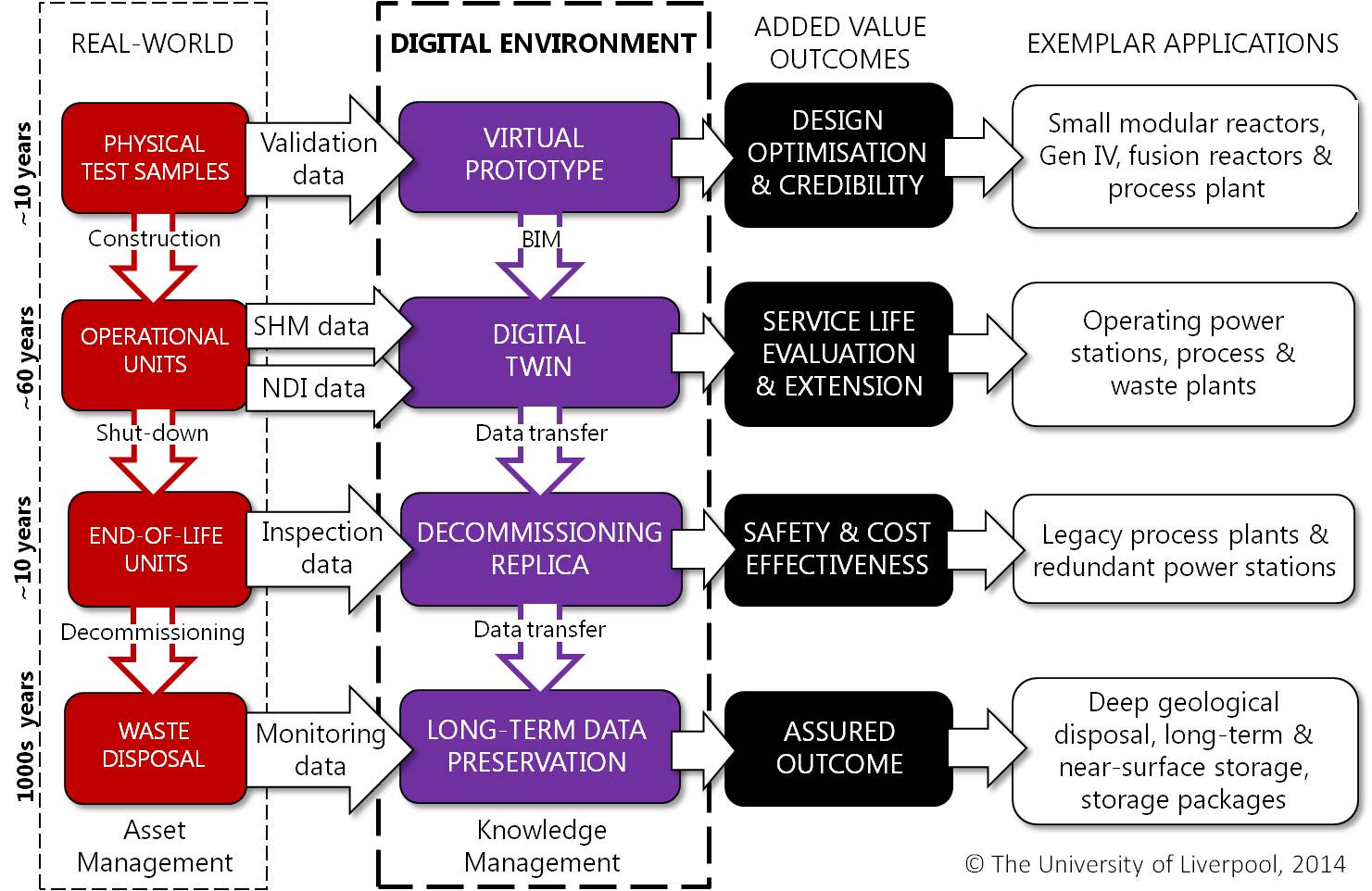
Schematic diagram showing the digital environment (second column from left in purple), its relationships to the real-world (left column in red) and the potential added value (third column from left) together with exemplar applications (right column). Coloured arrows are processes and coloured boxes represent physical (red) or digital (purple) infrastructure.

Schematic diagram showing the digital environment (second column from left in purple), its relationships to the real-world (left column in red) and the potential added value (third column from left) together with exemplar applications (right column). Coloured arrows are processes and coloured boxes represent physical (red) or digital (purple) infrastructure [from Patterson & Taylor, 2014].

The diagram is an extract from Patterson & Taylor, 2014.  The views expressed in this blog post are those of the author and not necessarily of those of his co-authors on other publications, or their employers.