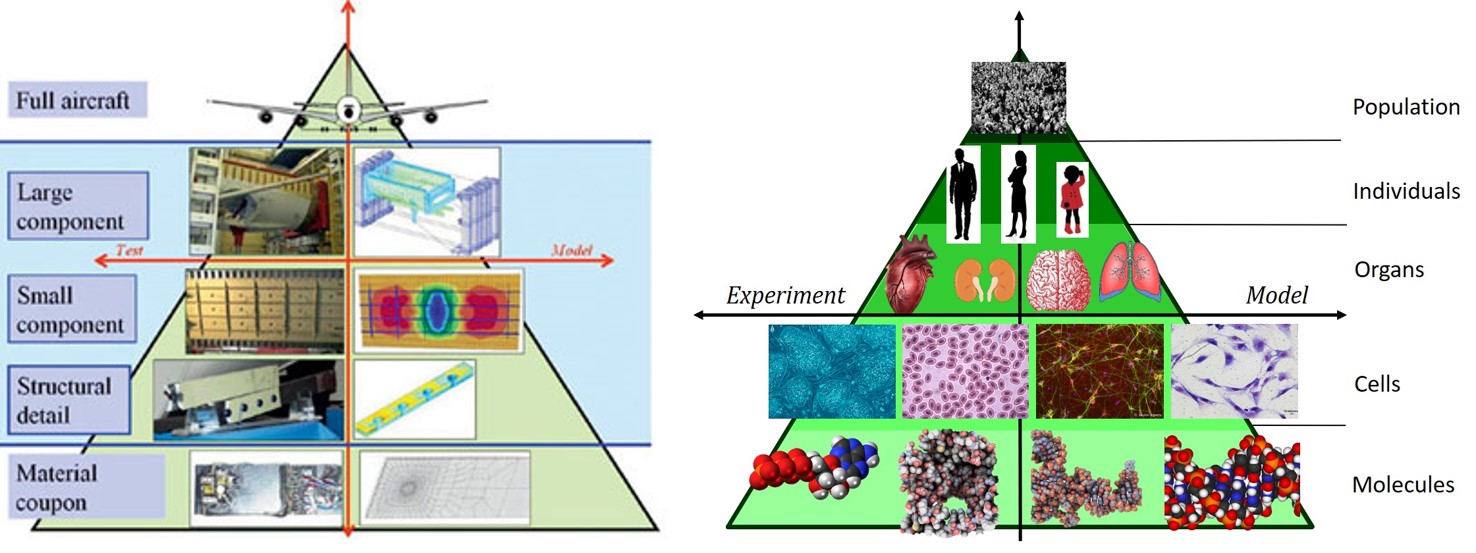
 In the 1979 Glenn Harris proposed an analytical hierarchy of models for estimating tactical force effectiveness for the US Army which was represented as a pyramid with four layers with a theatre/campaign simulation at the apex supported by mission level simulations below which was engagement model and engineering models of assets/equipment at the base. The idea was adopted by the aerospace industry [see the graphic on the left] who place the complete aircraft on the apex supported by systems, sub-systems and components beneath in increasing numbers with the pyramid divided vertically in half to represent physical tests on one side and simulations on the other. This represents the need to validate predictions from computational models with measurements in the real-world [see post on ‘Model validation‘ on September 18th, 2012]. These diagrams are schematic representations used by engineers to plan and organise the extensive programmes of modelling and physical testing undertaken during the design of new aircraft [see post on ‘Models as fables‘ on March 16th, 2016]. The objective of the MOTIVATE research project is to reduce quantity and increase the quality of the physical tests so that pyramid becomes lop-sided, i.e. the triangle representing the experiments and tests is a much thinner slice than the one representing the modelling and simulations [see post on ‘Brave New World‘ on January 10th, 2018].
At the same time, I am working with colleagues in toxicology on approaches to establishing credibility in predictive models for chemical risk assessment. I have constructed an equivalent pyramid to represent the system hierarchy which is shown on the right in the graphic. The challenge is the lack of measurement data in the top left of the pyramid, for both moral and legal reasons, which means that there is very limited real-world data available to confirm the predictions from computational models represented on the right of the pyramid. In other words, my colleagues in toxicology, and computational biology in general, are where my collaborators in the aerospace industry would like to be while my collaborators in the aerospace want to be where the computational biologists find themselves already. The challenge is that in both cases a paradigm shift is required from objectivism toward relativism; since, in the absence of comprehensive real-world measurement data, validation or confirmation of predictions becomes a social process involving judgement about where the predictions lie on a continuum of usefulness.
Sources:
Harris GL, Computer models, laboratory simulators, and test ranges: meeting the challenge of estimating tactical force effectiveness in the 1980’s, US Army Command and General Staff College, May 1979.
Trevisani DA & Sisti AF, Air Force hierarchy of models: a look inside the great pyramid, Proc. SPIE 4026, Enabling Technology for Simulation Science IV, 23 June 2000.
Patterson EA & Whelan MP, A framework to establish credibility of computational models in biology, Progress in Biophysics and Molecular Biology, 129:13-19, 2017.

 Realize Engineering