
Category Archives: design

Massive engineering

Last month I was at the Photomechanics 2018 conference in Toulouse in France.  Photomechanics is the science of using photons to measure deformation and displacements in anything, from biological cells to whole engineering structures, such as bridges or powerstations [see for example: ‘Counting photons to measure stress‘ posted on November 18th, 2015].  I am interested in the challenges created by the extremes of scale and environmental conditions; although on this occasion we presented our research on addressing the challenges of industrial applications, in the EU projects INSTRUCTIVE [see ‘Instructive update‘ on October 4th, 2017] and MOTIVATE [see ‘Brave New World‘ posted on January 10th, 2018].

It was a small conference without parallel sessions and the organisers were more imaginative than usual in providing us with opportunities for interaction.  At the end of first day of talks, we went on a guided walking tour of old Toulouse.  At the end of second day, we went to the Toulouse Aerospace Museum and had the chance to go onboard Concorde.

I stayed an extra day for an organised tour of the Airbus A380 assembly line.  Only the engine pylons are made in Toulouse.  The rest of the 575-seater plane is manufactured around Europe and arrives in monthly road convoys after travelling by sea to local ports.  The cockpit, centre, tail sections of the double-deck fuselage travel separately on specially-made trucks with each 45m long wing section following on its own transporter.  It takes about a month to assemble these massive sections.  This is engineering on a huge scale performed with laser precision (laser systems are used to align the sections).  The engines are also manufactured elsewhere and transported to Toulouse to be hung on the wings.  The maximum diameter of the Rolls-Royce Trent 900 engines, being attached to the plane we saw, is approximately same as the fuselage diameter of an A320 airplane.

Once the A380 is assembled and its systems tested, then it is flown to another Airbus factory in Germany to be painted and for the cabin to be fitted out to the customer’s specification.  In total, 11 Airbus factories in France, Germany, Spain and the United Kingdom are involved in producing the A380; this does not include the extensive supply chain supporting these factories.  As I toured the assembly line and our guide assailed us with facts and figures about the scale of the operation, I was thinking about why the nuclear power industry across Europe could not collaborate on this scale to produce affordable, identical power stations.  Airbus originated from a political decision in the 1970s to create a globally-competitive European aerospace industry that led to a collaboration between national manufacturers which evolved into the Airbus company.  One vision for fusion energy is a globally dispersed manufacturing venture that would evolve from the consortium that is currently building the ITER experiment and planning the DEMO plant.  However, there does not appear to be any hint that the nuclear fission industry is likely to follow the example of the European aerospace industry to create a globally-competitive industry producing massive pieces of engineering within a strictly regulated environment.

There was no photography allowed at Airbus so today’s photograph is of Basilique Notre-Dame de la Daurade in Toulouse.
Designing for damage

Eighteen months ago I wrote about an insight on high-speed photography that Clive Siviour shared during his 2016 JSA Young Investigator Lecture [see my post entitled ‘Popping balloons‘ on June 15th, 2016].  Clive is interested in high-speed photography because he studies the properties of materials when they are subject to very high rates of deformation, in particular polymers used in mobile phones and cycle helmets – the design requirements for these two applications are very different.  The polymer used in the case of your mobile phone needs to protect the electronics inside your phone by absorbing the kinetic energy when you drop the phone on a tiled floor and it needs to be able to do this repeatedly because you are unlikely to replace the case after each accidental drop. A cyclist’s helmet also needs to protect what is inside it but it only needs to do this once because you will replace your helmet after an accident.  So, the kinetic energy resulting from an impact can be dissipated through the propagation of damage in the helmut; but in the phone case, it has to be absorbed temporarily as strain energy and then released, like in a spring.

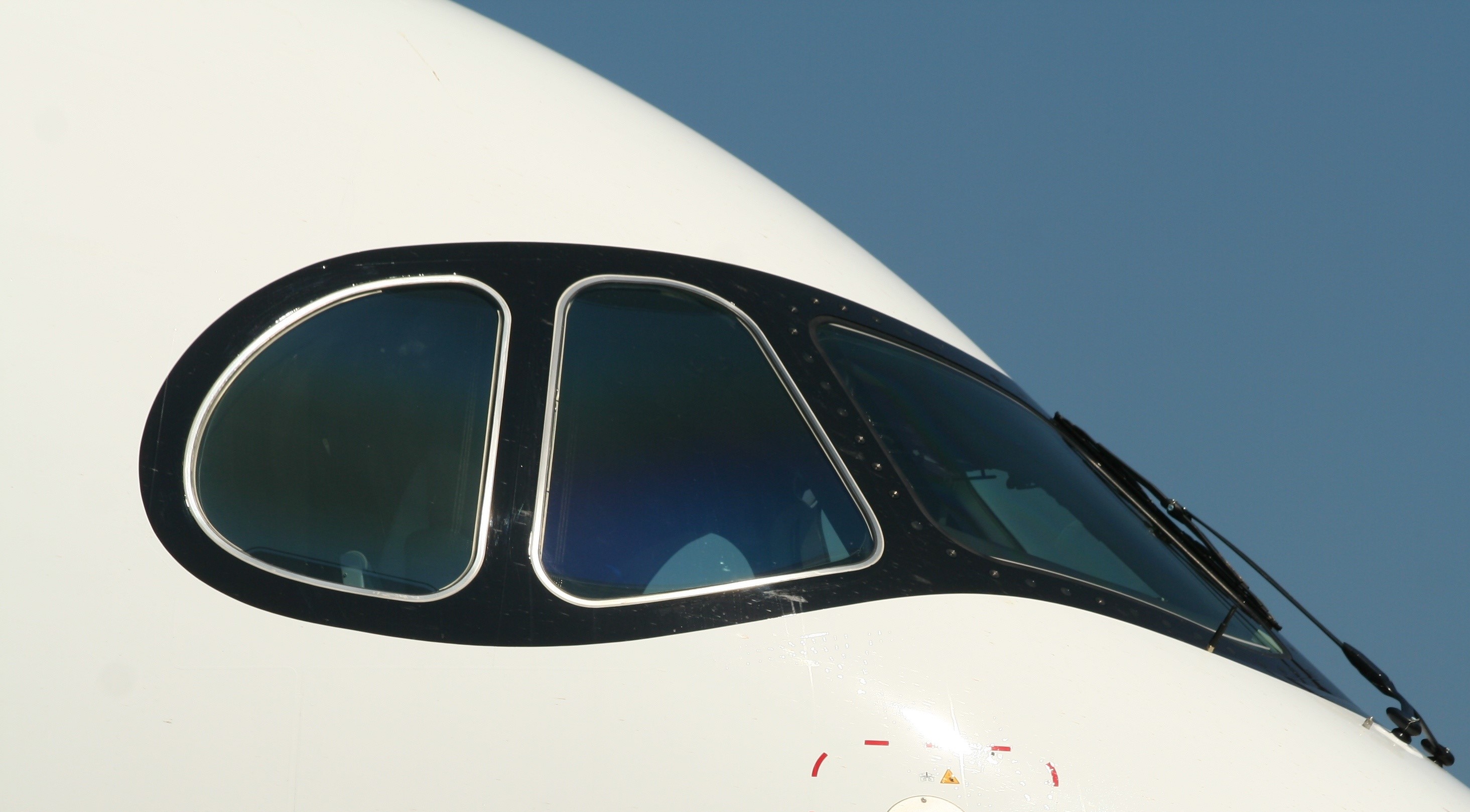
Of course there is at least an order of magnitude difference in the consequences associated with the design of a phone case and a cycle helmet.  We can step up the consequences, at least another order of magnitude, by considering the impact performance of the polycarbonate used in the cockpit windows of airplanes.  These need to able absorb the energy associated with impacts by birds, runway debris and other objects, as well as withstanding the cycles of pressurisation associated with take-off, cruising at altitude and landing.  They can be replaced after an event but only once the plane as landed safely.  Consequently, an in-depth understanding of the material behaviour under these different loading conditions is needed to produce a successful design.  Of course, we also need a detailed knowledge of the loading conditions, which are influenced not just by the conditions and events during flight but also the way in which the window is attached to the rest of the airplane.  A large and diverse team is needed to ensure that all of this knowledge and understanding is effectively integrated in the design of the cockpit window.  The team is likely to include experts in materials, damage mechanics, structural integrity, aerodynamic loading as well as manufacturing and finance, since the window has to be made and fitted into the aircraft at an acceptable cost.  A similar team will be needed to design the mobile phone casing with the addition of product design and marketing expertise because it is a consumer product.  In other words, engineering is team activity and engineers must be able to function as team members and leaders.

I wrote this post shortly after Clive’s lecture but since then it is has languished in my drafts folder – in part because I thought it was too long and boring.  However, my editor encourages me to write about engineering more often and so, I have dusted it off and shortened it (slightly!).

Image: https://commons.wikimedia.org/wiki/File:Airbus_A350_cockpit_windows_(14274972354).jpg

Formula Ocean

I have had intermittent interactions with motorsport during my engineering career, principally with Formula 1, Formula SAE and Formula Student teams.  The design, construction and competition involved in Formula Student generates tremendous enthusiasm amongst a section of the student community and enormously increases their employability.  As a Department Chair at Michigan State University, I was a proud and enthusiastic sponsor of the MSU Formula SAE team.  However, I find it increasingly difficult to support an activity that is associated with profligate expenditure of energy and resources – this is not the impression of engineering that should be portrayed to our current and future students.  Engineering is about so much more than making a vehicle go around a track as fast as possible.  See my posts on ‘Re-engineering Engineering‘ on August 30th, 2017, ‘Engineering is all about ingenuity‘ on September 14th, 2016 or ‘Life takes engineering‘ on April 22nd, 2015.

There are many other challenges that could taken up by student teams, in competition if that encourages participation, which would benefit human-kind and the planet.  A current hot topic in the UK media is the pollution of oceans by waste plastic [see for example BBC report]; so, engineering undergraduates could be challenged to design, construct and operate an autonomous marine vehicle that collects and processes plastic waste.  It could be powered from the embedded energy in the waste plastic collected in the ocean.  It would need to navigate to avoid collisions with other vessels, coastal features and wildlife, and to locate and identify the waste.  These represent technological changes in chemical, control, electronic, materials and mechanical engineering – and probably some other fields as well.  I have shared this concept with colleagues in Liverpool and there is some enthusiasm for it; maybe some competition from other universities is all that’s needed to get Formula Ocean started.  The machine with the largest positive net impact on the environment wins!


Georgian interior design and efficient radiators

My lecture last week, to first year students studying thermodynamics, was about energy flows and, in particular, heat transfer.  I mentioned that, despite being called radiators, radiation from a typical central heating radiator represents less than a quarter of its heat output with rest arising from convection [see post entitled ‘On the beach‘ on July 24th, 2013 for an explanation of types of heat transfer].  This led one student to ask whether black radiators, with an emissivity of close to one, would be more efficient.  The question arises because the rate of radiative heat transfer is proportionate to the difference in the fourth power of the temperature of the radiator and its surroundings, and to the surface emissivity of the surface of the radiator.  This implies that heat will transfer more quickly from a hot radiator but also more slowly from a white radiator that has an emissivity of 0.05 compared to 1 for black surface.

Thus, a black radiator will radiator heat more quickly than a white one; but does that mean it’s more efficient?  The first law of thermodynamics demands that the nett energy input to a radiator is the same as the energy input required to raise the temperature of the space in which it is located.  Hence, the usual thermodynamic definition of efficiency, i.e. what we want divided by what we must supply, does not apply.  Instead, we usually mean the rate at which a radiator warms up a room or the size of the radiator required to heat the room.  In other words, a radiator that warms a room quickly is considered more efficient and a small radiator that achieves the same as large one is also considered efficient.  So, on this basis a black radiator will be more efficient.

Recent research by a team, at my alma mater, has shown that a rough black wall behind the radiator also increases its efficiency, especially when the radiator is located slightly away from the wall.  Perhaps, it is time for interior designers to develop a retro-Georgian look with dark walls, perhaps with sand mixed into the paint to increase surface roughness.

Sources:

Beck SMB, Grinsted SC, Blakey SG & Worden K, A novel design for panel radiators, Applied Thermal Engineering, 24:1291-1300, 2004.

Shati AKA, Blakey SG & Beck SBM, The effect of surface roughness and emissivity on radiator output, Energy and Buildings, 43:400-406, 2011.

Image details:

Verplank 2 002<br />
Working Title/Artist: Woodwork of a Room from the Colden HouseDepartment: Am. Decorative ArtsCulture/Period/Location: HB/TOA Date Code: Working Date: 1767<br />
Digital Photo File Name: DP210660.tif<br />
Online Publications Edited By Steven Paneccasio for TOAH 1/3/14

https://www.metmuseum.org/toah/works-of-art/40.127/