Tag Archives: sustainability

Climate change and tides in Liverpool

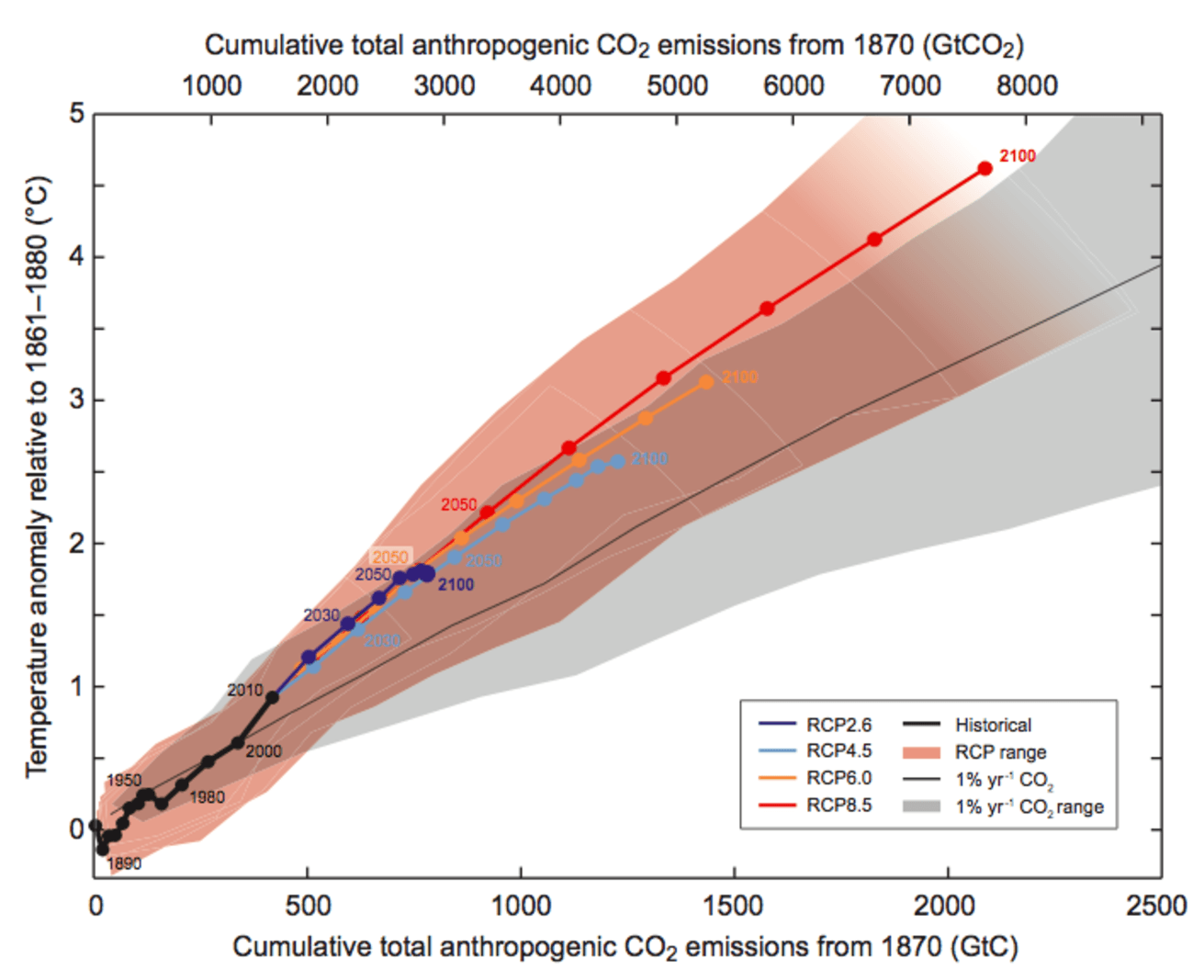
image-20141201-20565-1eoo7rhIf you live within sight of the sea, as we do, then your life is probably influenced, to some degree, by the rise and fall of tides.  In Liverpool, we are lucky to have a particularly long historical record of tidal heights and one of my colleagues, an oceanographer, Professor Ric Williams has used this record to discuss climate variability.  The record was started and maintained between 1768 and 1793 by Captain William Hutchinson whose achievement is commemorated with a fountain in Liverpool’s historic docks, which are a UNESCO World Heritage Site.

A few weeks ago I listened to a talk by Prof Williams, in which he described how there is a rather simple relationship between surface warming and the effect of future emissions of greenhouse gases.  If the predictions of surface warming are plotted as a function of how much carbon is emitted to the atmosphere, rather than time, then a simple response emerges: the more carbon we emit, the warmer it will get. Associated with the surface warming, there is an expected sea level rise from the expansion of the water column augmented by the effect of addition of freshwater from melting of land ice. Watch Prof Williams’ Youtube video to find out more.

Sources:

Woodworth, P.L. 1999. High waters at Liverpool since 1768: the UK’s longest sea level record. Geophysical Research Letters, 26 (11), 1589-1592.

Goodwin, P., Williams, R.G. & Ridgwell, A., Sensitivity of climate to cumulative carbon emissions dues to compensation of ocean heat and carbon uptake, Nature Geoscience, 8,29–34(2015).

Image: http://theconversation.com/our-equation-proves-climate-change-is-linked-to-emissions-34897


Opal offers validation opportunity for climate models

OrangeFanSpongeSmallMany of us will be familiar with the concept of the carbon cycle, but what about the silicon cycle?  Silicon is the second most abundant element in the Earth’s crust.  As a consequence of erosion, it is carried by rivers into the sea where organisms, such as sponges and diatoms (photosynthetic algae), convert the silicon in seawater into opal that ends up in ocean sediment when these organisms die.  This marine silicon cycle can be incorporated into climate models, since each step is influenced by climatic conditions, and the opal sediment distribution from deep sea sediment cores can be used for model validation.

This approach can assist in providing additional confidence in climate models, which are notoriously difficult to validate, and was described by Katharine Hendry, a Royal Society University Research Fellow at the University of Bristol at a recent conference at the Royal Society.  This struck me as an out-of-the box or lateral way of seeking to increase confidence in climate models.

There are many examples in engineering where we tend to shy away from comprehensive validation of computational models because the acquisition of measured data seems too difficult and, or expensive.  We should take inspiration from sponges – by looking for data that is not necessarily the objective of the modelling but that nevertheless characterises the model’s behaviour.

Source:

Thumbnail: http://www.aquariumcreationsonline.net/sponge.html

Are we all free riders?

girl in smogThe ‘tragedy of the commons’ is an economic theory founded on the idea that when there is unregulated use of a shared resource then the rational consumer, acting independently and in their own interests, will maximise their consumption leading to the depletion or destruction of the resource.  For example, if there is no cost or limit to grazing sheep on common land then a rational shepherd would maximise their flock size in order to maximise profit.  Eventually, the commons’ ability to sustain the sheep is overwhelmed and it becomes a wasteland.  Are we all taking a free ride on the world’s ecosystem?  Our cars and houses freely pump out huge quantities of carbon dioxide that are overwhelming our ecosystem.  Most of us do nothing – either because we refuse to believe the evidence, or we believe it is not in our interests to act, or we don’t think it is our problem, or we don’t know what to do, or a combination of these excuses.

This might seem a low priority to you.  But, for the 40% of the world’s population that live in the five countries with the worst air quality, it is a high priority.  If you visit these countries, you experience days when it is difficult to breathe because the pollution is so bad and it is hard to read your smartphone because the air is so thick with particles.  We are all part of a single ecosystem on the planet, Gaia if you like, and we are joined to one another through a myriad of connections.  So we ignore this issue at our peril, or the peril of our grandchildren.

It seems unlikely that our leaders will take effective coordinated action and so grass roots action is needed as suggested by Kofi AnnanAssess your carbon footprint now and think about ways to become carbon neutral.  If you want to find out the carbon footprint of your organization then the Carbon Trust has useful information and services.

Sources:

The Economist Pocket World in Figures 2015 edition, Profile Books Ltd, London 2014

Thumbnail: http://blogs-images.forbes.com/benjaminshobert/files/2015/01/China_Smog2-1940×1293.jpg

What a waste

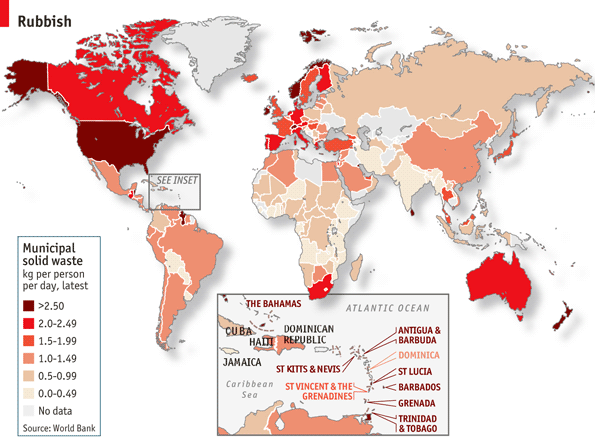
20120609_wom915Einstein’s famous equation, E=mc², does not influence everyday interactions of energy, E and mass, m.  The speed of light, c is 299 792 458 m/s which is very big number and implies a huge amount of energy is required to create a small amount of mass.  This means that energy and mass are independently conserved.  For energy, this is the first law of thermodynamics while the law of conservation of mass is usually attributed to Antoine Lavoisier.  On a planetary scale, the conservation of mass implies that we can assume that the quantity of matter is constant.  Can we apply the second law of thermodynamics to matter as well as energy?  One interpretaton of the second law is that Gibbs energy, or the energy available to do useful work, must decrease in all real processes.   This also applies when matter moves through our economic system.  For instance, we must do work to convert mineral ores into useful products which gradually degrade through use and natural processes, such as corrosion, until they become scrap and we must expend more resources to recycle them and make them useful again.  The sun provides us with a steady supply of useful energy, so that in energy terms planet Earth can be considered an open system with energy flows in and out.  Conversely in mass terms, planet Earth is effectively a closed system with negligible mass flow in or out, so that we do not have a steady supply of new matter from which to manufacture goods.  However, most of us behave with open-world mindset and throw away matter (goods) that are no longer useful to us when we should be repairing and recycling [see my post entitled ‘Old is beautiful‘ on May 1st 2013].  Maybe we can’t reach the zero-waste status aimed at by people like Bea Johnson, but most of us could do better than the 2.2 kg of solid waste produced each day by each of us in OECD countries. That’s 2.1 tonnes per year for an average OECD household (2.63 people)!

Sources:

The New Sustainable Frontier – principles of sustainable development, GSA Office of Governmentwide Policy, September 2009.

Daniel Hoornweq & Perinaz Bhada-Tata, What a Waste: A Global Review of Solid Waste Management, World Bank No.15, 2012.

http://www.economist.com/blogs/graphicdetail/2012/06/daily-chart-3