Tag Archives: research

Recognizing strain

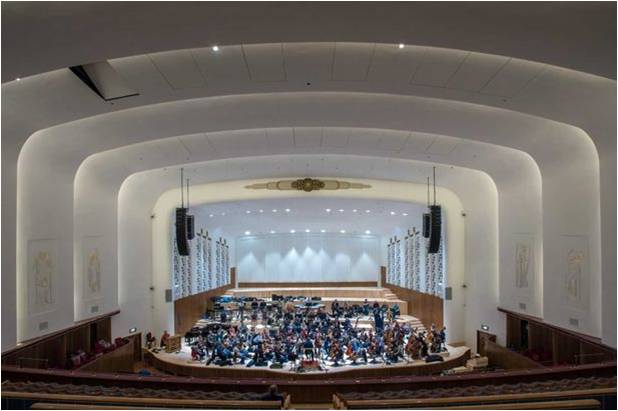
rlpoYou can step off an express train but you can’t speed up a donkey. This is paraphrased from ‘The Fly Trap’ by Fredrik Sjöberg in the context of our adoption of faster and faster technology and the associated life style. Last week we stepped briefly off the ‘express train’ and lowered our strain levels by going to a concert given by the Royal Liverpool Philharmonic Orchestra, including pieces by Dvorak, Chopin and Tchaikovsky. I am not musical at all and so I am unable to tell you much about the performances or compositions, except to say that I enjoyed the performances as did the rest of the audience to judge from the enthusiastic applause. A good deal of my enjoyment arose from the energy of the orchestra and my ability to recognise the musical themes or acoustic features in the pieces. The previous sentence was not intended as a critic’s perspective on the concert but a tenuous link…

Recognising features is one aspect of my recent research, though in strain data rather than music. Modern digital technology allows us to acquire information-rich data maps with tens of thousands of individual data values arranged in arrays or matrices, in which it can be difficult to spot patterns or features. We treat our strain data as images and use image decomposition to compress a data matrix into a feature vector. The diagram shows the process of image decomposition, in which a colour image is converted to a map of intensity in the image. The intensity values can be stored in a matrix and we can fit sets of polynomials to them by ‘tuning’ the coefficients in the polynomials. The coefficients are gathered together in a feature vector. The original data can be reconstructed from the feature vector if you know the set of polynomials used in the decomposition process, so decomposition is also a form of data compression. It is easier to recognise features in the small number of coefficients than in the original data map, which is why we use the process and why it was developed to allow computers to perform pattern recognition tasks such as facial recognition.

decompositionSources:

Wang W, Mottershead JE, Patki A, Patterson EA, Construction of shape features for the representation of full-field displacement/strain data, Applied Mechanics and Materials, 24-25:365-370, 2010.

Patki, A.S., Patterson, E.A, Decomposing strain maps using Fourier-Zernike shape descriptors, Exptl. Mech., 52(8):1137-1149, 2012.

Nabatchian A., Abdel-Raheem E., and Ahmadi M., 2008, Human face recognition using different moment invariants: a comparative review. Congress on Image and Signal Processing, 661-666.


‘Culture eats strategy for breakfast’

130-3071_IMGMy title is unashamedly borrowed from Richard Plepler, CEO of the premium US cable network, HBO.  He was quoted in an interview reported in the Financial Times on January 11th, 2015 [Lunch with the FT by Matthew Garrahan].  It was said in the context of discussing how a company can encourage creativity.  I like it because it sums up my own approach to nurturing an environment in which high-quality innovative research can flourish.  The role of the leader is to establish and maintain that environment in which everyone must feel able to express their opinions and then once the decision is made be prepared to unite in achieving the goal.  This requires a level of transparency that many leaders find hard to implement and ability to listen to dissenting views that most leaders find difficult or impossible to tolerate. Good leaders create a culture in which people feel safe expressing their views.  To quote Richard Plepler again “Someone once said to me, ‘You made the room safe to talk.’ And I said. ‘If you want to win, what other way is there to be?'”.

Engineering is a creative profession in which we need to worry more about culture and less about strategy.  Of course, bringing about culture change is much harder than writing a new strategy!

Goodhart’s law

blueskyWe used to talk about R&D, i.e. research and development. In broad terms, most research happened in universities and national labs while most development was undertaken by companies. Nowadays we are being pressed to research and innovative. Nearly, every application for research funding from government agencies must include a section on the likely impact of the proposed research. This emphasis on impact is a global trend that was identified by Dr Helen Neville, Vice-President at Procter & Gamble for Global Open Innovation, in a recent talk I heard her give on trends in international research collaboration. The focus of university research used to be blue-sky, i.e. research with no pre-conceived application. We are exploiting the blue-sky research of twenty or thirty years ago now. And by only funding research with identifiable impacts our successors are likely to be short on breakthroughs to exploit in the middle of the century. It is analogous to a forester harvesting trees planted by his parents and not planting any for his children.

Attempting to evaluate the potential impact of a piece of research whose outcome, by definition, is not yet known is problematic and a matter of judgement rather than measurement.  Even for a piece of university research performed twenty years ago it is not possible to make a precise measurement of its impact. There are no international standards against which to make the measurement, as there is for the metre or the kilogram.  Consequently, the impact of research is probably one of those cultural measures that are subject to Goodhart’s law.  In 1975, Charles Goodhart postulated that once a measure is chosen for making policy decisions it begins to lose its value as a measure.  This is because people adjust their behaviour to optimise the value of the measure, e.g. university researchers tend towards research with short-term impact rather than focussing on discovery followed by dissemination and, or development.

Source: Measuring culture.  Robert P Crease in Physics World, April 2013.

Impact vs. breakthrough

Last week I was at a meeting to recommend the award of research grants to scientists and engineers at universities.  Weighing the relative merits of research proposals from physical scientists and from engineers is a little like trying to compare chalk and cheese.  The scientists at such meetings tend to argue that none of the engineering research proposals will lead to scientific breakthroughs, which is one criterion for the awarding of grants; while engineers might suggest that the societal impact of scientific research proposals are intangible and remote.  There is an element of truth in both perspectives since broadly speaking engineering is about the application of science for the benefit of society.  Scientists need to make breakthroughs so that there are new ideas for engineers to apply; however often it is not clear how to apply the breakthrough beneficially, reliably, safely and cheaply, thus engineers also to perform research to establish the best route to the application of existing breakthroughs.

Or to quote Einstein: ‘scientists investigate that which already is; engineers create that which has never been’.