
Tag Archives: Engineering

Engineering novelist

Photo credit: Tom

Photo credit: Tom

Reading books is an important aspect of coming to know who we are [see my post entitled ‘Reading offline’ on March 19th, 2014] and it forms a keycomponent of my deep vacation [see last week’s post]. For the last two years, we have read the books shortlisted for Baileys’ Women’s Fiction Prize [see my comment on Field of Flowers posted on July 8th, 2015] during our family vacation. Our holiday rental cottage was stocked with a large collection of second-hand books and so after the shortlist I moved onto some older novels, one of which was the ‘Lonely Road’ by Nevil Shute. Nevil Shute (1899 – 1960) was an aeronautical engineer who also wrote very successful novels, of which the most famous are perhaps are ‘On the Beach‘ and ‘A Town Like Alice’. His engineering background is often evident in his novels, particularly the pair of novels published posthumously under the title ‘Stephen Morris’. I found his novel, ‘Ruined City’ about industrial and urban regeneration, particular poignant in the current economic climate. These novels were as popular with the younger members of my family as with my generation, which leads me to suggest that they are good vehicles for raising awareness at a subliminal level about engineering. What we need are some modern authors to follow the example provided by Nevil Shute. Maybe it could be your books filling the bookshelves or tablets of budding engineers in a few years time? [see my post entitled ‘Good reads for budding engineers‘ on February 25th, 2015].
Forensic engineering

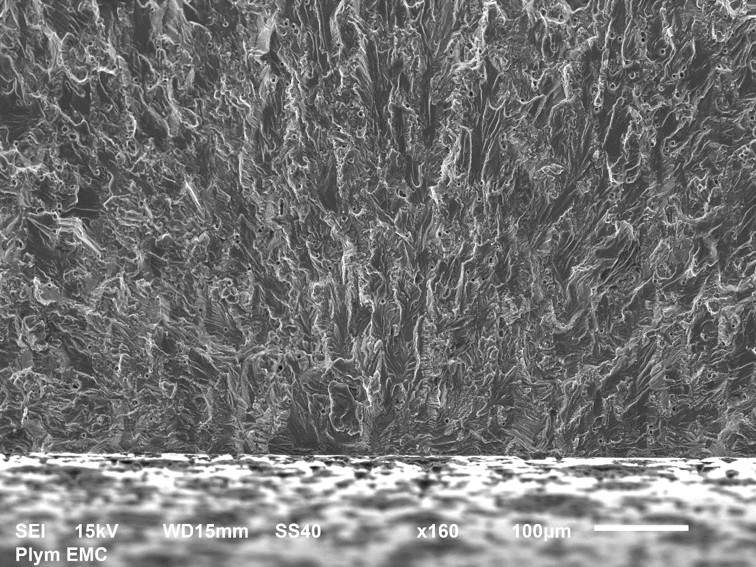
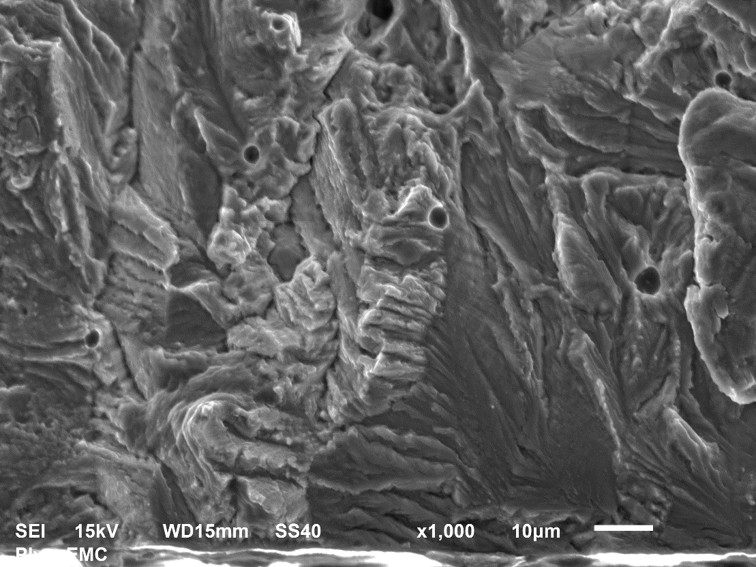
Picture1The picture above shows the fracture surface of a thin bar of aluminium alloy that had a circular hole through the middle, like the peep-hole in a front door. The photograph was taken in a Scanning Electron Microscope (SEM) at x160 magnification. There is a scale bar in the bottom right corner showing a length of 100 microns. We are looking approximately in the longitudinal direction, which was the direction of loading, and across the photograph from left to right corresponds to the direction you would look through the hole. The lower one third of the picture shows the machined surface of the hole cut or machined by the drill. The top two-thirds shows the surface created by the fatigue crack as it extended incrementally with each cycle of load. The crack started from edge of the machined surface approximately on the vertical centre-line of the picture. I can tell this because all of the features in the texture of the fracture surface point towards this point because the failure radiated out from this location. The picture below shows the crack initiation area at x1000 magnification. It is a small area at interface with hole above the letters ‘SS40’ in the top photograph; this should be enough to let you identify the common features but the interpretation of these images requires significant skill.

Fractography is the forensic study of failure surfaces such as this to establish the cause of failure. In this example, the hole in aluminium bar ensured that it will always fail with cyclic loading through the growth of a crack from somewhere around the hole. The textured form of the fracture surface occurs because the material is not homogeneous at this scale but made up of small grains. The failure of each grain is influenced by its orientation to the loading which results in the multi-faceted surface in the photographs.

I made the photographs the focus of this post because I thought they are interesting, but may be that’s because I’m an engineer, and because they are a tiny part in a fundamental research programme on which I have been spending a significant portion of my time. A goal of programme is to understand how to use these materials to build more energy-efficient structures that are cheaper and last longer without failing by, for example, fatigue.

More details:

The bar was 1.6mm thick and 38mm wide in the transverse direction and made from 2024-T3 Aluminium alloy. The hole diameter was 6.36mm. A tension load was repeatedly applied and removed in the longitudinal direction which caused the initiation and growth of a fatigue crack from the hole that after many cycles of loading led to the bar breaking in half along a plane perpendicular to the load direction. The pictures were taken at the University of Plymouth by Khurram Amjad with the assistance of Peter Bond and Roy Moate using a JEOL JSM-6610LV.

x1000

Happiness is …engineering

164-6499_IMGCreativity, which is an important component of problem-solving, has been associated with workplace success, healthy psychological functioning and the maintenance of loving relationships [see my post entitled ‘Love an Engineer’ on September 24th, 2014].  Engineering is all about creative problem-solving so it should come as no surprise that engineering was rated as the happiest job in a recent survey [see last week’s post].

However, I would like to offer an alternative formula for happiness. According to Timothy Egan in the International NYT on May 16-17th, 2015 when Pope Francis was asked about his secret to happiness he said, ‘Slow down. Take time off. Live and let live. Don’t proselytise. Work for peace. Work at a job that offers basic human dignity. Don’t hold on to negative feelings. Move calmly through life. Enjoy art, books and playfulness.’

This sounds like a pretty good formula to me. As engineers, while we are enjoying art and books we can take inspiration from art and nature.

Sources:

Martin L & Schwartz D, 2014, A pragmatic perspective on visual representation and creative thinking, Visual Studies, 29(1):80-93.

Egan T, The pope and the art of joy. International New York Times, 16-17th May, 2015.

Choosing a career is like going shopping

WIN_20150616_121335When we go shopping many of us like to try things out and think about when we will use them, or wear them if they are clothes.  Susan Scurlock made this analogy at the Annual Congress of the UK Engineering Professors’ Council in April 2015 when she was talking about keeping children connected to engineering from the playroom floor to a career [see last week’s posting entitled ‘Everyone is born an engineer’].  It focusses attention on the important issue that if we want to attract young people into the engineering profession we have to let them try it out and we also have to offer an enticing prospect.

This might be obvious but we need something attractive to offer. And here, we have a problem because our male-dominated profession has created courses that appear boring and uninspiring to many in society.  This was one of the premises of a National Science Foundation project in the USA that I was involved in which looked at options for change in the engineering curriculum at university.   The main problem is not conceiving imaginative effective changes but persuading colleagues to implement these changes. It can work and there are shining examples such as those programmes with a focus on reducing global poverty and inequality at UC Berkeley and other enlightened institutions which were described by Sarah Mazzetti recently in the New York Times.

We have another big selling point that we tend to keep quiet about. Engineering is the happiest job in the world according to analysis by the Guardian newspaper on April 8th, 2015.

For more on the results of that NSF project see:

Busch-Vishniac, I., Kibler, T., Campbell, P.B., Patterson, E.A., Guillaume, D., Jarosz, J., Chassapis, C., Emery, A., Ellis, G., Whitworth, H., Metz, S., Brainard, S., Ray, P., 2011, Deconstructing Engineering Education Programmes: The DEEP Project to reform the mechanical engineering curriculum, European J Engng Education, 36(3):269-283.

Patterson, E.A., Campbell, P.B., Busch-Vishniac, I., Guillaume, D.W., 2011, The effect of context on student engagement in engineering, European J. Engng Education, 36(3):211-224.