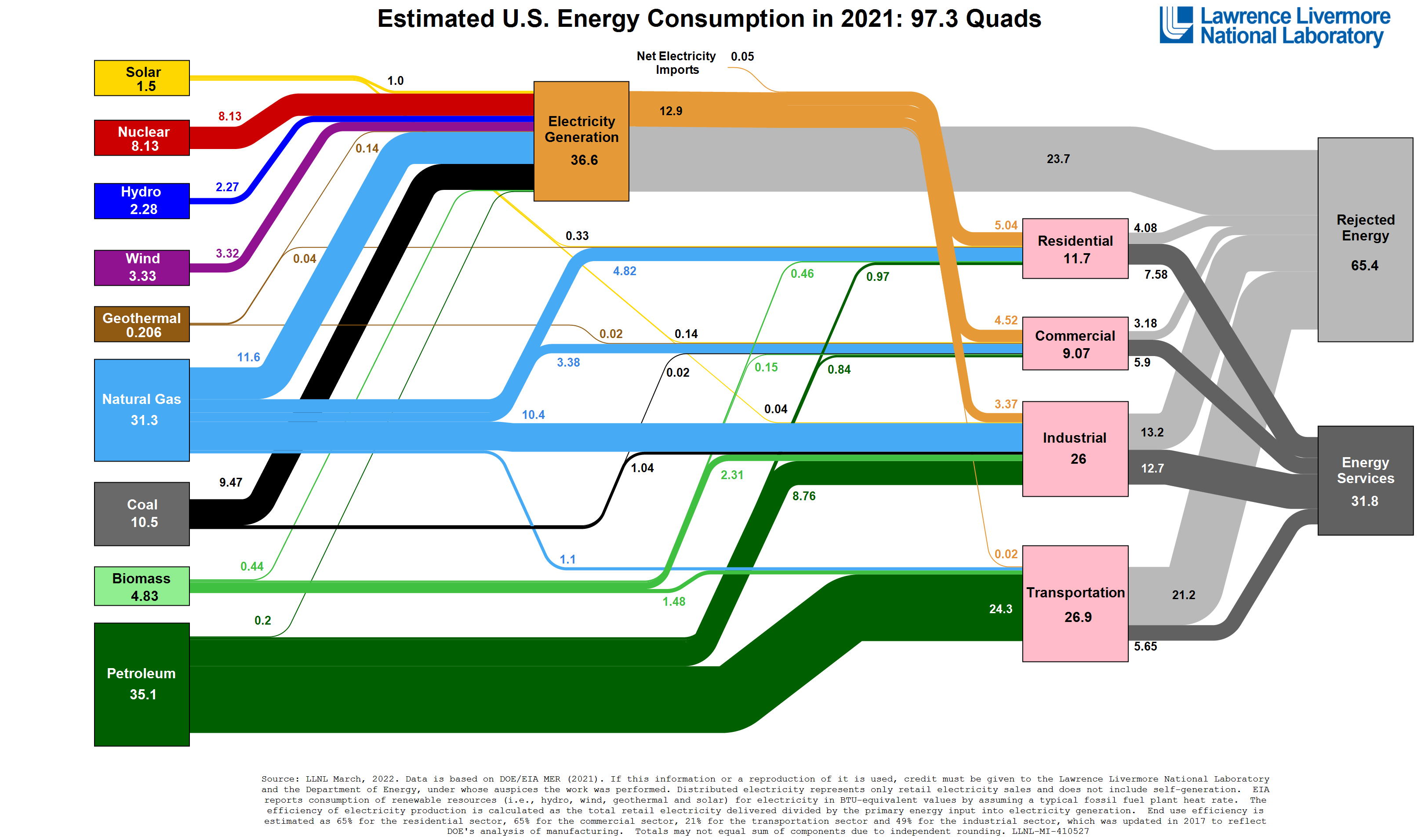
I like a good infographic and this one showing annual energy flows for a country is one of my favourites [see ‘Energy blending’ on May 22nd 2013]. Some governments produce them annually. The image shows the latest one for the UK [2021]. It makes interesting but perhaps depressing reading. Transportation using fossil fuels accounts for 31% (41.6/134.1 million tonnes oil equivalent) of the UK energy consumption while electricity output accounts for only 21% (28.6/134.1 million tonnes oil equivalent). This implies that if all vehicles were powered by electricity then the output of our power stations would need to increase to 70.2 million tonnes oil equivalent or between two- and three-fold (excluding conversion & transmission losses). You can perform a similar analysis for the USA [see 2021 Energy flow chart from LLNL]. Fossil-fuelled transportation accounted for 25% (24.3/97.3 Quads) and electricity output 13% (12.9/97.3 Quads) so converting all transportation to be electrically powered requires a three-fold increase in electrical output from power stations. It is more difficult to find equivalent data for Japan; however, in 2014 [see Energy flow chart from I2CNER Kyushu University] fossil-fuelled transportation accounted for 32% (3.03/9.52 EJ) and electricity output 38% (3.66/9.52 EJ) so converting all transportation to be electrically powered requires a two-fold increase in electrical output from power stations. None of the above takes account of space heating mainly via fossil fuel or that many existing power stations are fossil-fuelled and need to be replaced in order to achieve net zero carbon emissions. Hence, the required scale of construction of power stations using renewable sources, including nuclear, solar and wind, is enormous and in most countries it is barely discussed let alone planned or started; leading to the conclusion that there is little chance of achieving net zero carbon emissions by 2050 as called for by the Paris agreement.
Tag Archives: energy
Immeasurable productivity?
This is the second in a series of ‘reprints’ from my archive of posts. I will be back with new posts in a few weeks refreshed after my vacation. This post was first published in November 2013 under the title ‘Productive cheating‘.
I cut out a Dilbert cartoon from the New York Times a few weeks ago that I found amusing and shared it with my new Head of School. Dilbert informs his boss that he will be taking advantage of the new unlimited vacation policy by being away for 200 days in the coming year but will still double his productivity. His boss replies that there is no way to measure productivity for engineers.
Of course, bosses are very interested in measuring productivity and marketing executives like to brag about the productivity or efficiency of whatever it is they are selling. Engineers know that it is easy to cheat on measures of productivity and efficiency, for instance, by carefully drawing the boundaries of the system to exclude some inputs or some wasteful outputs [see my post on ‘Drawing Boundaries’ on December 19th, 2012 ]. So claims of productivity or efficiency that sound too good to be true probably aren’t what they seem.
Also in the New York Times [on October 15th, 2013] Mark Bittman discussed the productivity of the two food production systems found in the world, i.e. industrial agriculture and one based on small landholders, what the ETC group refers to as peasant food webs. He reports that the industrial food chain uses 70% of agricultural resources to provide 30% of the world’s food while peasant farming produces the remaining 70% with 30% of the resources. The issue is not that industrial agriculture’s claims for productivity in terms of yields per acre are wrong but that the industry measures the wrong quantity. Efficiency is defined as desired output divided by required input [see my post entitled ‘National efficiency‘ on May 29th, 2013]. In this case the required output is people fed not crop yield and a huge percentage of the yield from industrial agriculture never makes to people’s mouths [see my post entitled ‘Food waste’ on January 23rd, 2013].
Sources:
http://www.nytimes.com/2013/10/15/opinion/how-to-feed-the-world.html?ref=markbittman&_r=0
http://www.etcgroup.org/content/poster-who-will-feed-us-industrial-food-chain-or-peasant-food-webs
Storm in a computer
As part of my undergraduate course on thermodynamics [see ‘Change in focus’ on October 5th, 2022) and in my MOOC on Thermodynamics in Everyday Life [See ‘Engaging learners on-line‘ on May 25th, 2016], I used to ask students to read Chapter 1 ‘The Storm in the Computer’ from Philosophy and Simulation: The Emergence of Synthetic Reason by Manuel Delanda. It is a mind-stretching read and I recommended that students read it at least twice in order to appreciate its messages. To support their learning, I provided them with a précis of the chapter that is reproduced below in a slightly modified form.
At the start of the chapter, the simplest emergent properties, such as the temperature and pressure of a body of water in a container, are discussed [see ‘Emergent properties’ on September 16th, 2015]. These properties are described as emergent because they are not the property of a single component of the system, that is individual water molecules but are features of the system as a whole. They arise from an objective averaging process for the billions of molecules of water in the container. The discussion is extended to two bodies of water, one hot and one cold brought into contact within one another. An average temperature will emerge with a redistribution of molecules to create a less ordered state. The spontaneous flow of energy, as temperature differences cancel themselves, is identified as an important driver or capability, especially when the hot body is continually refreshed by a fire, for instance. Engineers harness energy gradients or differences and the resultant energy flow to do useful work, for instance in turbines.
However, Delanda does not deviate to discuss how engineers exploit energy gradients. Instead he identifies the spontaneous flow of molecules, as they self-organise across an energy gradient, as the driver of circulatory flows in the oceans and atmosphere, known as convection cells. Five to eight convections cells can merge in the atmosphere to form a thunderstorm. In thunderstorms, when the rising water vapour becomes rain, the phase transition from vapour to liquid releases latent heat or energy that helps sustain the storm system. At the same time, gradients in electrical charge between the upper and lower sections of the storm generate lightening.
Delanda highlights that emergent properties can be established by elucidating the mechanisms that produce them at one scale and these emergent properties can become the components of a phenomenon at a much larger scale. This allows scientists and engineers to construct models that take for granted the existence of emergent properties at one scale to explain behaviour at another, which is called ‘mechanism-independence’. For example, it is unnecessary to model molecular movement to predict heat transfer. These ideas allow simulations to replicate behaviour at the system level without the need for high-fidelity representations at all scales. The art of modelling is the ability to decide what changes do, and what changes do not, make a difference, i.e., what to include and exclude.
Source:
Manuel Delanda Philosophy and Simulation: The Emergence of Synthetic Reason, Continuum, London, 2011.
Image: Painting by Sarah Evans owned by the author.
Energy transformations
I mentioned a couple of weeks ago that I am teaching thermodynamics at the moment [see ‘Conversations about engineering over dinner and a haircut‘ on February 16th, 2022]. I am using a blended approach [see ‘ Blended learning environments‘ on November 14th, 2018] to deliver the module to more than 300 first year undergraduate students with one hour in the lecture theatre each week while the students follow the components of the MOOC I developed some years ago [see ‘Free: Energy! Thermodynamics in Everyday Life‘ on November 11th, 2015, and ‘Engaging learners online‘ on May 25th, 2016]. I have found that first year undergraduates are reluctant to participate in the online discussions that are part of the MOOC and so last year I asked them to discuss each topic in small groups with their academic tutor. I got some very positive feedback from tutors who had interesting and stimulating discussions with their students. We are repeating the process again this year. The first discussion is about energy transformations: noting that energy is always conserved but constantly transformed into different forms, each student is asked to start from an energy state of their choice and to trace the transformations backwards until they can go no further. In the lecture preceding the discussion with their tutor I provide some examples for starting states, including breakfast cereal, a pole vaulter in mid-jump and a bullet train. I also describe the series of transformations from the Big Bang to tectonic plate movement: after the initial expansion caused by the Big Bang, the universe cooled sufficiently to allow the formation of sub-atomic particles followed by atoms of hydrogen and some helium and lithium that gravity caused to coalesce into clouds which became the early stars, or solar nebula. A crust formed on the solar nebula which broke away to form planets. Our planet has a molten core with temperatures varying from 4,400 to 6000 degrees Celsius, compared to around 5,500 degrees on the surface of the sun. The temperature variation in the Earth’s core cause thermal currents which drive the movement of tectonic plates and so on [see ‘The hills are shadows, and they flow from form to form, and nothing stands‘, on February 9th, 2022]. Most chains of energy transformation lead backwards to the sun and forwards to dissipation of energy into some unusable form which we might call ‘entropy’ [see ‘Life-time battle‘ on January 30th, 2013].