Tag Archives: education

Thermodynamics labs as homework

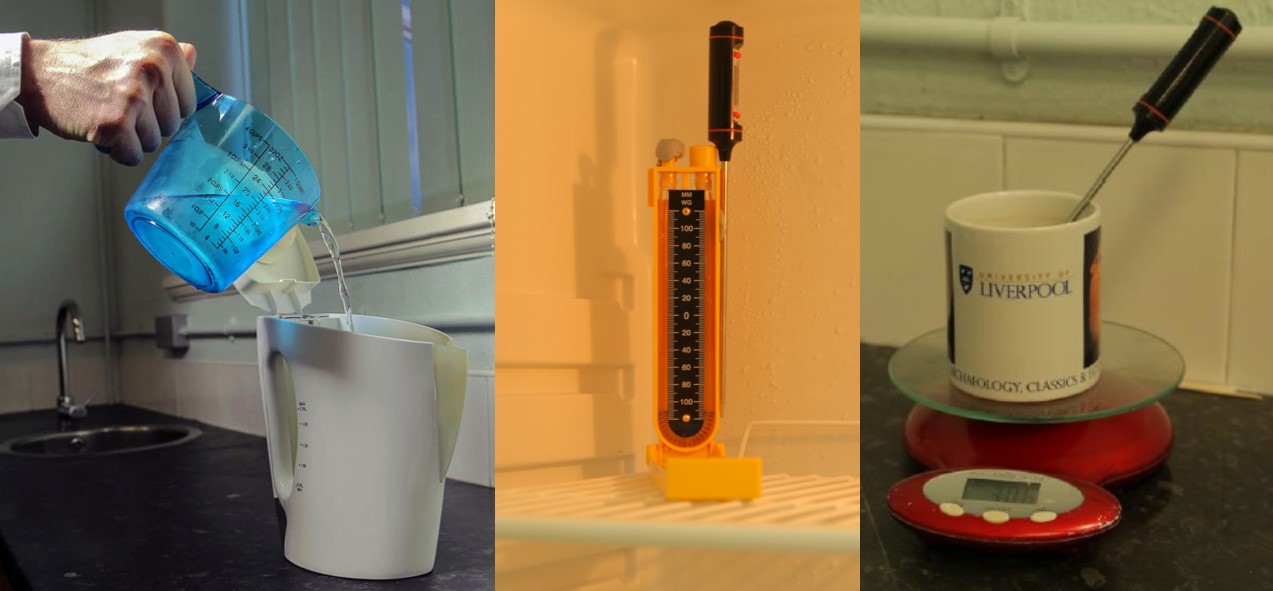
Many of my academic colleagues are thinking about modifying their undergraduate teaching for next academic year so that they are more resilient to coronavirus.  Laboratory classes present particular challenges when access and density of occupation are restricted.  However, if the purpose of laboratory classes is to allow students to experience phenomena, to enhance understanding, to develop intuition and to acquire skills in using equipment, making measurements and analysing data, then I believe this can achieved using practical exercises for homework.  I created practical exercises, that can be performed in a kitchen at home, as part of a Massive Open Online Course (MOOC) about thermodynamics [See ‘Engaging learners on-line‘ on May 25th, 2016].  I have used the same exercises as part of my first year undergraduate module on thermodynamics for the past four years with similar levels of participation to those experienced by my colleagues who run traditional laboratory classes [see ‘Laboratory classes thirty years on‘ on May 15th, 2019].  I have had a number of enquiries from colleagues in other universities about these practical exercises and so I have decided to make the instruction sheets available to all.  Please feel free to use them to support your teaching.

The versions below are from the MOOC entitled ‘Energy: Thermodynamics in Everyday Life‘ and provide information about where to obtain the small amount of equipment needed, and hence are self-contained.  Although the equipment only costs about £20, at the University of Liverpool, we lend our students a small bag of equipment containing a measuring beaker, a digital thermometer, a plug-in power meter and a plumber’s manometer.  I also use a slightly different version of these instructions sheets that provide information about ‘lab’ reports that students must submit as part of their coursework.

I reported on the initial introduction of blended learning and these practical exercises in Patterson EA, 2019, Using everyday examples to engage learners on a massive open online course, IJ Mechanical Engineering Education, 0306419018818551.

Instruction sheets for thermodynamics practical exercises as homework:

Energy balance using the first law of thermodynamics | Efficiency of a kettle

Ideal gas behaviour | Estimating the value of absolute zero

Overall heat transfer coefficient | Heat losses from a coffee cup & glass


Meta-knowledge: knowledge about knowledge

As engineers, we like to draw simple diagrams of the systems that we are attempting to analyse because most of us are pictorial problem-solvers and recording the key elements of a problem in a sketch helps us to identify the important issues and select an appropriate solution procedure [see ‘Meta-representational competence’ on May 13th, 2015].  Of course, these simple representations can be misleading if we omit parameters or features that dominate the behaviour of the system; so, there is considerable skill in idealising a system so that the analysis is tractable, i.e. can be solved.  Students find it especially difficult to acquire these skills [see ‘Learning problem-solving skills‘ on October 24th, 2018] and many appear to avoid drawing a meaningful sketch even when examinations marks are allocated to it [see ‘Depressed by exams‘ on January 31st, 2018].  Of course, in thermodynamics it is complicated by the entropy of the system being reduced when we omit parameters in order to idealise the system; because with fewer parameters to describe the system there are fewer microstates in which the system can exist and, hence according to Boltzmann, the entropy will be lower [see ‘Entropy on the brain‘ on November 29th, 2017].  Perhaps this is the inverse of realising that we understand less as we know more.  In other words, as our knowledge grows it reveals to us that there is more to know and understand than we can ever hope to comprehend [see ‘Expanding universe‘ on February 7th, 2018]. Is that the second law of thermodynamics at work again, creating more disorder to counter the small amount of order achieved in your brain?

Image: Sketch made during an example class

Feedback is a gift

In academic life you get used to receiving feedback, including plenty of negative feedback when your grant proposal is declined by a funding agency or your manuscript is rejected by the editor of a journal.  We are also subject to annual performance reviews which can be difficult if all of your proposals and manuscripts have been rejected.  So, how should we respond to negative feedback?

The Roman philosopher, Marcus Aurelius is credited with the saying ‘Everything we hear is an opinion, not a fact’, which perhaps implies we should not take the negative feedback too seriously, or at least we should look for some evidence.

Tasha Eurich has suggested we should mine it for insight and harness it for improvement but without incurring collateral damage to your self-confidence.  He recommends a five-point approach, based on empirical evidence:

  1. Don’t rush to react
  2. Gather more evidence
  3. Find a harbinger
  4. Don’t be a lonely martyr but engage in dialogue
  5. Remember that change is not the only option; you can accept your weaknesses, share them and work around them.

If you are the one giving the negative feedback then it is worth remembering the stages of response to bad news are denial, anger, bargaining, depression and acceptance.  Hopefully, the feedback will not induce the full range of response but, when it does, you should not be surprised.

See earlier posts on giving [‘Feedback on feedback‘ on June 28th, 2017] and receiving student feedback [‘Deep long-term learning‘ on April 28th, 2018].


Source: Tasha Eurich, ‘The right way to respond to negative feedback’, HBR, May 31st, 2018.

Laboratory classes thirty years on

Henry Lea Laboratory, The University of Sheffield in the 1960s

I have happy memories of teaching laboratory classes at the University of Sheffield in the mid 1980s and 1990s in the Henry Lea Laboratory.  The laboratory was crammed full of equipment for experiments in mechanics of materials.  We conducted the practical classes on a limited selection of test machines that stood around a set of benches in the centre of the laboratory on which were a series of bench-top experiments for undergraduates.  The outer reaches of the laboratory were packed with test machines of various shapes and sizes that were the domain of the research students and staff.  So, undergraduate students were privileged to conduct their laboratory classes surrounded by research activity – this was one of the advantages of attending a research-intensive university to study engineering.  However, this is not the experience that modern students gain from laboratory classes.  Sheffield, like Liverpool, and many other research-intensive universities has purpose-built teaching laboratories that provide modern spacious facilities for teaching and learning but also segregate undergraduates from the research business of the university.  In the UK, the increase in student numbers, as we moved towards 50% participation in higher education, was probably a prime driver for the design and construction of these facilities.  However, often the growth in student numbers exceeds the planned capacity of the teaching laboratories and the student experience is reduced by being in a group of five or six with only one or two of them being able to get hands-on experience at the same time.  To overcome this problem, I have used practical exercises as homework assignments that can be performed in the kitchen at home by first year students.  These were initially designed for the MOOC on thermodynamics that I developed a few years ago but they work equally well for undergraduate students and allow individuals to gain experience of conducting a simple experiment, recording and processing data, and write a short report about their findings [see post on ‘Blending learning environments‘ on November 14th, 2018 and ‘Slow down time to think [about strain energy]‘ on March 8th, 2017].  I have found that the participation rate is about the same as for traditional laboratory classes but different because students can learn from their mistakes in private and acquire some experimental skills [1].  However, it is a long way from conducting labs for small cohorts in a laboratory where world-class research is in progress.

Reference:

1. Patterson EA, Using everyday examples to engage learners on a massive open online course, IJ Mechanical Engineering Education, doi: 10.1177/0306419018818551, 2018.