Tag Archives: design

Brave New World

OLYMPUS DIGITAL CAMERATerm has started, and our students are preparing for end-of-semester examinations; so, I suspect that they would welcome the opportunity to deploy the sleeping-learning that Aldous Huxley envisaged in his ‘Brave New World’ of 2540.  In the brave new world of digital engineering, some engineers are attempting to conceive of a world in which experiments have become obsolete because we can rely on computational modelling to simulate engineering systems.  This ambitious goal is a driver for the MOTIVATE project [see my post entitled ‘Getting smarter‘ on June 21st, 2017]; an EU-project that kicked-off about six months ago and was the subject of a brainstorming session in the Red Deer in Sheffield last September [see my post entitled ‘Anything other than lager, stout or porter!‘ on September 6th, 2017.  The project has its own website now at www.engineeringvalidation.org

A world without experiments is almost unimaginable for engineers whose education and training is deeply rooted in empiricism, which is the philosophical approach that requires assumptions, models and theories to be tested against observations from the real-world before they can be accepted.  In the MOTIVATE project, we are thinking about ways in which fewer experiments can provide more and better measured data for the validation of computational models of engineering systems.   In December, under the auspices of the project, experts from academia, industry and national labs from across Europe met near Bristol and debated how to reshape the traditional flow-chart used in the validation of engineering models, which places equal weight on experiments and computational models [see ASME V&V 10-2006 Figure 2].  In a smaller follow-up meeting in Zurich, just before Christmas [see my post ‘A reflection of existentialism‘ on December 20th, 2017], we blended the ideas from the Bristol session into a new flow-chart that could lead to the validation of some engineering systems without conducting experiments in parallel.  This is not perhaps as radical as it sounds because this happens already for some evolutionary designs, especially if they are not safety-critical.  Nevertheless, if we are to achieve the paradigm shift towards the new digital world, then we will have to convince the wider engineering community about our novel approach through demonstrations of its successful application, which sounds like empiricism again!  More on that in future updates.

Image by Erwin Hack: Coffee and pastries awaiting technical experts debating behind the closed door.
Airborne urban mobility

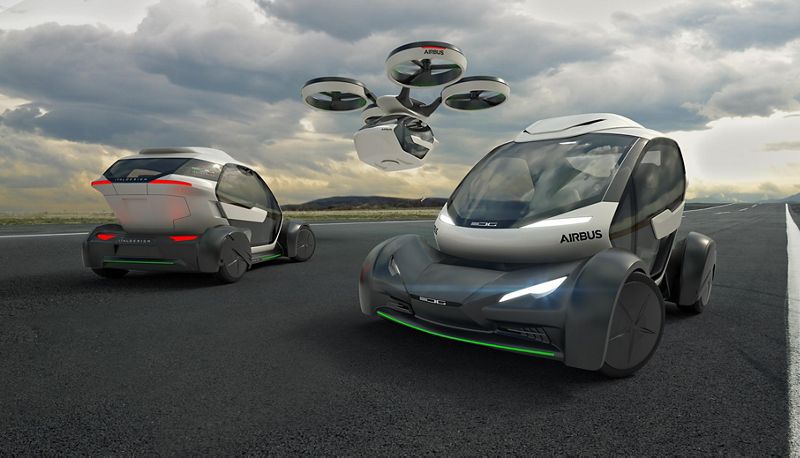
Pop.Up_copyright Italdesign 2

At the Airbus PhD workshop that I attended a couple of weeks ago [see my post entitled Making Engineering Work for Society on September 13th 2017], Axel Flaig, Head of Airbus Research and Technology, gave us an excellent opening presentation describing their vision for the future.  Besides their vision for the next generation of passenger aircraft with reductions in CO2, NOx and noise emissions of 75%, 90% and 65% respectively against 2000 levels by 2050, they are also looking at urban air mobility.  We have 55 megacities [cities with a population of more than 10 million] and it is expected that this will increase to 93 by 2035 [see my post entitled ‘Hurrying Feet in Crowded Camps’ on August 16th, 2017].  These megacities are characterized by congestion and time-wasted moving around them; so, Airbus is working on designs for intra-city transport that takes us off the roads and into the air.  Perhaps the most exciting is the electric Pop.up concept that is being developed with Italdesign.  But, Airbus are beyond concepts: they have a demonstrator single-seater, self-pilot vehicle, the Vahana that will fly in 2017 and a multi-passenger demonstrator scheduled to fly in 2018.

Soon, we will have to look left, right and up before we cross the road, or maybe nobody will walk anywhere – though that would be bad news for creative thinking [see my post on ‘Gone Walking’ on 19th April 2017], amongst other things!


Image from http://www.airbus.com/newsroom/press-releases/en/2017/03/ITALDESIGN-AND-AIRBUS-UNVEIL-POPUP.html where there is also a video.

Making engineering work for society

Last week I attended a one-day workshop for PhD students sponsored by Airbus.  Most of the students produced a poster describing their research; and a dozen brave ones gave a three-minute presentation on their PhD thesis.  It’s a challenge to describe three years of research in three minutes to an audience that are not experts in your specialist field.  However, the result was an exciting and stimulating morning covering subjects as diverse as multidisciplinary design optimization and cognitive sources of ethical behaviour in business.  The latter was presented by Solenne Avet who was the only woman amongst the twelve three-minute thesis presenters.  The gender diversity was better for the other, longer talks with two women out of six presenters.  Interestingly, the female PhD students were the only ones tackling the interaction between engineering and human behaviour, including system-human communication, collective engineering work and innovation processes, which I have suggested is essential for viable engineering solutions to our global and societal challenges [see my post ‘Re-engineering engineering’ on August 30th, 2017].  This population sample is too small to make a reliable generalization; however, it suggests that a gender-balanced engineering profession would be more likely to succeed in making substantial contributions to our current challenges [see UN Global Issues Overview].

Image from https://members.architecture.com/custom/bespoke/directory/view_images.asp?id=257460&type=O&dir=1&CaseRef=140776&imgName=43535_100017586_1.jpg

The red crane

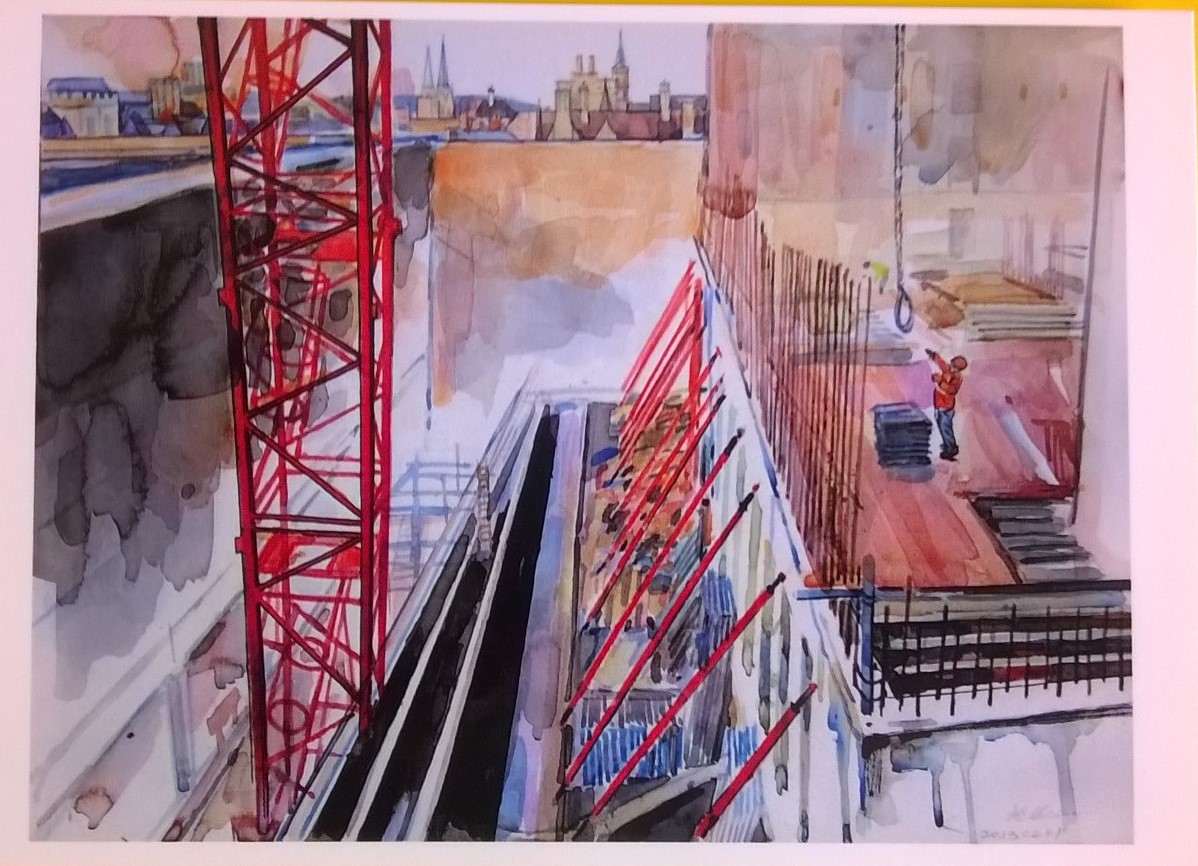
The red crane by Weimen He

One of my favourite institutions to visit is the Bodleian’s Weston Library in Oxford.  I have written before about their rotating exhibition in the Treasury of unique books and manuscripts from their collection [see my post entitled ‘Pope and Austen‘ on September 9th, 2015].  A recent visit did not disappoint and included one of John Le Carré’s manuscripts showing his extensive editing as well as early texts written on birch bark.  However, it was in the shop that something really caught my eye.  The fusion of art and engineering in a postcard depicting a painting called ‘The red crane’, by artist in residence, Dr Weimen He, capturing the moments in time during the refurbishment of the library.  This level of fusion is rare in my experience and perhaps the ethos that created it is one of the reasons the Weston Library is such a pleasure to visit.

The Roman architect, Vitruvius identified the three principles of good structural design to be ‘firmitas, utilitas, venustas’ or durability, utility and beauty.  Too often utility, including value for money, trumps beauty and shortens horizons for durability; so that little is contributed to our culture and nothing worthwhile will be left for future generations.

BTW there is a very large bookshop next door to the Weston Library and I couldn’t resist buying ‘The Story of a Brief Marriage‘ by Anuk Arudpragasam.  It’s a beautiful novel of consciousness about love and war.