Tag Archives: creativity

Getting it wrong

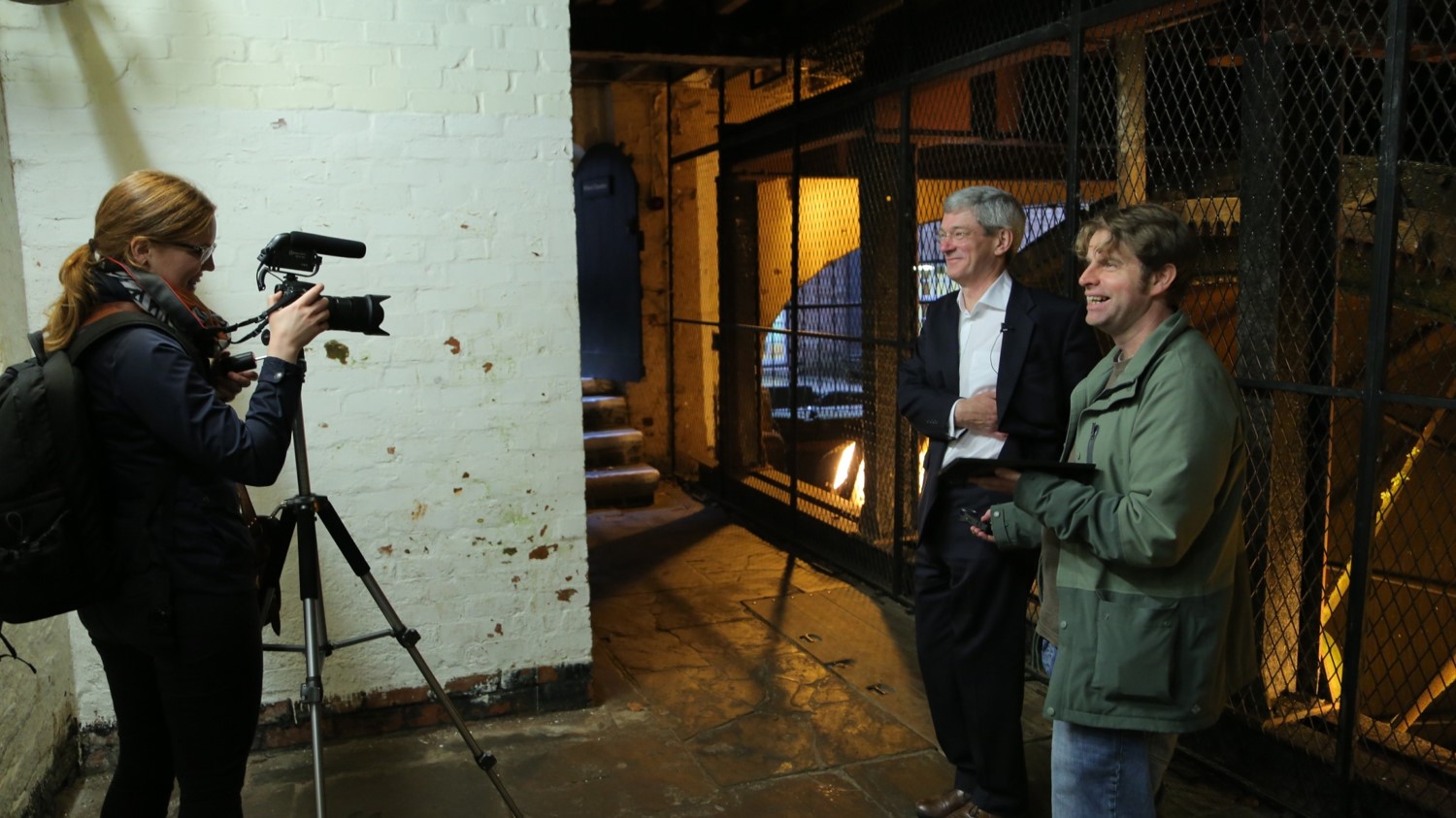
Filming for the MOOC Energy: Thermodynamics in Everyday Life

Last week’s post was stimulated by my realisation that I had made a mistake in a lecture [see ‘Amply sufficiency of solar energy?‘ on October 25th, 2017]. During the lecture, something triggered a doubt about a piece of information that I used in talking about the world as a thermodynamic system. It caused me to do some more research on the topic afterwards which led to the blog post.  The students know this already, because I sent an email to them as the post was published.  It was not an error that impacted on the fundamental understanding of the thermodynamic principles, which is fortunate because we are at a point in the course where students are struggling to understand and apply the principles to problems.  This is a normal process from my perspective but rather challenging and uncomfortable for many students.  They are developing creative problem-solving skills – becoming comfortable with the slow and uncertain process of creating representations and exploring the space of possible solutions [Martin & Schwartz, 2009 & 2014].  This takes extensive practice and most students want a quick fix: usually looking at a worked solution, which might induce the feeling that some thermodynamics has been understood but does nothing for problem-solving skills [see my post on ‘Meta-representational competence‘ on May 13th, 2015].

Engineers don’t like to be wrong [see my post on ‘Engineers are slow, error-prone‘ on April 29th, 2014].  The reliability of our solutions and designs is a critical ingredient in the social trust of engineering [Madhaven, 2016].  So, not getting it wrong is deeply embedded in the psyche of most engineers.  It is difficult to persuade most engineers to appear in front of a camera because we worry, not just about not getting it wrong, but about telling the whole truth.  The whole truth is often inconvenient for those that want to sensationalize issues for their own purposes, such as to sell news or gain votes, and this approach is anathema to many engineers.  The truth is also often complicated and nuanced, which can render an engineer’s explanation cognitively less attractive than a simple myth, or in other words less interesting and boring.  Unfortunately, people mainly pass on information that will cause an emotional response in the recipient, which is perhaps why engineering blogs are not as widely read as many others! [Lewandowsky et al 2012].


This week’s lecture was about energy flows, and heat transfer in particular; so, the following posts from the archive might be interest: ‘On the beach‘ on July 24th, 2013, ‘Noise transfer‘ on April 3rd, 2013, and ‘Stimulating students with caffeine‘ on December 17th, 2014

Sources:

Martin L & Schwartz DL, Prospective adaptation in the use of external representations, Cognition and Instruction, 27(4):370-400, 2009.

Martin L & Schwartz DL, A pragmatic perspective on visual representation and creative thinking, Visual Studies, 29(1):80-93, 2014.

Madhaven G, Think like an engineer, London: One World Publications, 2016.

Lewandowsky S, Ecker UKH, Seifert CM, Schwarz N & Cook J, Misinformation and its correction: continued influence and successful debiasing, Psychological Science in the Public Interest, 13(3):106-131, 2012.
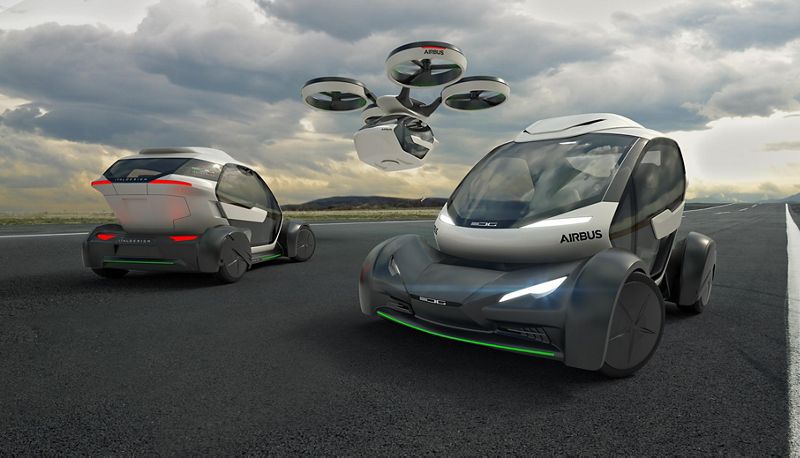
Airborne urban mobility

Pop.Up_copyright Italdesign 2

At the Airbus PhD workshop that I attended a couple of weeks ago [see my post entitled Making Engineering Work for Society on September 13th 2017], Axel Flaig, Head of Airbus Research and Technology, gave us an excellent opening presentation describing their vision for the future.  Besides their vision for the next generation of passenger aircraft with reductions in CO2, NOx and noise emissions of 75%, 90% and 65% respectively against 2000 levels by 2050, they are also looking at urban air mobility.  We have 55 megacities [cities with a population of more than 10 million] and it is expected that this will increase to 93 by 2035 [see my post entitled ‘Hurrying Feet in Crowded Camps’ on August 16th, 2017].  These megacities are characterized by congestion and time-wasted moving around them; so, Airbus is working on designs for intra-city transport that takes us off the roads and into the air.  Perhaps the most exciting is the electric Pop.up concept that is being developed with Italdesign.  But, Airbus are beyond concepts: they have a demonstrator single-seater, self-pilot vehicle, the Vahana that will fly in 2017 and a multi-passenger demonstrator scheduled to fly in 2018.

Soon, we will have to look left, right and up before we cross the road, or maybe nobody will walk anywhere – though that would be bad news for creative thinking [see my post on ‘Gone Walking’ on 19th April 2017], amongst other things!


Image from http://www.airbus.com/newsroom/press-releases/en/2017/03/ITALDESIGN-AND-AIRBUS-UNVEIL-POPUP.html where there is also a video.

Blinded by the light

It has become a habit during our summer vacation to read the novels short-listed for Bailey’s Women’s Prize for Fiction.  Unusually this year, we were not only unanimous in our choice of the best novel but we also agreed with the judges and selected the ‘The Power‘ by Naomi Alderman.  In another of the books, Do Not Say We Have Nothing by Madeleine Thien, a Chinese composer called Sparrow thinks ‘about the quality of sunshine, that is, how daylight wipes away the stars and planets, making them invisible to human eyes, might daylight be a form of blindness? Could it be that sound was also be a form of deafness? If so, what was silence?’.  I felt some resonance between these thoughts and John Hull’s writings on blindness and my earlier blog posting on ‘Listening with your eyes shut‘ [on May 31st, 2017].  In our everyday life, we are bombarded with sounds from people living around us, from traffic and from devices in our homes and places of work.  We rarely experience silence; however, when we do, perhaps on holiday staying in a remote rural location, then a whole new set of sounds becomes apparent: waves breaking on the shore in the distance, the field mouse rooting around under the floorboards, or the noises of cattle enjoying the lush grass in the field next door.  Okay, so you have to be in the right place to hear these sounds of nature but you also need silence otherwise you are deaf to them, as Sparrow suggests.

The same is true for knowledge and understanding because our minds have finite capacity [see my post entitled ‘Silence is golden‘ on January 14th, 2014].  When you are bombarded with information and data it is easy to become overwhelmed and unable to structure the information in way that makes it useful or meaningful.  In our connected society, information has become like white noise, or daylight obscuring the stars and planets.  Information is blinding us to knowledge and understanding.  We need to aggressively filter the information flow in order to gain insight and knowledge.  We should switch off the digital devices, which bombard us with information constantly, to leave our minds free for conceptual and creative thinking because that’s one of the few tasks in which we can outperform the smartest machine [see my post entitled ‘Smart machines‘ on February 26th, 2014].

In a similar vein see: ‘Ideas from a balanced mind‘ on August 24th, 2016 and ‘Thinking out-of-the-skull‘ on March 18th, 2015.

The red crane

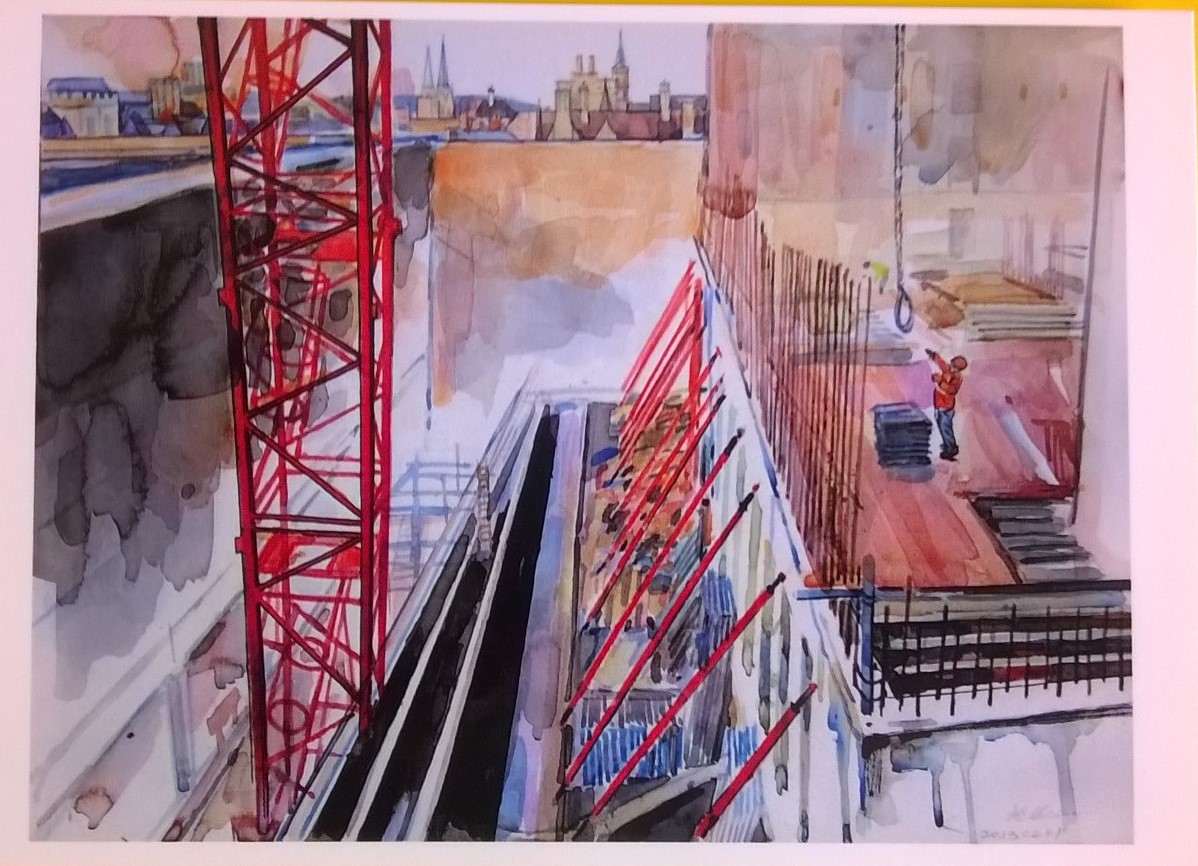
The red crane by Weimen He

One of my favourite institutions to visit is the Bodleian’s Weston Library in Oxford.  I have written before about their rotating exhibition in the Treasury of unique books and manuscripts from their collection [see my post entitled ‘Pope and Austen‘ on September 9th, 2015].  A recent visit did not disappoint and included one of John Le Carré’s manuscripts showing his extensive editing as well as early texts written on birch bark.  However, it was in the shop that something really caught my eye.  The fusion of art and engineering in a postcard depicting a painting called ‘The red crane’, by artist in residence, Dr Weimen He, capturing the moments in time during the refurbishment of the library.  This level of fusion is rare in my experience and perhaps the ethos that created it is one of the reasons the Weston Library is such a pleasure to visit.

The Roman architect, Vitruvius identified the three principles of good structural design to be ‘firmitas, utilitas, venustas’ or durability, utility and beauty.  Too often utility, including value for money, trumps beauty and shortens horizons for durability; so that little is contributed to our culture and nothing worthwhile will be left for future generations.

BTW there is a very large bookshop next door to the Weston Library and I couldn’t resist buying ‘The Story of a Brief Marriage‘ by Anuk Arudpragasam.  It’s a beautiful novel of consciousness about love and war.