Tag Archives: creativity

Thinking more clearly by writing weekly

In an echo of Henry Thoreau’s retreat to the woods around Walden pond, Sylvain Tesson escaped the ugliness of modern life and spent six months in a log cabin on the shore of Lake Baikal in Siberia.  He wanted to surround himself with silence in the wilderness.  He kept a diary ‘as a supplement to memory, to stave off forgetting’.  He describes how the act of writing ‘makes life fruitful’; how ‘the daily appointment with the blank page forces one … to listen harder, to think more clearly, to see more intently’.  I have similar feelings about writing a weekly post for this blog and being faced with a blank screen each week.  Sometimes it is a joy to order my thoughts and commit some of them to writing; other times it is a chore and a challenge to dream up something vaguely interesting to tell you.

BTW Teeson’s book was a pleasure to read and easier than Thoreau’s in my view.

References:

Sylvain Tesson, Consolations of the forest: alone in a cabin in the middle Taiga, London: Penguin Books, 2014.

Henry David Thoreau, Walden, London: Penguin Classics, 2016.

Compelling presentations

It used to be that you only had to compete with the view out of the window when you were talking to a group of people.  Now, you have to compete with the view of the world available through people’s mobile devices.  You know when your audience arrives and sets up their laptops that you have a challenge ahead of you.  A few of them might be planning to take notes using their laptop but most will be distracted by the constant flow of information delivered by email and messaging applications.  Of course, you can use the same technology to embellish your presentation and to hold their attention; but often the result is ‘death by Powerpoint’ and the audience retreats into their own worlds – doing their own thing.

There’s a nice quote from an interview with Eric Clapton in the San Diego Union Tribune (September 4th, 2005): ‘It’s very hard, so I try and make it as engaging as it can be. But you have to face the fact that, no matter how good it is, you can only hold their attention for a little while.‘  So, you have to plan you talk in small steps and to re-engage your audience at the start of each step.  There needs to be a narrative and the same rules apply as when writing [see post entitled ‘Reader, Reader, Reader’ on April 15th, 2015].  Powerpoint is not a requisite nor a substitute but preparation is essential.  As a group of undergraduate students told me during a recent visit to another university, they can easily spot the lecturers who prepare conscientiously and are worth listening to.

I am at a scientific conference this week where a wide range of speaking skills will be on display and I have my mobile devices with me to provide alternative stimulation.  The real value of the conference is the opportunity to interact with other researchers in a community of knowledge and for that we need shorter talks and more time for discussion.  But the mechanics of modern scientific conferences is a separate issue!


Image: view from lecture theatre on London campus where I taught science and technology leadership last year [see post entitled ‘Leadership is like shepherding‘ on May 10th, 2017].

Depressed by exams

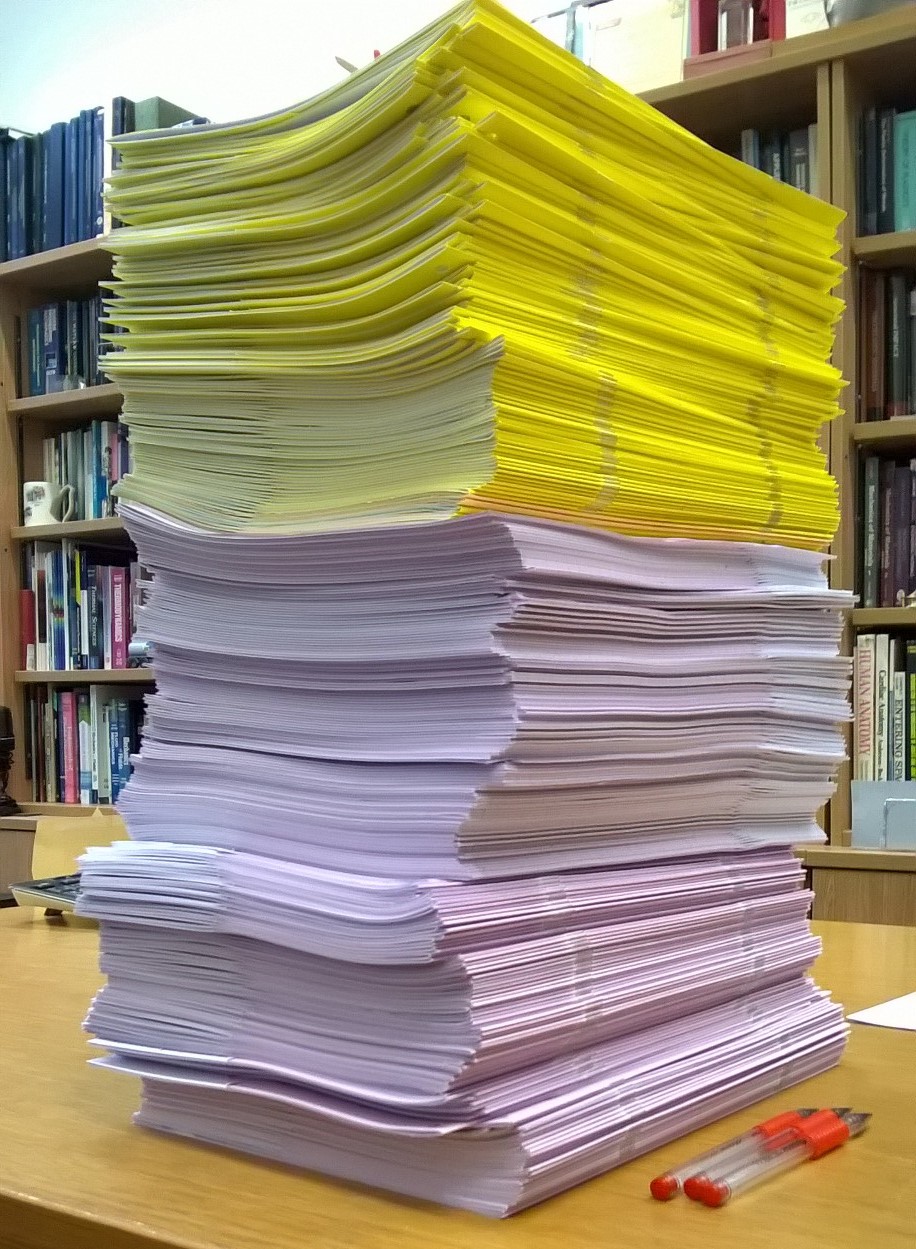
I am not feeling very creative this week, because I am in middle of marking examination scripts; so, this post is going to be short.  I have 20 days to grade at least 1100 questions and award a maximum of 28,400 marks – that’s a lot of decisions for my neurons to handle without being asked to find new ways to network and generate original thoughts for this blog [see my post on ‘Digital hive mind‘ on November 30th, 2016].

It is a depressing task discovering how little I have managed to teach students about thermodynamics, or maybe I should say, how little they have learned.  However, I suspect these feelings are a consequence of the asymmetry of my brain, which has many more sites capable of attributing blame and only one for assigning praise [see my post entitled ‘Happenstance, not engineering‘ on November 9th, 2016].  So, I tend to focus on the performance of the students at the lower end of the spectrum rather than the stars who spot the elegant solutions to the exam problems.

Sources:

Ngo L, Kelly M, Coutlee CG, Carter RM , Sinnott-Armstrong W & Huettel SA, Two distinct moral mechanisms for ascribing and denying intentionality, Scientific Reports, 5:17390, 2015.

Bruek H, Human brains are wired to blame rather than to praise, Fortune, December 4th 2015.

Not much change

A Happy and Prosperous New Year to all of my readers!

At this time of year, it is traditional in the media to review the previous year and comment on what lies ahead in the new year.  However, not much has changed in my blog during 2017: I wrote and published 52 posts that attracted about 20,000 views through the WordPress site, which is pretty much the same as 2016.  Although, there was a growth in readers via LinkedIn, Tumblr and Twitter.  This is not enough traffic to achieve a place in the UK’s Top 50 Blogs according to Vuelio, but then neither the title nor the content of this blog is designed to attract the mass-markets to which most of these high-volume sites appeal.  Instead, I suspect that I am writing for a small bubble of like-minded people [see my post ‘You’re all weird‘ on February 8th, 2017]; nevertheless, it would be nice to feel that the bubble will continue to expand.  Maybe the small face-lift will help though the Latin verse below will likely not help!

It is tempting at this point to ramble on further about the lack of interest in scholarship in modern society; however, to do so would be to follow a tradition that is at least 800 years old.  In the thirteenth century manuscript, Carmina Burana there is a poem called ‘Florebat olim studium’.  Its first lines are

Florebat olim studium

nunc vertitude in tedium,

iam scire diu viguit,

sed ludere prevaluit.


These translate as ‘Scholarship once flourished, now it is turned into boredom; for a long time knowledge was esteemed, but now playing is preferred.’  This seems to have been echoed by generations of professors and, as my editor says, is part of the human condition.

I read about the Carmina Burana in a beautiful book: ‘Meetings with Remarkable Manuscripts‘ by Christopher de Hamel who takes the reader on a series of visits to twelve of the most important medieval manuscripts starting with the sixth century Gospels of Saint Augustine in the library of Corpus Christi College, Cambridge and finishing with the sixteenth century Spinola Hours in the J. Paul Getty Museum, Los Angeles.  It is part history book tracing the advent of literacy in Western Europe from the sixth century, when only the clergy could read and write, through to start of printing when 30,000 titles were issued in the last fifty years of the fifteen century; and part travelogue as de Hamel describes his visits to the museums and libraries where the twelve manuscripts are preserved.  Book reviews are not a regular feature of this blog but this is a book worth reading that might not otherwise be on your list.

Image: from front cover of Meetings with Remarkable Manuscripts by Christopher de Hamel showing detail from the Morgan Beatus M644, folio 252v © The Morgan Library & Museum/Art Resource, NY/Scala, Florence.