Category Archives: energy science

Engaging learners on-line

Filming at Quarry Bank Mill

Filming at Quarry Bank Mill

The Everyday Engineering Examples page of this blog continue to be very popular.  More than 70 engineering schools in the USA have signed up to use this approach to teaching engineering science as part of the ENGAGE project.  The lesson plans on that page assist instructors to deliver traditional lectures that are engaging and effective.  Now, we have transferred the approach to online delivery in a MOOC that was designed to support undergraduate learning as well as to increase public engagement and understanding of engineering science.

The MOOC entitled ‘Energy: Thermodynamics in Everyday Life‘ was completed by more than 960 learners from about 35 countries who ranged in age from 13 to 78 years old with a correspondingly wide range of qualifications in terms of both subject and level.  I believe that this is the first MOOC to use Everyday Engineering Examples within a framework of the 5E lesson plans and it seems to have been effective because the completion rate was 50% higher than the average for FutureLearn MOOCs.

We also included some experiments for MOOC learners to do at home in their kitchen.  Disappointingly only a quarter of learners performed the experiments but surprisingly almost half of all learners(46%) reported that the experiments contributed to their understanding of the topics.  This might be because results and photos from the experiments were posted on a media wall by learners.  There was also a vibrant discussion throughout the five-week course with a comment posted every 8 minutes (or more than 6,500 comments in total).

More than half the undergraduates (53%) who followed the MOOC did not continue to attend the traditional lectures and roughly the same percentage agreed or agreed strongly that the MOOC could replace the traditional lecture course with only 11% disagreeing.  So maybe the answer to my question about death knell for lectures [see my post ‘Death Knell for the lecture?‘ on October 7th, 2015] is that I can hear the bell tolling.

I gave a Pecha Kucha 20×20 on these developments at an International Symposium on Inclusive Engineering Education in London last month, which is available as a short video.
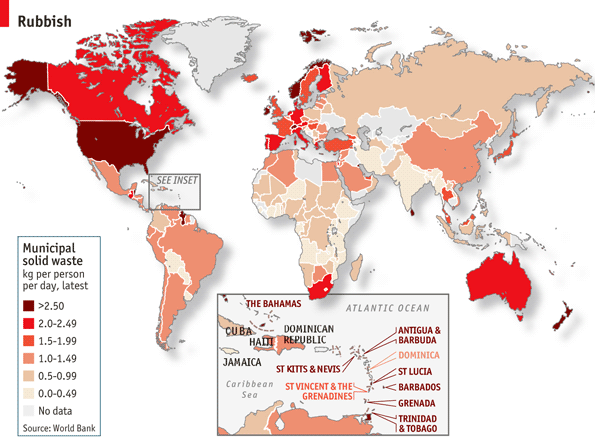
What a waste

20120609_wom915Einstein’s famous equation, E=mc², does not influence everyday interactions of energy, E and mass, m.  The speed of light, c is 299 792 458 m/s which is very big number and implies a huge amount of energy is required to create a small amount of mass.  This means that energy and mass are independently conserved.  For energy, this is the first law of thermodynamics while the law of conservation of mass is usually attributed to Antoine Lavoisier.  On a planetary scale, the conservation of mass implies that we can assume that the quantity of matter is constant.  Can we apply the second law of thermodynamics to matter as well as energy?  One interpretaton of the second law is that Gibbs energy, or the energy available to do useful work, must decrease in all real processes.   This also applies when matter moves through our economic system.  For instance, we must do work to convert mineral ores into useful products which gradually degrade through use and natural processes, such as corrosion, until they become scrap and we must expend more resources to recycle them and make them useful again.  The sun provides us with a steady supply of useful energy, so that in energy terms planet Earth can be considered an open system with energy flows in and out.  Conversely in mass terms, planet Earth is effectively a closed system with negligible mass flow in or out, so that we do not have a steady supply of new matter from which to manufacture goods.  However, most of us behave with open-world mindset and throw away matter (goods) that are no longer useful to us when we should be repairing and recycling [see my post entitled ‘Old is beautiful‘ on May 1st 2013].  Maybe we can’t reach the zero-waste status aimed at by people like Bea Johnson, but most of us could do better than the 2.2 kg of solid waste produced each day by each of us in OECD countries. That’s 2.1 tonnes per year for an average OECD household (2.63 people)!

Sources:

The New Sustainable Frontier – principles of sustainable development, GSA Office of Governmentwide Policy, September 2009.

Daniel Hoornweq & Perinaz Bhada-Tata, What a Waste: A Global Review of Solid Waste Management, World Bank No.15, 2012.

http://www.economist.com/blogs/graphicdetail/2012/06/daily-chart-3

No beginning or end

milkywayNASAIn the quantum theory of gravity, time becomes the fourth dimension to add to the three dimensions of space (x, y, z or length, width and height), and Stephen Hawking has suggested that we consider it analogous to a sphere. Developing this analogy, we imagine time to be like a flea running around on the surface of a ping-pong ball. A continuous journey, without a beginning or an end. The ‘big bang’, frequently discussed as the beginning of everything, and the ‘big crunch’, proposed by physicists as how things will end, would be the north and south poles of the sphere. The Universe would simply exist. The radius of circles of constant distance from the poles (what we might call lines of latitude) would represent the size of the Universe. Quantum theory also requires the existence of many possible time histories of which we inhabit one. Different lines of longitude can represent these histories.

If you are not already lost (the analogy does not include a useful compass) then physicists would give you a final spin by dropping in the concept of imaginary time! Maybe it is time for the flea to jump off the ping-pong ball, but before it does, we can appreciate that it might move in one direction and then retrace its steps (or its hops if you wish to be pedantic). The flea can travel backwards because in this concept of the Universe, time has the same properties as the other dimensions of length, height and width and so it has backwards as well as forwards directions.”

This is an extract from a book called ‘The Entropy Vector: Connecting Science and Business‘ that I wrote sometime ago with Bob Handscombe.  I have reproduced it here in response to questions from a number of learners in my current MOOC.  The questions were initially about whether the first law of thermodynamics has implications for the universe as a closed system (i.e. one that can exchange energy but not matter with its surroundings) or as an isolated system (i.e. one that can exchange neither energy not matter with its surroundings).  These questions revolve around our understanding of the universe, which I have taken to be everything in the time and space domain, and the first law implies that the energy content of the universe is constant.  The expansion of the universe implies that the average energy density of the universe is getting lower, though it is not uniformly otherwise we would have reached the ‘cosmic heat death’ that I have discussed before.  However, this discussion in the MOOC led to questions about what happened to the first law of thermodynamics prior to the Big Bang, which I deflected as being beyond the scope of a MOOC on Energy! Thermodynamics in Everyday Life.  However, I think it deserves an answer, which is why reproduced the extract above.

Undermining axioms at the speed of light

International Prototype of the Kilogram (IPK)

International Prototype of the Kilogram (IPK)

An axiom is a statement so evident or well-established that it is accepted without controversy or question.  However, in his review of Sokal’s Hoax, Steven Weinberg has suggested that ‘none of the laws of physics known today (with the possible exception of the general principles of quantum mechanics) are exactly and universally valid’.  This propels physics to the same status as biology (see my post entitled ‘Laws of biology?‘ on January 13th 2016) – in lack exactly and universally valid laws and it suggests that there are no scientific axioms. 

‘Things that are equal to the same things are equal to each other’ is Euclid’s first axiom and in thermodynamics leads to the Zeroth Law: ‘Two things each in thermal equilibrium with a third are also in thermal equilibrium with each other’ (see my posts entitled ‘All things being equal‘ on December 3rd, 2014 on ‘Lincoln on equality‘ on February 6th, 2013).   Thermal equilibrium means that there is no transfer of thermal energy or heat between the two things, this leads to the concept of temperature because when two things are in thermal equilibrium we say that they are at the same temperature.   Last week I explained these ideas in both my first year undergraduate class on thermodynamics and my on-going MOOC.  This week, I have challenged MOOC participants to try to identify other measurement systems, besides temperature, that are based on Euclid’s first axiom.

For instance, its application to mechanical equilibrium leads to Newton’s laws and from there to mass as a measure of a body’s inertia.  We use Euclid’s axiom to evaluate the mass of things through a chain of comparisons that leads ultimately to the international kilogram at the Bureau International des Poids et Mesures in France.  Similarly, we measure time by comparing our time-pieces to an international standard for a second, which is the duration of  9,192,631,770 periods of radiation corresponding to the transition between the two hyperfine levels of the ground state of the cesium 133 atom. 

However, given Weinberg’s statement perhaps I can give you a harder challenge than MOOC participants: can you identify exceptions to Euclid’s first axiom?

I think I can identify one: if you calibrated two very accurate timepieces against a cesium 133 clock and then took one on a journey through space travelling at the speed of light while the other remained on Earth, when you brought the two together again on Earth they would not agree, based on Einstein’s theory of relativity, or what he called relativity of simultaneity.  Now see what you can come up with!

Sources:

Steven Weinberg, ‘Sokal’s Hoax’, NY review of Books, 43(13):11-15, August 1996.

Oliver Byrne, First Six Books of the Elements of Euclid, London: William Pickering, 1847

Joseph Schwartz & Michael McGuinness, Einstein for Beginners, London: Writers and Readeres Publishing Cooperative, 1979 & Penguin Random House, 2013.

Albert Einstein, Relativity: The Special and the General Theory, (translated by Robert W. Lawson), London: Methuen & Co Ltd., 1979 & on-line at www.bartleby.com/173/