Category Archives: Learning & Teaching

Feedback on feedback

Feedback on students’ assignments is a challenge for many in higher education.  Students appear to be increasingly dissatisfied with it and academics are frustrated by its apparent ineffectiveness, especially when set against the effort required for its provision.  In the UK, the National Student Survey results show that satisfaction with assessment and feedback is increasing but it remains the lowest ranked category in the survey [1].  My own recent experience has been of the students’ insatiable hunger for feedback on a continuing professional development (CPD) programme, despite receiving detailed written feedback and one-to-one oral discussion of their assignments.

So, what is going wrong?  I am aware that many of my academic colleagues in engineering do not invest much time in reading the education research literature; perhaps because, like the engineering research literature, much of it is written in a language that is readily appreciated only by those immersed in the subject.  So, here is an accessible digest of research on effective feedback that meets students’ expectations and realises the potential improvement in their performance.

It is widely accepted that feedback is an essential component [2] in the learning cycle and there is evidence that feedback is the single most powerful influence on student achievement [3, 4].  However, we often fail to realise this potential because our feedback is too generic or vague, not sufficiently timely [5], and transmission-focussed rather than student-centered or participatory [6].  In addition, our students tend not to be ‘assessment literate’, meaning they are unfamiliar with assessment and feedback approaches and they do not interpret assessment expectations in the same way as their tutors [5, 7].  Student reaction to feedback is strongly related to their emotional maturity, self-efficacy and motivation [1]; so that for a student with low self-esteem, negative feedback can be annihilating [8].  Emotional immaturity and assessment illiteracy, such as is typically found amongst first year students, is a toxic mix that in the absence of a supportive tutorial system leads to student dissatisfaction with the feedback process [1].

So, how should we provide feedback?  I provide copious detailed comments on students’ written work following the example of my own university tutor, who I suspect was following example of his tutor, and so on.  I found these comments helpful but at times overwhelming.  I also remember a college tutor who made, what seemed to me, devastatingly negative comments about my writing skills, which destroyed my confidence in my writing ability for decades.  It was only restored by a Professor of English who recently complimented me on my writing; although I still harbour a suspicion that she was just being kind to me.  So, neither of my tutors got it right; although one was clearly worse than the other.  Students tend to find negative feedback unfair and unhelpful, even when it is carefully and politely worded [8].

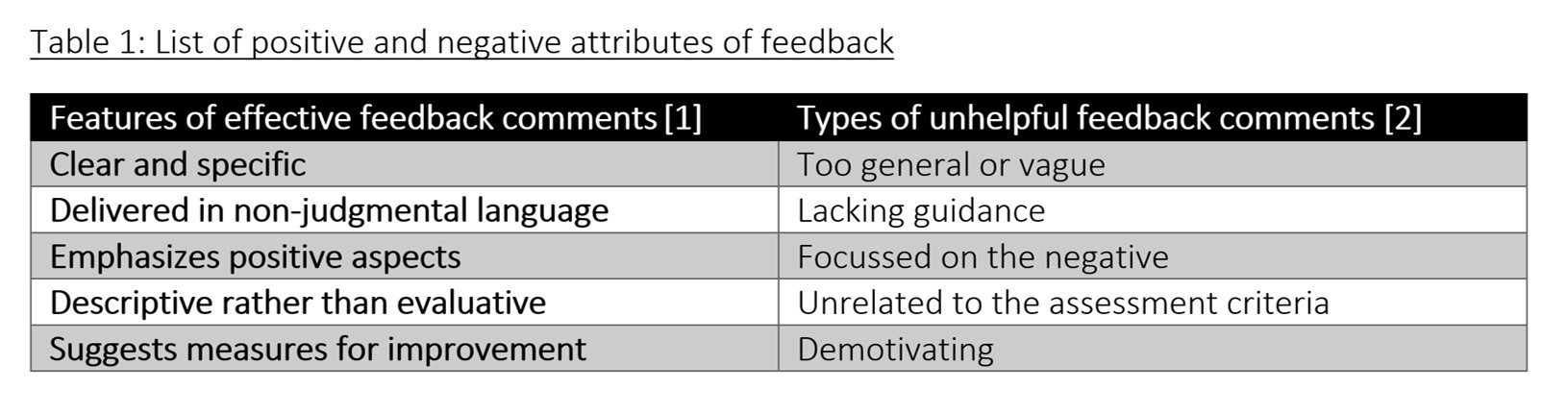
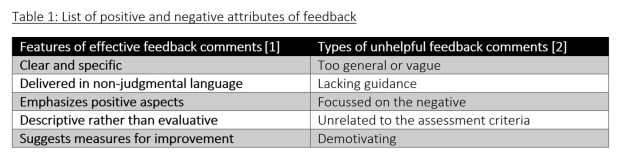
Students like clear, unambiguous, instructional and direction feedback [8].  Feedback should provide a statement of student performance and suggestions for improvement [9], i.e. identify the gap between actual and expected performance and provide instructive advice on closing the gap.  This implies that specific assessment criteria are required that explicitly define the expectation [2].  The table below lists some of the positive and negative attributes of feedback based on the literature [1,2].  However, deploying the appropriate attributes does not guarantee that students will engage with feedback; sometimes students fail to recognise that feedback is being provided, for example in informal discussion and dialogic teaching; and hence, it is important to identify the nature and purpose of feedback every time it is provided.  We should reduce our over-emphasis on written feedback and make more use of oral feedback and one-to-one, or small group, discussion.  We need to take care that the receipt of grades or marks does not obscure the feedback, perhaps by delaying the release of marks.  You could ask students about the mark they would expect in the light of the feedback; and, you could require students to show in future work how they have used the feedback – both of these actions are likely to improve the effectiveness of feedback [5].

In summary, feedback that is content rather than process-driven is unlikely to engage students [10].  We need to strike a better balance between positive and negative comments, which includes a focus on appropriate guidance and motivation rather than justifying marks and diagnosing short-comings [2].  For most of us, this means learning a new way of providing feedback, which is difficult and potentially arduous; however, the likely rewards are more engaged, higher achieving students who might appreciate their tutors more.
References

[1] Pitt E & Norton L, ‘Now that’s the feedback that I want!’ Students reactions to feedback on graded work and what they do with it. Assessment & Evaluation in HE, 42(4):499-516, 2017.

[2] Weaver MR, Do students value feedback? Student perceptions of tutors’ written responses.  Assessment & Evaluation in HE, 31(3):379-394, 2006.

[3] Hattie JA, Identifying the salient facets of a model of student learning: a synthesis of meta-analyses.  IJ Educational Research, 11(2):187-212, 1987.

[4] Black P & Wiliam D, Assessment and classroom learning. Assessment in Education: Principles, Policy & Practice, 5(1):7-74, 1998.

[5] O’Donovan B, Rust C & Price M, A scholarly approach to solving the feedback dilemma in practice. Assessment & Evaluation in HE, 41(6):938-949, 2016.

[6] Nicol D & MacFarlane-Dick D, Formative assessment and self-regulatory learning: a model and seven principles of good feedback practice. Studies in HE, 31(2):199-218, 2006.

[7] Price M, Rust C, O’Donovan B, Handley K & Bryant R, Assessment literacy: the foundation for improving student learning. Oxford: Oxford Centre for Staff and Learning Development, 2012.

[8] Sellbjer S, “Have you read my comment? It is not noticeable. Change!” An analysis of feedback given to students who have failed examinations.  Assessment & Evaluation in HE, DOI: 10.1080/02602938.2017.1310801, 2017.

[9] Saddler R, Beyond feedback: developing student capability in complex appraisal. Assessment & Evaluation in HE, 35(5):535-550, 2010.

[10] Hounsell D, Essay writing and the quality of feedback. In J Richardson, M. Eysenck & D. Piper (eds) Student learning: research in education and cognitive psychology. Milton Keynes: Open University Press, 1987.


Slowing down time to think [about strain energy]

161-6167_imgLet me take you bungee jumping.  I should declare that I am not qualified to do so, unless you count an instructor’s certificate for rock-climbing and abseiling, obtained about forty years ago.  For our imaginary jump, pick a bridge with a good view and a big drop to the water below and I’ll meet you there with the ropes and safety gear.

It’s a clear early morning and the air is crisp and fresh – ideal for throwing yourself off a bridge attached to a rope.  The rope is the star of this event.  It’s brand new, which is reassuring, and arrived coiled over my shoulder.  A few days ago, I asked you how much you weigh – that’s your real weight fully clothed, at least I hope that’s the number you gave me otherwise my calculations will be wrong and you’ll get wet this morning!  I have calculated how much the rope will stretch when it arrests your free-fall from the bridge parapet; so, now I am measuring out enough rope to give you an exciting fall but to stop you short of the water.  I’m a professor of structural materials and mechanics so I feel confident of getting this bit right; but it’s a long time since I worked as an abseiling instructor so I suggest you check those knots and that harness that we’ve just tightened around you.

You’ve swung yourself over the parapet and you’re standing on the ledge that the civil engineers conveniently left for bridge jumpers.  The rope is loosely coiled ready with its end secured to a solid chunk of parapet.  As you alternate between soaking up the beautiful view and contemplating the chasm at your feet, you wonder why you agreed to come with me.  At this moment, you have a lot of potential energy due to your height above the sparkling water [potential energy is your mass multiplied by your height and gravitational acceleration], but no kinetic energy because you are standing motionless.  The rope is relaxed or undeformed and has zero strain energy.

Finally, you jump and time seems to stand still for you as the fall appears to be happening in slow motion.  The air begins to rush past your ears in a whoosh as you build up speed and gain kinetic energy [equal to one half your mass multiplied by your velocity squared].  The bridge disappeared quickly but the water below seems only to be approaching slowly as you lose height and potential energy.  In reality, your brain is playing tricks on you because you are being accelerated towards the water by gravity [at about 10 metres per second squared] but your total energy is constant [potential plus kinetic energy unchanged].  Suddenly, your speed becomes very apparent.  The water seems very close and you cry out in surprise.  But the rope is beginning to stretch converting your kinetic energy into strain energy stored by stretching its fibres [at a molecular level work is being done to move molecules apart and away from their equilibrium position].  Suddenly, you stop moving downwards and just before you hit the water surface, the rope hurls you upwards – your potential energy reached a minimum and you ran out of kinetic energy to give the rope; so now it’s giving you back that stored strain energy [and the molecules are relaxing to their equilibrium position].  You are gaining height and speed so both your kinetic and potential energy are rising with that squeal that just escaped from you.

Now, you’ve noticed that the rope has gone slack and you’re passing a loop of it as you continue upwards but more slowly.  The rope ran out of strain energy and you’re converting kinetic energy into potential energy.  Just as you work out that’s happening, you run out of kinetic energy and you start to free-fall again.

Time no longer appears to stationary and your brain is working more normally.  You begin to wonder how many times you’ll bounce [quite a lot because the energy losses due to frictional heating in the rope and drag on your body are relatively small] and why you didn’t ask me what happens at the end.  You probably didn’t ask because you were more worried about jumping and were confident that I knew what I was doing, which was foolish because, didn’t I tell you, I’ve never been bungee jumping and I have no idea how to get you back up onto the bridge.  How good were you at rope-climbing in the gym at school?

When eventually you stop oscillating, the rope will still be stretched due to the force on it generated by your weight.  However, we can show mathematically that the strain energy and deformation under this static load will be half the values experienced under the dynamic loading caused by your fall from the bridge parapet.  That means you’ll have a little less distance to climb to the parapet!

Today’s post is a preview for my new MOOC on ‘Understanding Super Structures’, which is scheduled to start on May 22nd, 2017.  This is the script for a step in week 2 of the five-week course, unless the director decides it’s too dangerous.  By the way, don’t try this home or on a bridge anywhere.

Revisiting closed systems in nature

milkywayNASA

It is the beginning of the academic year and once again I am teaching introductory thermodynamics to engineering undergraduate students and my MOOC entitled ‘Energy: Thermodynamics in Everyday Life‘ is running in parallel.  Last week after my lecture on thermodynamic systems, a student approached me to ask whether the universe is a closed and isolated system.  It’s an interesting question and the answer is depends on the definition of universe.   In thermodynamics, we usually define a boundary to delineate the system of interest as everything inside the boundary and everything else are the surroundings.  The system and surroundings taken together are the universe (see my post ‘No beginning or end‘ on February 24th, 2016).  If the universe is defined as the system then there are no surroundings; hence the system cannot exchange energy or matter with anything which is the definition of a closed and isolated system.

Physicists often refer to the observable universe, or define the universe as everything we can observe.  We are aware that we cannot observe everything.  Hence, it is reasonable to suppose that the observable universe exchanges energy and matter with the unobservable space beyond it, in which case the observable universe is an open system.  We could also consider the concept that we are part of multiverse and our universe is only one of many, in which case it seems likely that is not isolated, i.e. it can exchange energy, and perhaps it is open, i.e. it can exchange both energy and matter with other parts of the multiverse.

This is not really thermodynamics in everyday life.  However, the occurrence of closed systems in nature appears to interest a lot of people to judge from the visits to my previous posts on this topic.  See ‘Closed Systems in Nature?‘ on  December 12th, 2012; Is Earth a closed system? Does it matter? on December 10th, 2014; and ‘No Closed Systems in Nature‘ on August 12th, 2015. For more about system boundaries, see my post entitled ‘Drawing Boundaries‘ on December 19th, 2012.

Popping balloons

Balloons ready for popping

Balloons ripe for popping!

Each year in my thermodynamics class I have some fun popping balloons and talking about irreversibilities that occur in order to satisfy the second law of thermodynamics.  The popping balloon represents the unconstrained expansion of a gas and is one form of irreversibility.  Other irreversibilities, including friction and heat transfer, are discussed in the video clip on Entropy in our MOOC on Energy: Thermodynamics in Everyday Life which will rerun from October 3rd, 2016.

Last week I was in Florida at the Annual Conference of the Society for Experimental Mechanics (SEM) and Clive Siviour, in his JSA Young Investigator Lecture, used balloon popping to illustrate something completely different.  He was talking about the way high-speed photography allows us to see events that are invisible to the naked eye.  This is similar to the way a microscope reveals the form and structure of objects that are also invisible to the naked eye.  In other words, a high-speed camera allows us to observe events in the temporal domain and a microscope enables us to observe structure in the spatial domain.  Of course you can combine the two technologies together to observe the very small moving very fast, for instance blood flow in capillaries.

Clive’s lecture was on ‘Techniques for High Rate Properties of Polymers’ and of course balloons are polymers and experience high rates of deformation when popped.  He went on to talk about measuring properties of polymers and their application in objects as diverse as cycle helmets and mobile phones.