Author Archives: Eann Patterson

Horsepower driving ambition

A photograph of 'Physical Energy' in Kensington Gardens - a sculpture of a man on a horseWalking across Kensington Gardens in London last week, on my way to attend a conference on Carbon, I came across the sculpture in the picture.  It is ‘Physical Energy’ by George Frederick Watts (1817 – 1904), which really confused me because I automatically started thinking about the sort of energy that is associated with horsepower.  Horsepower is a unit of power (energy per unit time) developed by James Watt (1736 – 1819) to evaluate the output of his steam engines.  The plaque below the sculpture calls it a ‘sculptural masterpiece; a universal embodiment of the dynamic force of ambition’ and states that the artist described it as a ‘symbol of that restless physical impulse to seek the still unachieved in the domain of physical things.’  So, while the connections seemed obvious to me, it would appear that Watts was not inspired by Watt.

The conference was interesting too.  There were delegates from all over the world presenting research on a wide range of topics from new designs of batteries to using carbon as an sorbent for toxins, carbon-based composites and self-assembly of metal-organic meso-crystals.  Two students that I have supervised were presenting their research on establishing credibility for models of the graphite core in nuclear power plants and on algorithms for identifying the surface morphology in samples of graphite.

Space between the words

I am an habitual user of a fountain pen.  It is the only writing implement that I carry with me since I enjoy writing with a fountain pen and because I can keep track of one pen but no more than one.  I have used it, and its predecessors, to make notes in a series of forty notebooks that stretch back to when I started as a research assistant forty years ago.  I used to record laboratory results in my notebooks but nowadays I have a research team who perform all of the work in the laboratory.  I still use my pen and notebook to record meetings, ideas and notes on papers.  I find the process of writing notes by hand to be conducive to both remembering detail and connecting fragments of information into new thoughts and ideas.  I am not alone in having these experiences.  Researchers have found that taking notes by hand improves the performance of students in answering conceptual questions compared to students who use a laptop to take notes.  When you write on a laptop, it is easy to delete words and re-start a sentence, whereas to create a coherent set of notes in a book you need to craft a sentence prior to committing pen to paper.  Perhaps the latter process allows a more persistent assembly of neurons to be formed in your brain [see ‘Slow deep thoughts from a planet-sized brain‘ on March 25th, 2020]; or maybe it is just the irregular spacing between handwritten words which creates a more distinct pattern that can be more readily recalled than the repetitive single spaces in typed text.  I certainly feel there is a connection between recalling the image of a page from my notebook and remembering the content even though I cannot usually read the words in my mental image.

Crumb RM, Hildebrandt R & Sutton TM, The value of handwritten notes: a failure to find state-dependent effects when using a laptop to notes and complete a quiz, Teaching of Psychology, 49(1):7-13, 2022.

Aorta: structure to rupture

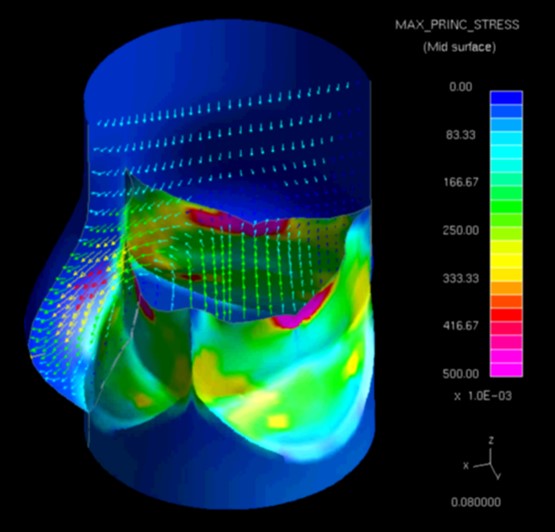
Decorative image from a video showing predicted flow through aortic valve and resultant stress in leaflets of valveRegular readers have probably already realised that I have very broad interests in engineering from aircraft and power stations [see ‘Conversations about engineering over dinner and haircut‘ on February 16th, 2022] to nanoparticles interacting with cells [see ‘Fancy a pint of science‘ on April 27th, 2022].  So, it will come as no surprise to hear that I gave a welcome address to a workshop on ‘Aorta: Structure to Rupture‘ last week.  The workshop was organised in Liverpool by one of my colleagues, with sponsorship from the British Heart Foundation, and I was invited to welcome delegates in my capacity as Dean of the School of Engineering.  It was exciting on two levels: speaking, for the first time in more than two years, to an audience who had travelled from around the world to discuss research. And because the topic was closely associated with cardiac dynamics, which is a field that I worked in for nearly twenty years until around 2006.  I was part of an interdisciplinary team modelling the fluid-structure interaction in the aortic valve as it opens when blood is pumped through it by the heart and then closes to prevent back flow into the heart.  The team dispersed after I moved to the USA in 2004.  So speaking to the workshop last week was something of a trip down memory lane for me and led me to look up our last publication in the field.  I was surprised to find it was cited seven times last year.

The image in the thumbnail is a snapshot from a video showing the predicted time-varying distribution of blood flow through the aortic valve and the resultant distribution of stress in the leaflets of the valve during a heart beat.  The simultation is described in our last publication in cardiac dynamics: Carmody, C. J., Burriesci, G., Howard, I. C., & Patterson, E. A.,  An approach to the simulation of fluid–structure interaction in the aortic valve. J. Biomechanics, 39(1), 158-169, 2006.

Unrecognised brilliance of shy and fearless leaders

Red tulips in a window boxAre you a quiet person? Perhaps shy would be an appropriate description. Do you have a clear vision of where you would like to lead your organisation but perhaps you are hesitant about stepping forward into a leadership position because you think that successful leaders are bold, self-confident, large-than-life and enjoy the limelight. You should think again. Research by Jim Collins and his team, published in the Harvard Business Review, has shown that the most powerfully transformative leaders have a paradoxical mixture of personal humility and professional resolve. They found that companies were transformed from a merely good performance to a sustained great performance in terms of their stock value only when led by a CEO who was both self-effacing and fearless. They called these class of people, level 5 leaders. They are ambitious for their organisation not themselves, assign credit for successes to others while accepting the blame for failures and have an unwavering resolve to do whatever is necessary to achieve the best long-term results despite the obstacles. So, if you worry that you lack the charisma to inspire your team then pause and consider whether you might be a level 5 leader with the rare combination of modesty and willfulness that, Jim Collins has suggested, are required to transform the performance of your organisation. Unfortunately, if you think you possess these characteristics then you almost certainly are not a level 5 leader because your humility would never allow you to entertain the thought!

Reference:

Jim Collins, Level 5 Leadership: The Triumph of Humility and Fierce Resolve, Harvard Business Review, January 2001.