Tag Archives: renewable energy

Commoditisation of civil nuclear power

Logo for BBC Inside ScienceA colleague and I published a paper last month that we hope will bring about a paradigm shift in the nuclear power industry. I was interviewed on BBC Radio 4’s Inside Science on the day following its publication – its the first time one of my scientific papers has made that big a splash in the media!  You can listen to the programme on BBC Sounds at https://www.bbc.co.uk/sounds/play/m001zdwv.

In the paper we describe a blueprint for the factory-production of sealed micro-power units with a digitally-enabled, holistic assurance framework.  Currently, several designs of micro-reactors are progressing to the prototype stage with hazards contained on-site.  The integration of these approaches enables a transformation of the regulatory regime to type or series approval at the factory, similar to the aerospace industry, and supported by digital tools such as block chains to provide transparent quality assurance within the supply chain.  The transformation of the regulatory regime and the shift to ‘flow’ production in a factory would remove the financial risk from the power plant to the factory thereby enabling nuclear power to become a realistic competitor for intermittent green energy sources, such as wind and solar, both in terms of financial and ecological costs.  The output from three production lines could replace the current electricity generating capacity from fossil fuels in the UK over approximately 15 years thus making a significant contribution to achieving net zero greenhouse gas emissions.  We propose a design philosophy for the micro-power units that will allow them to go unnoticed in an urban environment or even become an iconic product that signals a community’s commitment to responsible stewardship of the Earth’s resources.  Our blueprint represents a revolutionary change for the nuclear power industry that would likely lead to the commoditisation of nuclear power whereas the status quo probably leads to extinction.

The paper is published with open access (its free) at Patterson EA & Taylor RJ, 2024, The commoditisation of civil nuclear power, Royal Society Open Science, 11:240021.

Inconvenient data about electricity generation

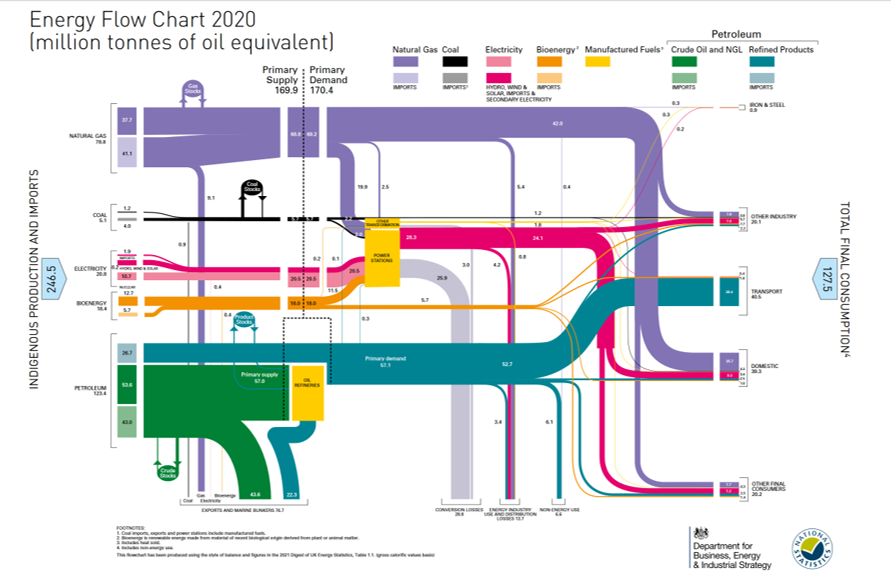
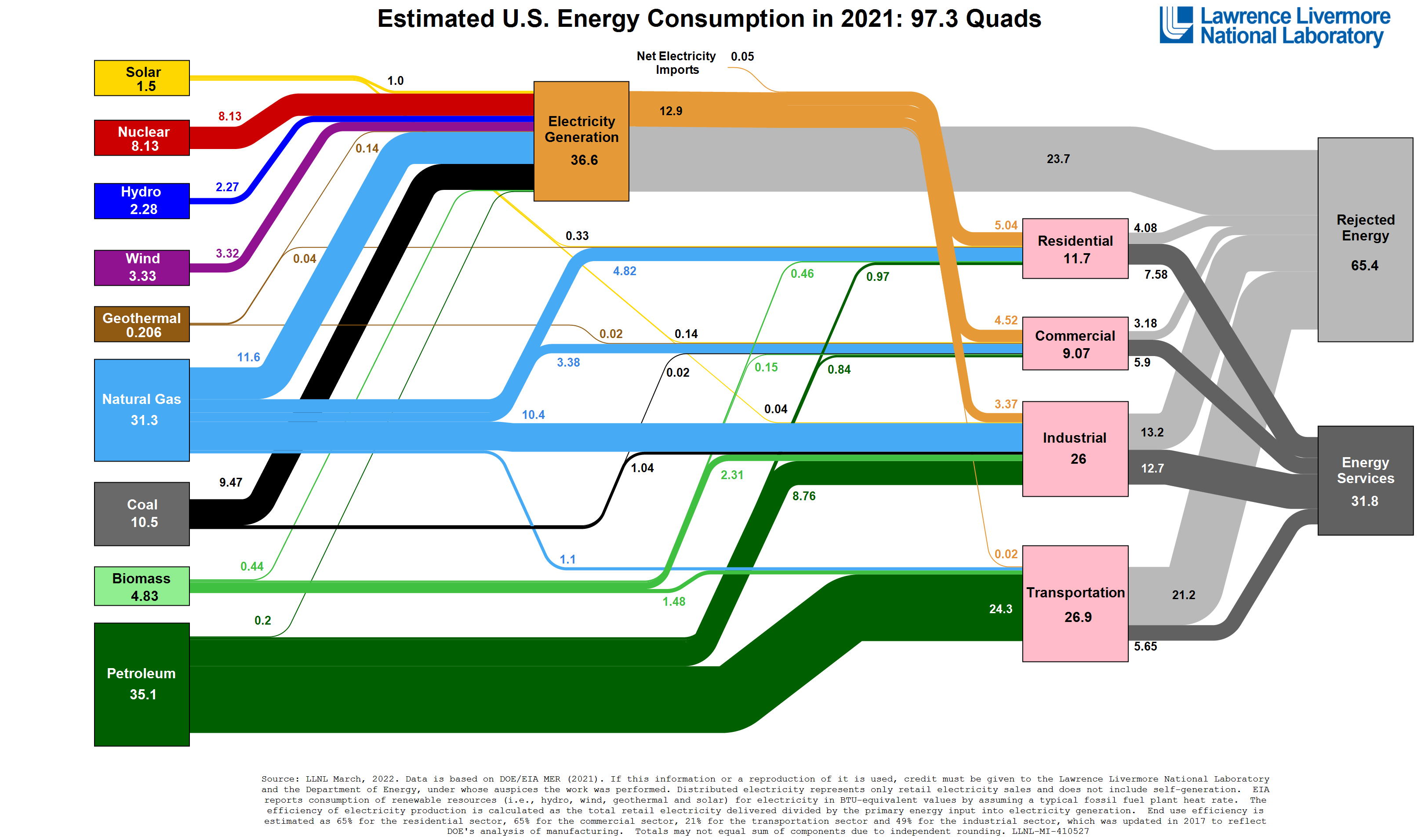
Decorative infographicI like a good infographic and this one showing annual energy flows for a country  is one of my favourites [see ‘Energy blending’ on May 22nd 2013].  Some governments produce them annually.  The image shows the latest one for the UK [2021]. It makes interesting but perhaps depressing reading.  Transportation using fossil fuels accounts for 31% (41.6/134.1 million tonnes oil equivalent) of the UK energy consumption while electricity output accounts for only 21% (28.6/134.1 million tonnes oil equivalent).  This implies that if all vehicles were powered by electricity then the output of our power stations would need to increase to 70.2 million tonnes oil equivalent or between two- and three-fold (excluding conversion & transmission losses).  You can perform a similar analysis for the USA [see 2021 Energy flow chart from LLNL].  Fossil-fuelled transportation accounted for 25%  (24.3/97.3 Quads) and electricity output 13% (12.9/97.3 Quads) so converting all transportation to be electrically powered requires a three-fold increase in electrical output from power stations. It is more difficult to find equivalent data for Japan; however, in 2014 [see Energy flow chart from I2CNER Kyushu University] fossil-fuelled transportation accounted for 32% (3.03/9.52 EJ) and electricity output 38% (3.66/9.52 EJ) so converting all transportation to be electrically powered requires a two-fold increase in electrical output from power stations.  None of the above takes account of space heating mainly via fossil fuel or that many existing power stations are fossil-fuelled and need to be replaced in order to achieve net zero carbon emissions.  Hence, the required scale of construction of power stations using renewable sources, including nuclear, solar and wind, is enormous and in most countries it is barely discussed let alone planned or started; leading to the conclusion that there is little chance of achieving net zero carbon emissions by 2050 as called for by the Paris agreement.

Difficult or inconvenient data about electric vehicles

photograph of a MDI Airpod 2.0The embodied carbon (i.e. the greenhouse gas emissions produced by its manufacture and assembly) of a typical small (compact) battery electric vehicle (BEV) is about 14 tonnes CO2 compared to about 7 tonnes CO2 in a compact internal combustion engine vehicle (ICEV) [see brusselblog.co.uk for overview of estimates from several sources].  This is mainly a result of the embodied carbon in the batteries.  My compact ICEV does about 50 mpg and we drive about 8,000 per year so we burn 160 gallons per year and one gallon generates about 9 kg CO2; thus, the carbon emissions from my ICEV are about 1.4 tonnes CO2/year. Hence, with our driving habits, building and using a compact ICEV car for five years is equivalent, in carbon emissions (= 7 + (1.4 x 5)), to just building a small electric car.  This does not account for the carbon footprint of electricity generation for the electric car which will not be zero and be dependent on how the electricity is generated; nor is recycling of your old vehicle included.  If you already have a ICEV car then your additional emissions resulting from its continued use will take about a decade to be more than buying a new electric car though by buying an electric vehicle you will move the pollution away from where you live and work.  If you buy an electric SUV, as about 45% of new car purchasers do worldwide [see IEA data], then many more years will be required to acheive a net reduction in carbon emission because the embodied carbon in an electric SUV can be five to ten times more than a compact ICEV.  The challenge for engineers is to develop vehicles that have both zero emissions in use and also zero embodied carbon.  Meanwhile, the bottom line is to use public transport whenever possible but if you need a car then have a small one and keep an electric one for much longer than an internal combustion engine vehicle – neither helps achieve net zero.

Image: the MDI Airpod that runs on compressed air [see ‘Hot air is good for balloons but cold air is better for cars‘ on May 19th , 2021.

Bringing an end to thermodynamic whoopee

Two weeks ago I used two infographics to illustrate the dominant role of energy use in generating greenhouse gas emissions and the disportionate production of greenhouse gas emission by the rich [see ‘Where we are and what we have‘ on November 24th, 2021].  Energy use is responsible for 73% of global greenhouse gas emissions and 16% of the world’s population are responsible for 38% of global CO2 emissions.  Today’s infographics illustrate the energy flows from source to consumption for the USA (above), UK and Europe (thumbnails below).  In the USA fossil fuels (coal, natural gas and petroleum) are the source of nearly 80% of their energy, in the UK it is a little more than 80% and the chart for Europe is less detailed but the proportion looks similar. COP 26 committed countries to ending ‘support for the international unabated fossil fuel energy sector by the end of 2022’ and recognised ‘investing in unabated fossil-related energy projects increasingly entails both social and economic risks, especially through the form of stranded assets, and has ensuing negative impacts on government revenue, local employment, taxpayers, utility ratepayers and public health.’  However, to reduce our dependency on fossil fuels we need a strategy, a plan of action for a fundamental change in how we power industry, heat our homes and propel our vehicles.  A hydrogen economy requires the production of hydrogen without using fossil fuels, electric cars and electric domestic heating requires our electricity generating capacity to be at least trebled by 2050 in order to hit the net zero target. This scale and speed of  transition to zero-carbon sources is such that it will have to be achieved using an integrated blend of green energy sources, including solar, wind and nuclear energy.  For example, in the UK our current electricity generating capacity is about 76 GW and 1 GW is equivalent to 3.1 million photovoltaic (PV) panels, or 364 utility scale wind turbines [www.energy.gov/eere/articles/how-much-power-1-gigawatt] so trebling capacity from one of these sources alone would imply more than 700 million PV panels, or one wind turbine every square mile.  It is easy to write policies but it is much harder to implement them and make things happen especially when transformational change is required.  We cannot expect things to happen simply because our leaders have signed agreements and made statements.  Now, national plans are required to ween us from our addiction to fossil fuels – it will be difficult but the alternative is that global warming might cause the planet to become uninhabitable for us.  It is time to stop ‘making thermodynamic whoopee with fossil fuels’ to quote Kurt Vonnegut [see ‘And then we discovered thermodynamics‘ on February 3rd, 2016].


Sources:

Kurt Vonnegut, A Man without a Country, New York: Seven Stories Press, 2005.  He wrote ‘we have now all but destroyed this once salubrious planet as a life-support system in fewer than two hundred years, mainly by making thermodynamic whoopee with fossil fuels’.

US Energy flow chart: https://flowcharts.llnl.gov/commodities/energy

EU Energy flow chart: https://ec.europa.eu/eurostat/web/energy/energy-flow-diagrams

UK Energy flow chart: https://www.gov.uk/government/collections/energy-flow-charts#2020