Tag Archives: design

Caustics

caustic_hole

White light caustic of 4mm diameter hole in 6mm (PMMA) plate subject to 3kN tension

As children many of us have burnt a hole (yes, tenuous link to last week’s post on ‘Holes’) in a piece of paper by focussing the sun’s rays with a magnifying glass. If you move the glass up or down and tilt it slightly then the sun’s rays will not be focussed on a spot and instead you see a complex spiralling pattern of light. This pattern is caused by the rays being bent by their passage through different sections of the curved glass. The same type of pattern, known as a caustic, appears on the bottom of your bath when you let (clean) water run out down the plug-hole if you have spotlights above the bath. This caustic is produced by the light rays from the spotlight being bent by varying degrees depending on where they pass through the vortex formed by the water spinning down the hole.  Caustics can also be produced when light passes through a glass of water or on the bottom of an outdoor swimming pool in bright sunlight.

The top picture shows the caustic formed by light passing through a transparent plate with a hole when the plate is stretched in the vertical direction. The load in the plate has to flow around the hole where it ‘bunches up’ or concentrates (see last week’s post entitled ‘Holes’) which causes high levels of local deformation with the plate thinning non-linearly at the intersection of the hole circumference and horizontal diameter. When the light passes through the deformed region it is deviated by amount dependent on the local thinning and forms the pattern shown.

This is not a totally abstract phenomenon because the same mechanism of thinning occurs at the tip of cracks as a result of the very high stress concentration at the sharp crack tip, as shown schematically in the diagram below. So we can evaluate the stress concentration by measuring the caustic it generates; it is even possible to predict in which direction the crack will grow next.

Schematic diagram of transparent plate with a crack loaded vertically in tension (left), light ray tracings through the cracked region (centre) and caustic formed on a screen (right).

Schematic diagram of transparent plate with a crack loaded vertically in tension (left), light ray tracings through the cracked region (centre) and caustic formed on a screen (right).

For information:

Carazo-Alvarez, J.D., Patterson, E.A., 1999, ‘A general method for automated analysis of caustics’, Optics & Lasers in Engng., 32: 95-110.

http://lgg.epfl.ch/caustics/

Dream Car?

f1When you are young most people would like a car with the performance of a racing car. When you get a little older and have children then you want something with the strength of an armoured personnel carrier in order to keep them safe. By the time you are old enough to have grandchildren, you are worried about whether the world’s resources will still be round for them and you would like a car with the fuel efficiency of the ETH PAC Car II which at 15,212 mpg, or 0.01857 litres/100 km holds the world record for fuel efficiency. In my case the compromise is a Volkswagen Golf, which is an example of the engineering conflict resolution between cost, structural integrity, performance and sustainability discussed in last week’s post [‘Conflict Resolution’ on June 25, 2014].

My colleague who lives in Zürich has an alternative resolution to the conflict. He does not own a car. Instead he has bought shares in a car sharing scheme, Mobility. If he needs a car then he selects a car on-line from those available in the nearest car-park and there 2500 available from 1200 in Switzerland. When I visited him a few weeks ago he picked up a sporty BMW 1 series by using a smart card in his wallet to open the car and said if he had been on his own then he would have taken the little SMART car parked next to it. As my Swiss colleague said if you are the car you drive then he can be a different person everyday.

What is Engineering?

Engineering turnover in the UK was £1.1 trillion (for the year ending March 2012) which was 24.5% of UK turnover.  So clearly engineering is big and important to the economy of industrialised countries.  But what it is?  That’s a harder question to answer!  In 2013 almost two-thirds of the public could cite the engineering development of the last 50 years that has had the greatest impact on them – that compares with slightly more than one-third in 2010 so more people are beginning to recognise engineering when they see it.  Can you cite the engineering development that has had the greatest impact on you?  If so, post a comment (use the ‘Leave a reply’ box at the bottom of the page).

What is Engineering? As well as being the title of this post it is also a website that attempts to answer the question. You will find the classical answers there and elsewhere, i.e. that engineering is about taking the resources able in nature and converting them into products (e.g. buildings, computers, medical devices and planes) and services (e.g. water, electricity and communications) for society.  Engineers are problem-solvers who communicate and organise the implementation of solution which might be how to create a zero emission car or a carbon-neutral public building.  The best engineers look for elegant solutions so I rather like the no.2 definition that you get when you Google the question, i.e. ‘the action of working artfully to bring something about’.

Source: www.engineeringUK.com

Setting standards

cenLast week I wrote about digital image correlation as a method for measuring surface strain and displacement fields.  The simplicity and modest cost of the equipment required combined with the quality and quantity of the results is revolutionizing the field of experimental mechanics.  It also has the potential to do the same in computational mechanics by enabling more comprehensive validation of models and thus enhancing the credibility and confidence in engineering simulations.  I have written and lectured on this topic many times, see for instance my post of September 17th, 2012 entitled ‘Model credibility’ or  http://sdj.sagepub.com/content/48/1.toc

At the moment, I am chair of a CEN workshop WS71 that is developing a precursor to a standard on validation of computational solid mechanics models.  To inform our deliberations, we have organised an Inter-Laboratory Study (ILS) to allow people to try out the proposed validation protocol and give us feedback.   If you would like to have a go then download the information pack.  You don’t need to do any experiments or modelling, just try the validation procedure with some of the data sets provided.  The more engineers that participate in the ILS then the better that the final CEN document is likely to be; so if you know someone who might be interested then forward this blog to them or just send them the link.

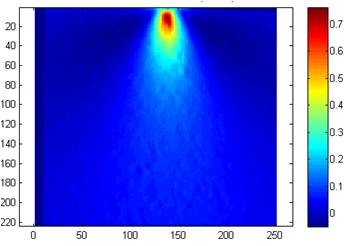
Displacement field measured using image correlation for metal wedge indenting a rubber block

Displacement field measured using digital image correlation for a metal wedge indenting a rubber block

CEN WS71: http://www.cen.eu/cen/Sectors/TechnicalCommitteesWorkshops/Workshops/Pages/WS71VANESSA.aspx

EU FP7 project VANESSA: www.engineeringvalidation.org

For information on the data field shown to the right see: http://sdj.sagepub.com/content/49/2/112.abstract