Category Archives: Thermodynamics

Conversations about engineering over dinner and a haircut

For decorative purposes: colour contour map of a face mask produced using fringe projectionRecently, over dinner, someone I had just met asked me what type of engineering I do. I always find this a difficult question to answer because I am sure that they are just being polite and do not want to hear any technical details but I find it hard to give an interesting answer without diving into details. Earlier the same day I had given a lecture on thermodynamics to about 300 undergraduate students so I told my inquisitor about this experience and explained that thermodynamics was the science of energy and its transformation into different forms. Then, I muttered something about being interested in making and using measurements to ensure that computational models of aircraft and nuclear power stations are reliable and the conversation quickly moved on. A week or so earlier, I was having my hair cut when the barber asked me a similar question about what I did and I told him that I was a professor of engineering which led to a conversation about robots. We speculated about whether we would ever lose our jobs to robots and decided that we were both fairly secure against that threat. There is a high degree of creativity in both of our roles – while I always ask for the same haircut, my hair is in a different state every time I visit the barbers’ and I leave looking slightly different every time. I don’t think that I would like the uniformity that a row of robots in the barbers’ shop might produce. And, then there is the conversation during the haircut. A robot would need to pass the Turing test, i.e., to exhibit intelligent behaviour indistinguishable from a human, which no computer has yet achieved or is likely to do so in our lifetime, at least not a cost that would allow them to replace barbers. The same holds for professors – the shift to delivering lectures online during the pandemic might have made some professors worry that their jobs were at risk as recorded lectures replaced live performances; however, student feedback tells us that students have a strong preference for on-campus teaching and the high turnout for my thermodynamics lectures supports that conclusion.

Footnotes:

For a new website I was asked to describe my research interests in about 25 words and used the following: ‘the acquisition of information-rich measurement data and its use to develop digital representations of complex systems in the aerospace, biological and energy sectors’.  Fine for a website but not dinner conversation! 

There have been some attempts to build a robot that cut your hair, for example see this video

Image shows a colour contour map describing the shape of a facemask produced using fringe projection which could be used as part of the vision system for a robotic barber.  For more information on fringe projection see: Ortiz, M. H., & Patterson, E. A. (2005). Location and shape measurement using a portable fringe projection system. Experimental mechanics, 45(3), 197-204 or watch this video from the INDUCE project that was active from 1998 to 2001.

Bringing an end to thermodynamic whoopee

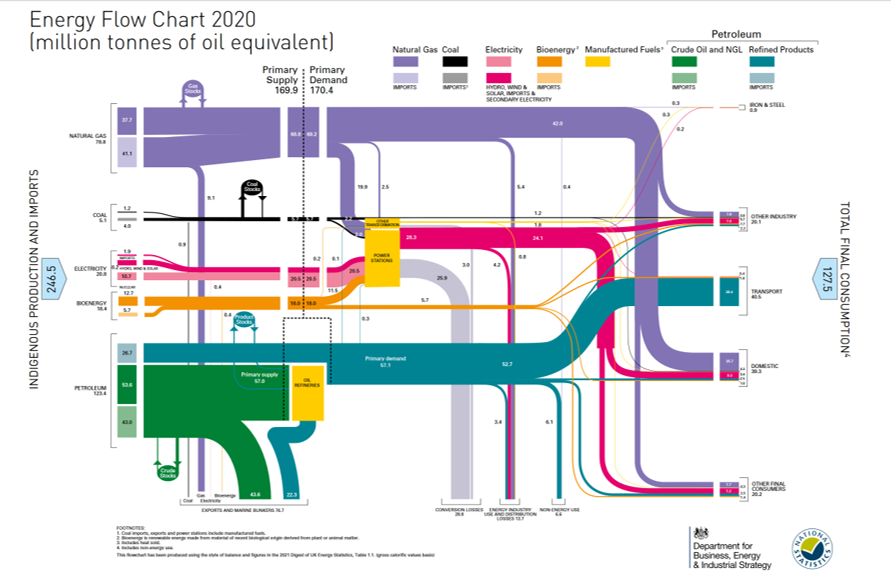
Two weeks ago I used two infographics to illustrate the dominant role of energy use in generating greenhouse gas emissions and the disportionate production of greenhouse gas emission by the rich [see ‘Where we are and what we have‘ on November 24th, 2021].  Energy use is responsible for 73% of global greenhouse gas emissions and 16% of the world’s population are responsible for 38% of global CO2 emissions.  Today’s infographics illustrate the energy flows from source to consumption for the USA (above), UK and Europe (thumbnails below).  In the USA fossil fuels (coal, natural gas and petroleum) are the source of nearly 80% of their energy, in the UK it is a little more than 80% and the chart for Europe is less detailed but the proportion looks similar. COP 26 committed countries to ending ‘support for the international unabated fossil fuel energy sector by the end of 2022’ and recognised ‘investing in unabated fossil-related energy projects increasingly entails both social and economic risks, especially through the form of stranded assets, and has ensuing negative impacts on government revenue, local employment, taxpayers, utility ratepayers and public health.’  However, to reduce our dependency on fossil fuels we need a strategy, a plan of action for a fundamental change in how we power industry, heat our homes and propel our vehicles.  A hydrogen economy requires the production of hydrogen without using fossil fuels, electric cars and electric domestic heating requires our electricity generating capacity to be at least trebled by 2050 in order to hit the net zero target. This scale and speed of  transition to zero-carbon sources is such that it will have to be achieved using an integrated blend of green energy sources, including solar, wind and nuclear energy.  For example, in the UK our current electricity generating capacity is about 76 GW and 1 GW is equivalent to 3.1 million photovoltaic (PV) panels, or 364 utility scale wind turbines [www.energy.gov/eere/articles/how-much-power-1-gigawatt] so trebling capacity from one of these sources alone would imply more than 700 million PV panels, or one wind turbine every square mile.  It is easy to write policies but it is much harder to implement them and make things happen especially when transformational change is required.  We cannot expect things to happen simply because our leaders have signed agreements and made statements.  Now, national plans are required to ween us from our addiction to fossil fuels – it will be difficult but the alternative is that global warming might cause the planet to become uninhabitable for us.  It is time to stop ‘making thermodynamic whoopee with fossil fuels’ to quote Kurt Vonnegut [see ‘And then we discovered thermodynamics‘ on February 3rd, 2016].


Sources:

Kurt Vonnegut, A Man without a Country, New York: Seven Stories Press, 2005.  He wrote ‘we have now all but destroyed this once salubrious planet as a life-support system in fewer than two hundred years, mainly by making thermodynamic whoopee with fossil fuels’.

US Energy flow chart: https://flowcharts.llnl.gov/commodities/energy

EU Energy flow chart: https://ec.europa.eu/eurostat/web/energy/energy-flow-diagrams

UK Energy flow chart: https://www.gov.uk/government/collections/energy-flow-charts#2020

Boltzmann’s brain

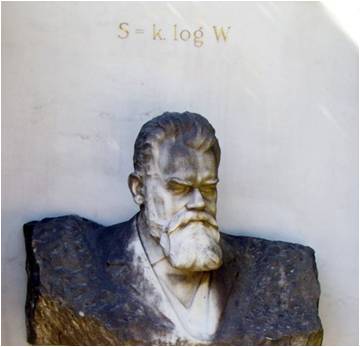
Ludwig Boltzmann developed a statistical explanation of the second law of thermodynamics by defining entropy as being proportional to the logarithm of the number ways in which we can arrange a system [see ‘Entropy on the brain‘ on November 29th 2017].  The mathematical expression of this definition is engraved on his head-stone.  The second law states that the entropy of the universe is always increasing and Boltzmann argued it implies that the universe must have been created in a very low entropy state.  Four decades earlier, in 1854, William Thomson concluded the dissipation of heat arising from the second law would lead to the ‘death’ of the universe [see ‘Cosmic heat death‘ on February 18th, 2015] while the big bang theory for the creation of the universe evolved about twenty years after Boltzmann’s death.  The probability of a very low entropy state required to bring the universe into existance is very small because it implies random fluctuations in energy and matter leading to a highly ordered state.  One analogy would be the probability of dead leaves floating on the surface of a pond arranging themselves to spell your name.  It is easy to think of fluctuations that are more likely to occur, involving smaller systems, such as one that would bring only our solar system into existence, or progressively more likely, only our planet, only the room in which you are sitting reading this blog, or only your brain.  The last would imply that everything is in your imagination and ultimately that is why Boltzmann’s argument is not widely accepted although we do not have a good explanation for the apparent low entropy state at the start of the universe.  Jean-Paul Sartre wrote in his book Nausea ‘I exist because I think…and I cannot stop myself from thinking.  At this very moment – it’s frightful – if I exist, it is because I am horrified at existing.’  Perhaps most people would find horrifying the logical extension of Boltzmann’s arguments about the start of the universe to everything only existing in our mind.  Boltzmann’s work on statistical mechanics and the second law of thermodynamics is widely accepted and support the case for him being genius; however, his work raised more questions than answers and was widely criticised during his lifetime which led to him taking his own life in 1906.

Sources:

Paul Sen, Einstein’s fridge: the science of fire, ice and the universe.  London: Harper Collins, 2021.

Jean-Paul Sartre, Nausea.  London: Penguin Modern Classics, 2000.

Fridges slow down time

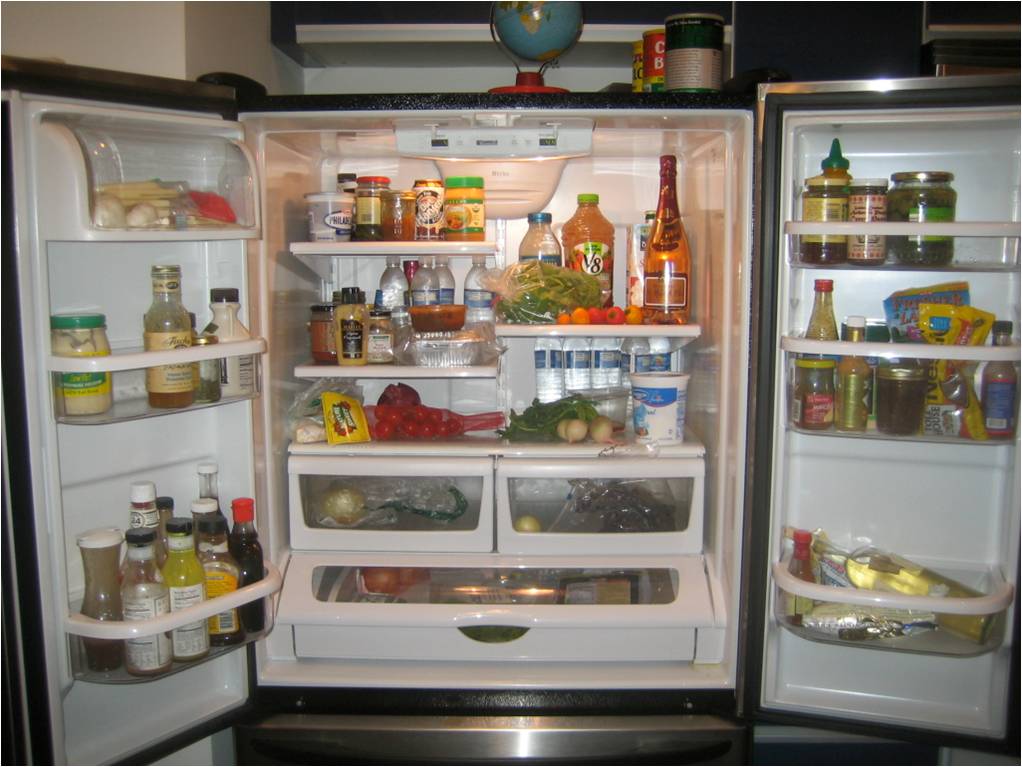
Photograph of the interior of a large domestic fridgeWe sense the passage of time by the changes that occur around us (see ‘We inhabit time as fish live in water‘ on July 24th, 2019) and these changes are brought about by processes that generate entropy.   Entropy is often referred to as the arrow of time because forwards in time is always the direction in which the entropy of the universe increases, as demanded by the second law of thermodynamics (see for example ‘Subtle balance of sustainable orderliness‘ on June 22nd, 2016).  The temperature in a refrigerator is sufficiently low that it slows down the processes of decay in the food stored in it (see’ Life-time battle‘ on January 30th, 2013) which effectively slows down time locally in the fridge.  However, there is a price to pay because the process of creating of the cold zone in the fridge increases the entropy in the universe and moves the universe infinitesimally closer to cosmic heat death (see ‘Will it all be over soon?‘ on November 2nd, 2016).  So, cooling the food in your fridge slows down time locally but brings the end of the universe a tiny bit closer.  Perhaps that’s not worth worrying about until you start thinking about how many fridges there are in the world (about half a billion are sold every year) and how many other devices are generating entropy.  The end of the universe might still be billions of years away but all that anthropogenic entropy is contributing to the increase in the temperature of the Earth’s ecosystem.