Category Archives: sustainability

Storm in a computer

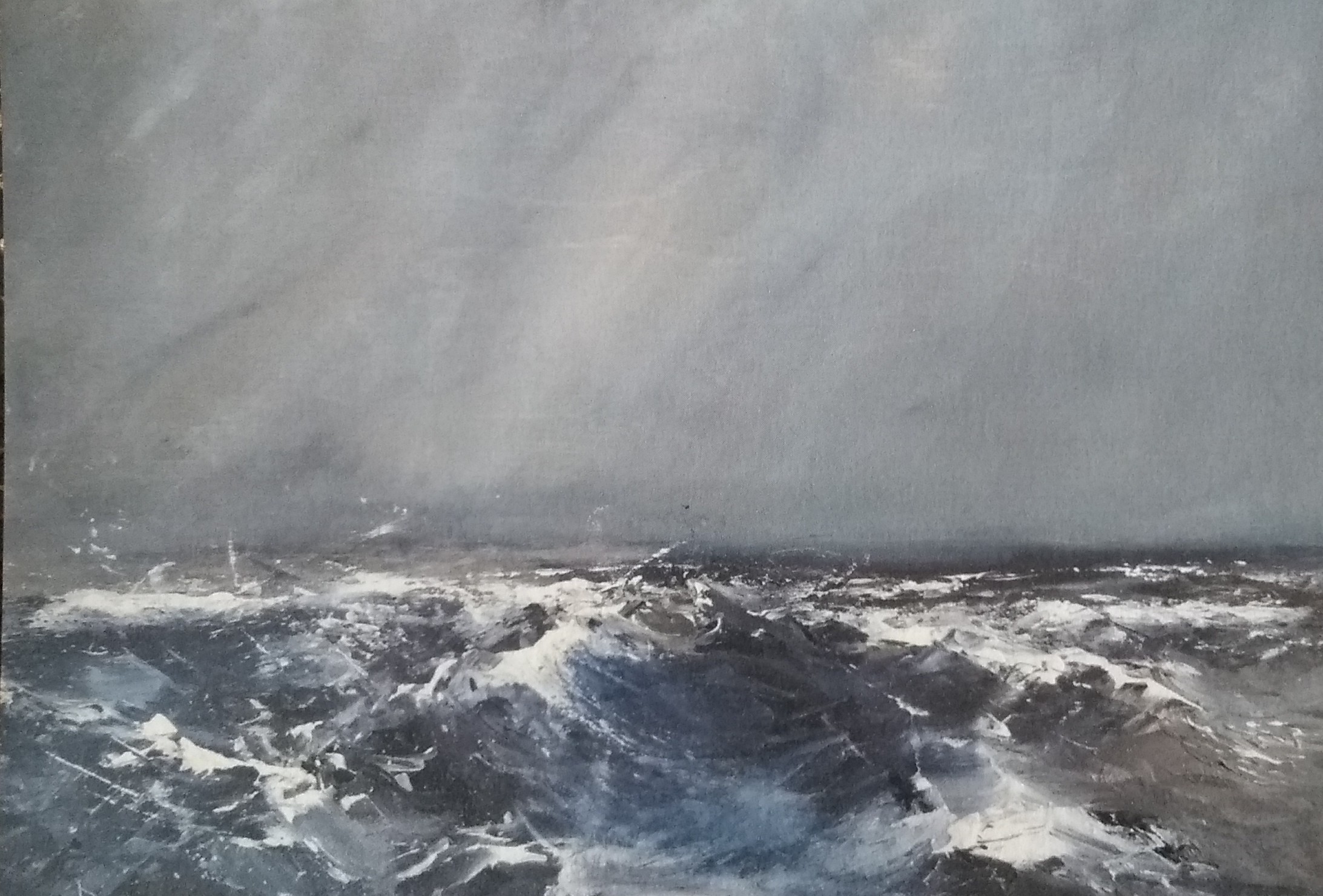
Decorative painting of a stormy seascapeAs part of my undergraduate course on thermodynamics [see ‘Change in focus’ on October 5th, 2022) and in my MOOC on Thermodynamics in Everyday Life [See ‘Engaging learners on-line‘ on May 25th, 2016], I used to ask students to read Chapter 1 ‘The Storm in the Computer’ from Philosophy and Simulation: The Emergence of Synthetic Reason by Manuel Delanda.  It is a mind-stretching read and I recommended that students read it at least twice in order to appreciate its messages.  To support their learning, I provided them with a précis of the chapter that is reproduced below in a slightly modified form.

At the start of the chapter, the simplest emergent properties, such as the temperature and pressure of a body of water in a container, are discussed [see ‘Emergent properties’ on September 16th, 2015].  These properties are described as emergent because they are not the property of a single component of the system, that is individual water molecules but are features of the system as a whole.  They arise from an objective averaging process for the billions of molecules of water in the container.  The discussion is extended to two bodies of water, one hot and one cold brought into contact within one another.  An average temperature will emerge with a redistribution of molecules to create a less ordered state.  The spontaneous flow of energy, as temperature differences cancel themselves, is identified as an important driver or capability, especially when the hot body is continually refreshed by a fire, for instance.  Engineers harness energy gradients or differences and the resultant energy flow to do useful work, for instance in turbines.

However, Delanda does not deviate to discuss how engineers exploit energy gradients.  Instead he identifies the spontaneous flow of molecules, as they self-organise across an energy gradient, as the driver of circulatory flows in the oceans and atmosphere, known as convection cells.  Five to eight convections cells can merge in the atmosphere to form a thunderstorm.  In thunderstorms, when the rising water vapour becomes rain, the phase transition from vapour to liquid releases latent heat or energy that helps sustain the storm system.  At the same time, gradients in electrical charge between the upper and lower sections of the storm generate lightening.

Delanda highlights that emergent properties can be established by elucidating the mechanisms that produce them at one scale and these emergent properties can become the components of a phenomenon at a much larger scale.  This allows scientists and engineers to construct models that take for granted the existence of emergent properties at one scale to explain behaviour at another, which is called ‘mechanism-independence’.  For example, it is unnecessary to model molecular movement to predict heat transfer.  These ideas allow simulations to replicate behaviour at the system level without the need for high-fidelity representations at all scales.  The art of modelling is the ability to decide what changes do, and what changes do not, make a difference, i.e., what to include and exclude.

Source:

Manuel Delanda Philosophy and Simulation: The Emergence of Synthetic Reason, Continuum, London, 2011.

Image: Painting by Sarah Evans owned by the author.

Global citizenship in the context of COP27

About five years ago I wrote a long piece for the Citizens of Everywhere project and also published it on this blog [see ‘We are citizens of the world‘ on April 5th, 2017].  One theme of the essay was the way in which scientists and engineers work as part of a global community contributing to, and exploiting, a shared knowledge and understanding of natural and manufactured phenomena; and in this process, as global citizens, we are relatively unaware and uninfluenced by the national boundaries drawn and fought over by politicians and leaders.  Engineers frequently draw boundaries to define a system for analysis [see ‘Drawing boundaries‘ on December 19th, 2012] but we understand that they do not exist in reality so energy and, sometimes, matter can flow across them.  Similarly, national boundaries are man-made constructs, occasionally existing in physical reality such as the Berlin Wall, but usually only on a map.  Most people would like to be able move freely around the world; however, we are often restricted from crossing borders by the location of our mother when she gave birth to us.  Gaia Vince in her book, Nomad Century: How to Survive the Climate Upheaval, has suggested that assigning nationality based on your birthplace is arbitrary and instead we should have a universal UN citizenship with a national affiliation.  This might be one small step towards achieving peaceful mass migrations from uninhabitable zones created by major changes in the Earth’s climate.  There could be 1.5 billion environmental migrants by 2050 according to the UN’s International Organisation for Migration – that’s one in five people!

As I have argued before [see ‘Planetary Emergency‘ on February 20th, 2019], our politicians need to stop arguing about borders and starting worrying about the whole planet not just at COP27 but in everything they do. We are all in this together and no man-made border will protect us from the impact of making the planet a hostile environment for life.

Source: Anjana Ahuja, Acclimatising to crisis, FT Weekend, 27 August/28 August 2022.

The world is not our oyster

We think it is all about us. The world is our oyster. We developed the current global economic structure in which the costs of environmental damage, labour exploitation, and socio-political disruption are ignored, or perhaps even celebrated, as the price of doing business. Our philosophy stumbles over the word ‘equal’ because it maintains that we have dominion over all that is nature. We struggle to imagine that others might know something we don’t, or that fish and trees have languages of their own. If such understanding was possible for us, life on earth would not becoming to an end.

The words are mine but I have borrowed very heavily from Geetanjali Shree in ‘The Tomb of Sand‘ for the first two and last two sentences. She is describing white people and the West. Also from Chandran Nair in ‘Dismantling Global White Privilege: Equity for a post-Western World‘ in the third sentence and from Suzanne Simard in ‘Finding the Mother Tree‘.

Sources:

Chandran Nair, Dismantling Global White Privilege: Equity for a post-Western World, Berrett-Koehler Publishers Inc, 2022

Geetanjali Shree, The Tomb of Sand, Tilted Axis Press, 2021.

Suzanne Simard, Finding the Mother Tree, Penguin, 2021.


The rest of the planet has been waiting patiently for us to figure it out

Research in British Columbia has found evidence of nitrogen from fish in tree rings.  The salmon that swim in the local rivers provide food for predators, such as bears and eagles, who leave the remains of the salmon lying around on the floor of the forest where it decomposes allowing the trees to absorb the nitrogen embedded in the bones of the salmon.  In some cases, up to three-quarters of a tree’s nitrogen is from salmon.  This implies that interfering in the life cycle of the salmon, for instance by commercial fishing, will impact on its predators, the forest and everything that is dependent on or interacts with the trees.  The complex nature of these interconnections have been apparent to the aboriginal peoples of the world for a very long time [see ‘Blinded by reductionism‘ on August 24th, 2022].  To quote Suzanne Simard, ‘Mistreatment of one species is mistreatment of all.  The rest of the planet has been waiting patiently for us to figure that out’.

Source: Suzanne Simard, Finding the Mother Tree, Penguin, 2021.

Image: photograph of an original painting bought by the author in Beijing