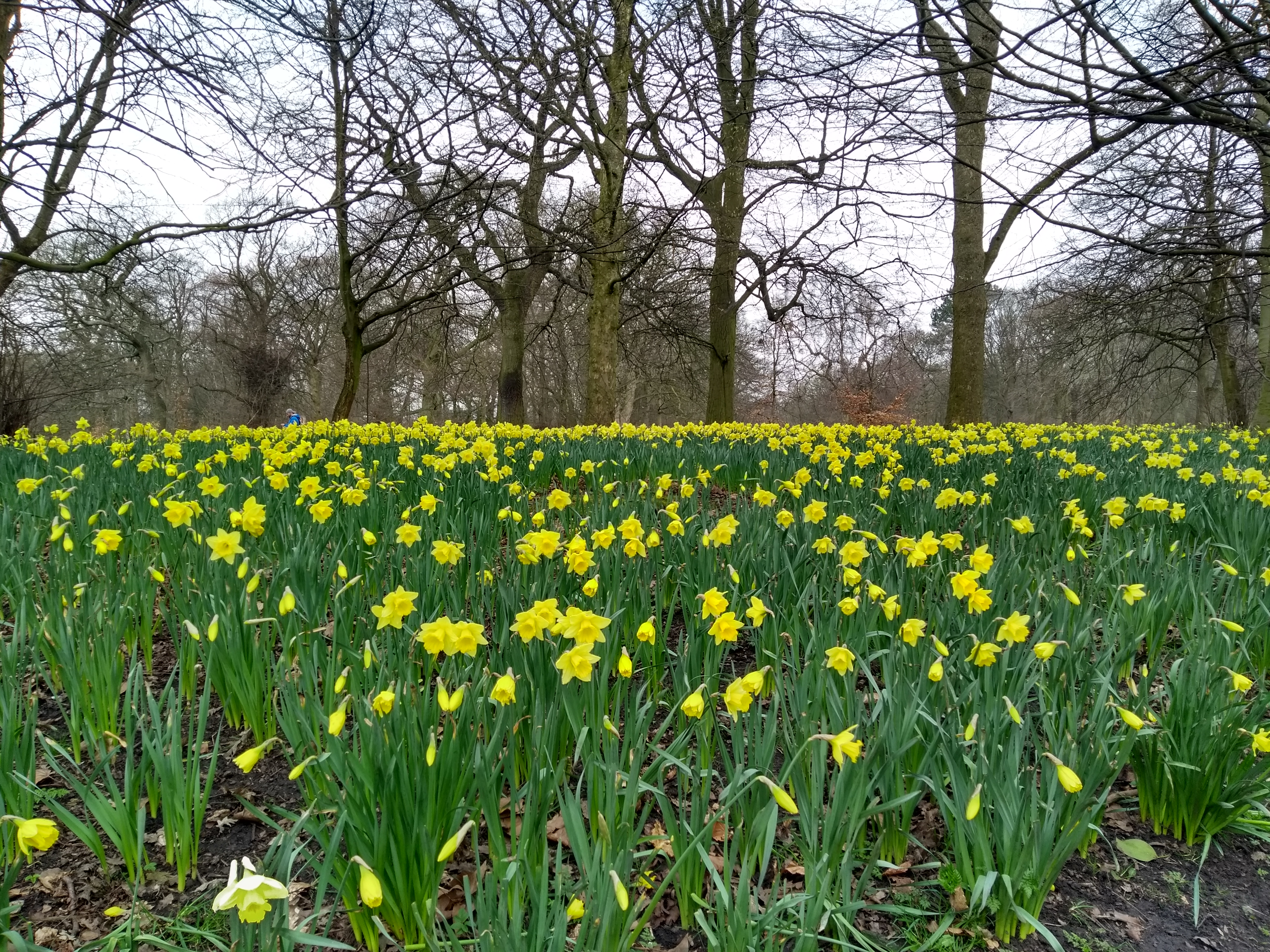
Traditionally in Easter week, I go to the Lake District for a week of hill-walking with my family and a digital detox [see ‘Eternal non-existence‘ on April 24th, 2019 and ‘Gone walking‘ on April 19th, 2017]. For the second year in succession, we have had to cancel our trip due to the national restrictions on movement during the pandemic [see ‘Walking and reading during a staycation‘ on April 15th, 2020]. I am still attempting a digital detox but the walking is restricted to a daily circuit of our local park. While Sefton Park is not on the scale of Central Park in New York or Regent’s Park in London, it is sufficiently large that a walk to it, round its perimeter and home again takes us about two hours. It might not be as strenuous as climbing Stickle Pike but it is better than repeatedly climbing the stairs which was the limit of our exercise last year [see ‘Virtual ascent of Moel Famau‘ on April 8th, 2020]. We might not be allowed to leave our locality but we can switch off all of our devices, do some off-line reading (see ‘Reading offline‘ on March 19th, 2014), slow down, breathe our own air (see ‘Slow down, breathe your own air‘ on December 23rd, 2015) and enjoy the daffodils.
Category Archives: Soapbox
It’s tiring looking at yourself
For many people Zoom fatigue is very real. It has been studied by Jeremy Bailenson at Stanford University [see ‘‘Zoom fatigue’ brought into focus by Stanford study‘ in the FT on February 26th, 2021]. He found that one source of tiredness was the high level of self-evaluation that arises from continually having to look at a video of yourself. Of course, it is easy to fix by choosing not to display your own video on your screen. We all have two egos: one is our subjectivity or the physical sensations registered by our body via our senses; and, the other is our reputation or the reflection of ourselves which forms our social identity [see ‘A reflection on existentialism‘ on December 20th, 2017]. Gloria Orrigi describes this second self as not a simple reflection but one that is ‘warped, amplified, redacted and multiplied in the eyes of others’. Perhaps it is hardly surprising that being constantly exposed to the view of ourselves being seen by others over a video conference raises our level of fatigue as we subconsciously and constantly review the impression being made on others. Orrigi describes our reputation as being like the trail left by snails has they slither over surfaces. Our social interactions with others leave deposits in their minds that become an information trail that we cannot erase and can only partially control. The pandemic has forced many of our social interactions to be via the internet which means they also leave electronic trails over which we have little control and cannot erase; however, we probably worry less about these traces than we do those left in the minds of others. Perhaps that is why our conversations lack spontaneity when conducted via a Zoom call [see ‘Distancing ourselves from each other‘ on January 13th, 2021] or maybe it’s just because it’s very difficult to gossip on a video conference even using the ‘chat’ function. Robin Dunbar has suggested that the real reason language evolved in humans is to allow us to gossip and thus maintain the social cohesion. If we are suffering from a loss of social cohesion caused by a lack of gossip then it is likely our stress levels would be raised causing us further fatigue. So, maybe we should be picking up our phones and calling people for a chat instead of scheduling meetings on Zoom.
The picture is the photograph of me that others see when I switch off my camera in an internet call. It’s a selfie with which I am happy, for the moment anyway.
Sources:
Robin Dunbar, Grooming, gossip and the evolution of language, London: Faber and Faber, 1996.
Gloria Origgi, Reputation: what it is and why it matters, Princeton: Princeton University Press, 2018.
Collegiality as a defence against pandemic burnout
Many of my less experienced colleagues ask, ‘what is collegiality?’ Collegiality is the glue that holds universities together according to Neeta Baporikar. While Roland S. Barth suggested that if students are to learn and develop, then their teachers must also learn and develop and collegiality is the set of practices and culture that support this adult growth. In this context, Thomas Hoerr has proposed that collegiality has five components: (i) teachers talking about students with teachers; (ii) teachers working together to develop education programmes; (iii) teachers observing one another; (iv) teachers teaching each other; and (v) teachers talking about education and working together on committees. Neeta Baporikar echoes this view by concluding that if we hope to teach students to participate, examine issues, collaborate, think critically and synthesise new approaches then we should be their model.
In an environment where research is a priority, it is possible to substitute ‘researcher’ for ‘teacher’ in the descriptions above. Then collegiality becomes researchers talking about [research] students, researchers working together to develop research programmes, researchers observing one another, researchers teaching each other, and researchers talking about research and working together on committees. The idea that collegiality is a strategy for excellence holds as well as for research as it does for teaching.
The pressures on early career academics in a research university can be intense and the temptation to focus exclusively on delivering teaching and performing research can lead individuals to work in isolation and to neglect the opportunities provided by active engagement with their colleagues. However, leaders must also take responsibility for creating an environment in which collegiality can thrive and encouraging active participation – it is part our service to the academic community as leaders to create and maintain a culture of scholarship and excellence [see ‘Clueless on leadership style’ on June 14th, 2017]. Neeta Baporikar provides steps that heads of departments can take to nurture collegiality, including providing a vision, encouraging collaborative participation, listening to diverse opinions, building on people’s strengths, and being aware of the world outside the department. This is similar to the shepherding approach to leadership that I wrote about in May 2017 [‘Leadership is like shepherding’ on May 10th, 2017]. However, it has all become much more difficult in a pandemic – both collegiality and leadership. Last week an article in Nature suggested that pandemic burnout is rife amongst academics working long hours in isolation to transpose and deliver their teaching materials online, to maintain their research without the spontaneity of face-to-face discussions with their team or collaborators, and to support the well-being and mental health of students who are also at risk of burnout. It is suggested that burnout can be managed by finding a forum to express your feelings, creating ways to detach from stress, prioritizing and normalizing conversations about mental health, and fighting the isolation through meeting with peers. These steps are a combination of traditional collegiality and the five ways to well-being: connect, be active, take notice, keep learning and give [see graphic in ‘On the impact of writing on well-being’ on March 3rd, 2021].
References
Neeta Baporikar, Collegiality as a strategy for excellence in academia, IJ Strategic Change Management, 6(1), 2015.
Roland Barth, Improving schools from within, Jossey-Bass, 2010.
Virginia Gewin, Pandemic burnout is rampant in academia, Nature, 591: 489-491, 2021.
Thomas R. Hoerr, Principal Connection: The Juggler’s Guide to Collegiality, Communication Skills for Leaders, 72(7): 88 -89, 2015.
On the impact of writing on well-being
Last week, the continuation until at least the end of March of the lockdown, which has been in place in England since the start of the year, was announced. Many people are feeling jaded and worn out by the constraints and hardships imposed by the lockdown and are struggling to maintain their well-being and mental health. While others are trying to cope with the direct impact of the coronavirus on themselves and their family and friends. I have written before about the power of writing to transport me away from the pressures of everyday life [see ‘Feeling extraordinary at ease‘ on January 8th, 2020] and to help me order my thoughts [see ‘Thinking more clearly by writing weekly‘ on May 2nd, 2018]. These posts were inspired by reading books by Natalia Ginzburg and Sylvain Tesson. I have just finished reading ‘A Fly Girl’s Guide to University‘ edited by Odelia Younge in which Suhaiymah Manzoor-Khan writes about ‘times when my mental health was bad…writing became a solace and a friend’. In the context of institutional pressures, racism and exclusion, she describes writing about her feelings to help her to feel and listening to her own voice when nobody else would. I was reading the book to gain an appreciation of the experiences of woman of colour in a university; however, I think Manzoor-Khan’s words are relevant to everyone, especially when we are locked away and can only meet with much of our support networks via our computers and phones. Tim Hayward, in the FT in January 2021, wrote a deeply moving and insightful account of his experience of fighting coronavirus, including ten days on life support, and concludes by reflecting on how writing the article helped him handle the trauma. Of course, you don’t have to write for a newspaper, a book or a blog; although writing for an audience does focus your mind, you can write for yourself or friend and in doing so you can keep learning, take notice of your surroundings, and connect with people which will hit three out of five of the ways to well-being.
Sources:
Lola Olufemi, Odelia Younge, Waithera Sebatindira & Suhaiymah Manzoor-Khan, A Fly Girl’s Guide to University, Verve Poetry Press, Birmingham, 2019
Tim Hayward, Covid and me: 10 days on life support, FT Magazine, January 22nd, 2021.