Category Archives: Soapbox

Unlikely failure

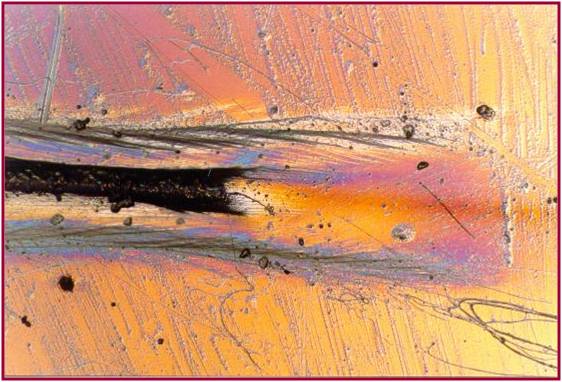
High magnification image of a crack in polycarbonate viewed in polarised light which reveals fringes that a proportional to the stress in the material.

I used the term ‘unlikely to fail’ in my last post, in the context of engineering designs.  This might appear alarming, since people might assume that engineers design things to never fail.  However it is impossible to design with a certainty that failure will not happen.  There are several reasons for this, including: the conflicting requirements of less material to reduce cost and achieve sustainability and of more material to protect against failure; our lack of knowledge about in-service and exceptional operating conditions; and the extent, or otherwise, that the computational model used in the design analysis represents the real world.

Hence the phrase ‘unlikely to fail’.  We can reduce the likelihood, or probability, of failure, usually at additional financial and resource cost, but we can never reduce the probability to zero, i.e. there is always a risk of failure, although we do our best to ensure that designs are ‘unlikely to fail’.
Model validation

Front cover of ASME V&V 10-2006, Guide for verification and validation in computational solid mechanics, American Society of Mechanical Engineers, New York, 2006.

Why is validation important?  Validation of computational mechanics models is defined as ‘determining the degree to which a model is an accurate representation of the real world from the perspective of the intended uses of the model’, according to  ASME V&V 10-2006.  So, the validation of models of structural integrity for engineering design provides information about the degree to which the simulation results from the model can be believed.  This in turn helps in making decisions about how little material, and in what configuration, should be used to create elegant, sustainable designs that are unlikely to fail. So validation of computational mechanics models is an essential step in solving the ‘two earths’ dilemma (see post on August 13th, 2012).

Model credibility

Last week I spoke at the annual conference of the Associazione Italiana per ‘Analisi dell Sollecitazioni in Vicenza, Italy on the role of experimental mechanics in the validation of computational models used in engineering simulations.  We discussed the conflict between reducing cost and energy consumption and increasing performance and reliability of engineering machines and vehicles.  Generally, the former implies using less material more efficiently, while the latter tends to require the use of more material.  Engineers resolve this conflict by using computational models when optimising designs to simulate engineering behaviour.  The development of elegant and successful designs requires a high level of credibility in the models.  This credibility can be established by comparing the results from models with those from specially-conducted experiments; a process that is known as ‘validation’.

Innovation jobs

Yesterday, I listened to an interesting talk by Dr Liang-Gee Chen, President of the National Applied Research Laboratories of Taiwan at the UK-Taiwan Academic-Industry & Technology Transfer Collaboration Forum organised by the British Council.  He presented some statistics from the Kaufmann Foundation [http://www.kauffman.org/research-and-policy/business-dynamics-statistics.aspx], which demonstrated that nearly all new jobs in the USA are generated by new companies.  When you combine this with my conclusion in my posting on ‘Population crunch’, that we need a higher level of innovation in engineering, then we need to review the education programmes provided for our engineers to ensure that they include innovation and entrepreneurship.  These need to be integrated in engineering education programmes [see Handscombe et al, 2009].  We seem to have lost the plot in the UK and retreated to teaching engineering science, design and management orientated towards the employers with the loudest voice, i.e. multi-nationals, who are not likely to be the source of innovation jobs that will pull us out of the global recession.

Handscombe, R.D., Rodriguez-Falcon, E., Patterson, E.A., 2009, ‘Embedding enterprise in engineering’, IJ Mechanical Engineering Education, 37(4):263-274.