Tag Archives: Thermodynamics

Ample sufficiency of solar energy?

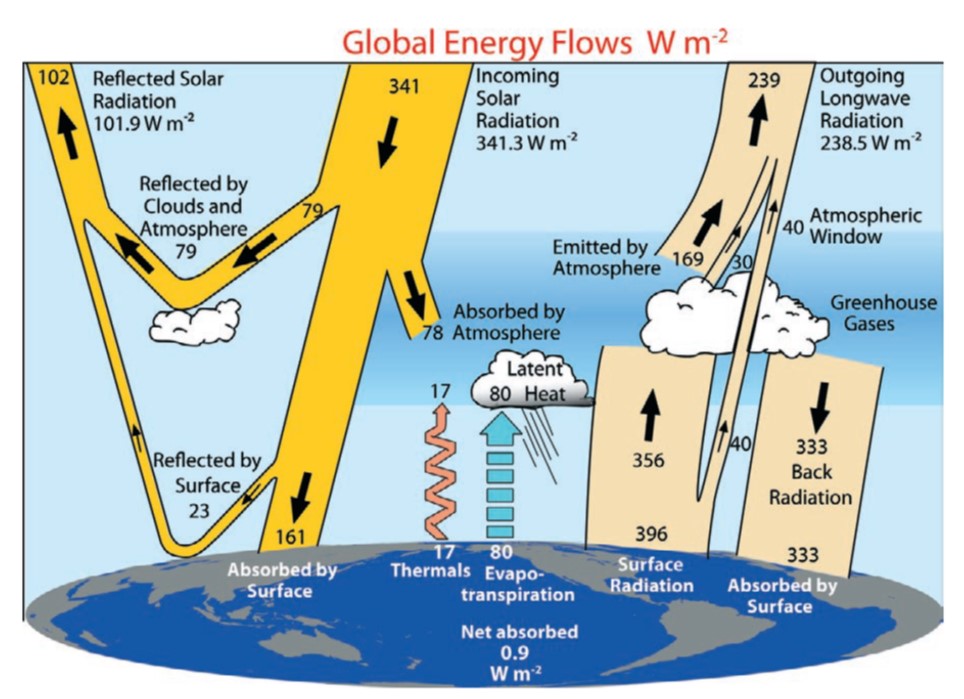
Global energy budget from Trenberth et al 2009

I have written several times about whether or not the Earth is a closed system [see for example: ‘Is Earth a closed system? Does it matter‘ on December 10th, 2014] & ‘Revisiting closed systems in Nature‘ on October 5th, 2016).  The Earth is not a closed thermodynamic system because there is energy transfer between the Earth and its surroundings as illustrated by the schematic diagram. Although, the total incoming solar radiation (341 Watts/sq. metre (W/m²)) is balanced by the sum of the reflected solar radiation (102 W/m²) and the outgoing longwave radiation (239 W/m²); so, there appears to be no net inflow or outflow of energy.  To put these values into perspective, the world energy use per capita in 2014 was 1919 kilograms oil equivalent, or 2550 Watts (according to World Bank data); hence, in crude terms we each require 16 m² of the Earth’s surface to generate our energy needs from the solar energy reaching the ground (161 W/m²), assuming that we have 100% efficient solar cells available. That’s a big assumption because the best efficiencies achieved in research labs are around 48% and for production solar cells it’s about 26%.

There are 7.6 billion of us, so at 16 m² each, we need  120,000 square kilometres of 100% efficient solar cells – that’s about the land area of Greece, or about 500,000 square kilometres with current solar cells, which is equivalent to the land area of Spain.  I picked these countries because, compared to Liverpool, the sun always shines there; but of course it doesn’t, and we would need more than this half million square kilometres of solar cells distributed around the world to allow the hours of darkness and cloudy days.

At the moment, China has the most generating capacity from photovoltaic (PV) cells at 78.07 GigaWatts or about 25% of global PV capacity and Germany is leading in terms of per capita generating capacity at 511 Watts per capita, or 7% of their electricity demand.  Photovoltaic cells have their own ecological footprint in terms of the energy and material required for their production but this is considerably lower than most of our current sources of energy [see, for example Emissions from photovoltaic life cycles by Fthenakis et al, 2008].

Sources:

Trenberth KE, Fasullo JT & Kiehl J, Earth’s global energy budget, Bulletin of  the American Meteorological Society, March 2009, 311-324, https://doi.org/10.1175/2008BAMS2634.1.

World Bank Databank: https://data.worldbank.org/indicator/EG.USE.PCAP.KG.OE

Nield D, Scientists have broken the efficiency record for mass-produced solar panels, Science Alert, 24th March 2017.

2016 Snapshot of Global Photovoltaic Markets, International Energy Agency Report IEA PVPS T1-31:2017.

Fthenakis VM, Kim HC & Alsema E, Emissions from photovoltaic life cycles, Environmental Science Technology, 42:2168-2174, 2008.

Steamy show

The Australian Academy of Technology and Engineering published a report sometime ago called ‘Technology is really a way of thinking‘.  They were right.  Once you become an engineer, then you can’t help looking at everything through the same ‘technology’ lens.  Let me give you an example.

A couple of weekends ago we went to see  ‘Anthony and Cleopatra‘ performed by the Royal Shakespeare Company in Stratford-upon-Avon.  It was a magnificient spectacle and a captivating performance, especially by Josette Simon as Cleopatra.  Before the performance started, we couldn’t help noticing the columns of steam forming in the auditorium from the ceiling downwards.  Initially, we thought that they were a stage effect creating an atmosphere in the theatre; but then I realised, it was ‘steam’ forming as the air-conditioning pushed cold air into the auditorium.  It’s the same effect that sometimes causes alarm on an aircraft, when it appears that smoke is billowing into the cabin prior to take-off.

The air in the theatre was a mixture of air and water vapour that was warm enough that the water was completely gaseous, and hence, invisible.  However, when the air-conditioning pumped cold air into the theatre, then the mixture of air and water was cooled to below the dew point of the water vapour causing it to condense into small droplets that were visible in the auditorium’s downlighters, forming the columns of ‘steam’.  Of course, the large mass of warm air in the auditorium quickly reheated the cold air, causing the droplets to evaporate and the columns of steam to disintegrate.  Most people just enjoyed the play; it’s just the technologists that were preoccupied with what caused the phenomenon!

If you want a more technical explanation, in terms of partial pressures and psychrometry, then there is an Everyday Engineering Example lesson plan available : 5E lesson plan T10 – psychrometric applications.

Picture: https://www.rsc.org.uk/shop/item/30200-anthony-and-cleopatra-poster-2017/

Is the world incomprehensible?

For hundreds of years, philosophers and scientists have encouraged one another to keep their explanations of the natural world as simple as possible.  Ockham’s razor, attributed to the 14th century Franciscan friar, William of Ockham, is a well-established and much-cited philosophical principle that of two possible explanations, the simpler one is more likely to be correct.  More recently, Albert Einstein is supposed to have said: ‘everything should be made as simple as possible, but not simpler’.  I don’t think that William of Ockham and Albert Einstein were arguing that we should keep everything simple; but rather that we should not make scientific explanations more complicated than necessary.  However, do we have a strong preference for focusing on phenomena whose behaviour is sufficiently uncomplex that it can be explained by relatively simple theories and models?  In other words, to quote William Wimsatt, ‘we tend to ignore phenomena whose complexity exceeds the capability of our detection apparatus and explanatory models’.  Most of us find science hard; perhaps, this is not just about the language used by the cognoscenti to describe it [see my post on ‘Why is thermodynamics so hard?‘ on February 11th, 2015]; but, more about the complexity of the world around us.  To think about this level of complexity requires us to assemble and synchronize very large collections of neurons (100 million or more) in our brains, which is the very opposite of the repetitive formation of relatively small assemblies of neurons that Susan Greenfield has argued are associated with activities we find pleasurable [see my post entitled ‘Digital hive mind‘ on November 30th, 2016].  This might imply that thinking about complexity is not pleasurable for most us, or at least requires very significant effort, and that this explains the aesthetic appeal of simplicity.  However, as William Wimsatt has pointed out, ‘simplicity is not reflective of a metaphysical principle of nature’ but a constraint applied by us; and which, if we persist in its application, will render the world incomprehensible to us.

Sources:

William C. Wimsatt, Randomness and perceived randomness in evolutionary biology, Synthese, 43(2):287-329, 1980.

Susan Greenfield, A day in the life of the brain: the neuroscience of consciousness from dawn to dusk, Allen Lane, 2016.

Consensus is just a coffee break

milk in coffee‘Consensus is just a coffee break’ to quote Caputo. He argued that if consensus was the ultimate aim then eventually we would all stop talking. The goal of conversation would be silence and as he wrote that would be a strange outcome for a species defined by its ability to speak. It is differences that drive everything: innovation, progress and the processes of life.

In thermodynamics, William Thomson (Lord Kelvin) observed that heat flows into the random motion of molecules and is never recovered, so that eventually a universe of uniform temperature will be created. When heat flows between matter at different temperatures we can extract work, for instance, using a heat engine. No work could be extracted from a universe of uniform temperature and so nothing would happen. Life would cease and there would be cosmic death [see my posts entitled ‘Will it all be over soon‘ on November 2nd, 2016 and ‘Cosmic Heat Death‘ on February 18th, 2015].

In the Hitchhiker’s Guide to the Galaxy, the crew of the Heart of Gold contemplated whether relationships between people were susceptible to the same laws that governed the relationships between atoms and molecules. The answer would appear to be affirmative in terms of dissonance being necessary for action.

So, we should celebrate and respect the differences in our communities. They are essential for a functioning, vibrant and successful society – without them life would not just consist of silent conversations but would cease completely.

Sources:

Caputo JD, Truth: Philosophy in Transit, London: Penguin 2013

Douglas Adams, The Hitchhiker’s Guide to the Galaxy, London: Picador, 2002.