Tag Archives: mechanical engineering

Reasons I became an engineer: #4

Images from the optical microscope showing the tracks of bacteria interacting with a surfaceThis is the last in a series of posts reflecting on my steps towards becoming an engineer.  At the end of the previous post, I described how I moved to Canada becoming a biomedical engineer in the Medical School at the University of Calgary.  It was a brief period of my career, because shortly after I started, I was encouraged to apply for a lectureship in mechanical engineering at my alma mater which I did successfully.  So, I returned to the University of Sheffield and started my career as an academic engineer.  I continued to work in biomedical engineering, focussing initially on cardiac mechanics [see ‘Tears in the heart’ on July 20th, 2022], then on osseointegrated prostheses [see ‘Turning the screw in dentistry’ on September 9th, 2020] and, more recently, on computational biology [see ‘Hierarchical modelling in engineering and biology’ on March 14th, 2018] and cellular dynamics [see ‘Label-free real-time tracking of individual bacterium’ on January 25th, 2023].  However, the dominant application area of my research has been aerospace engineering informed by, if not also influenced by, my experiences in the Royal Navy, including flying a jet trainer aircraft shortly before leaving.  In the last decade, I have been introduced to nuclear reactor engineering, both fission and fusion, and have used them as vehicles for developing research in digital engineering [see ‘Thought leadership in fusion engineering’ on October 9th, 2019].  This biographical series of posts has described my evolution as an engineer – it was not an ambition I ever had nor did anyone push me towards engineering but I have found that my way of thinking about problems is well-suited to engineering, or perhaps engineering has taught me a way of thinking.

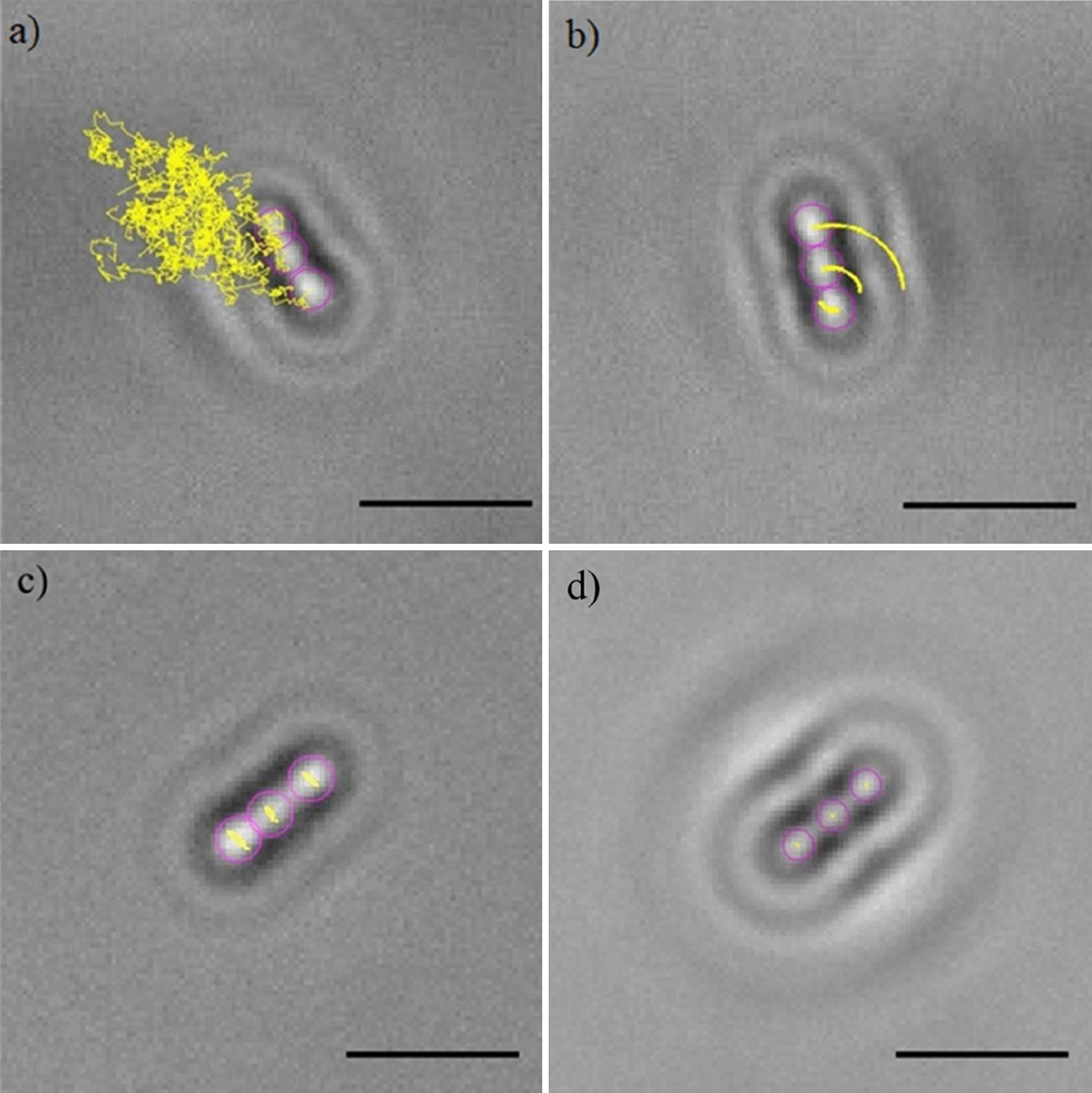
Image: Figure 4 – Tracks (yellow lines) of the sections (purple circles) of four E. coli bacteria experiencing: (a) random diffusion above the surface; (b) rotary attachment; (c) lateral attachment; (d) static attachment. The dynamics of the four bacteria was monitored for approximately 20 s. The length of the scale bars is 5 μm. From Scientific Reports, 12:18146, 2022.

Reasons I became an engineer: #3

Decorative image of photoelastic fringe pattern in section of jet engine componentThis is third in a series of posts reflecting on my path to becoming an engineer.  In the previous one, I described how I left the Royal Navy and became a research assistant at the University of Sheffield in the Department of Mechanical Engineering [see ‘Reasons I became an engineer: #2’ on May 3rd, 2023].  My choice of research topic was dictated by the need for a job because I had to buy myself out of the Royal Navy after they had sponsored my undergraduate degree and I needed a salary to allow me to make the monthly payments.  So, I accepted the first job that was offered when I went back to the University to talk about my options.  I worked on investigating the load and stress distributions in threaded connections with a view to designing bolted joints that would be lighter, stronger and with a longer life.  We used a combination of finite element modelling [see ‘Did cubism inspire engineering analysis?’ on January 25th 2017] and three-dimensional photoelasticity, which is an experimental technique that has fallen out of fashion [see ‘Art and Experimental Mechanics’ on July 17th, 2012].  I was fortunate because all of my work as a research assistant went into my PhD thesis which although not ground-breaking resulted in several journal papers [see ’35 years later and still working on a PhD thesis’ on September 16th 2020] and, with the help of personal contacts, a post-doctoral fellowship at the Medical School at the University of Calgary, Canada.  In Calgary, I worked on the design of experiments to measure the stress in the pericardium, which is a sac that surrounds the heart – still engineering but a major shift in focus from industrially-focussed mechanical engineering toward biomedical engineering.

Image: Fringe pattern in section of photoelastic model of jet engine showing distribution of stress from Patterson EA, Brailly P & Taroni M, High frequency quantitative photoelasticity applied to jet engine components, Experimental Mechanics, 46(6):661-668, 2006.

Reasons I became an engineer: #2

Decorative photograph showning the entrance to the Engineering Faculty at the University of SheffieldThis is the second in a series of posts reflecting on my route to becoming an engineer.  In the first one I described how I chose a degree in mechanical engineering so that I would have appreciation of the technical difficulties that engineers might cite when requesting operational changes for a ship that I hoped one day to command [see ‘Reasons I became an engineer: #1’ on April 19th, 2023].  I think I selected mechanical engineering because it provided a broader engineering education than other engineering degrees and I did not know enough to choose any other branch of engineering.  I went to the University of Sheffield and during vacations returned to the Royal Navy serving onboard HMS Active and flew out to join her wherever she was in the world, except when I went to the Royal Navy Engineering College at Manadon outside Plymouth to undertake engineering applications training.  I cast a brass nameplate, which I still have in my office, and made a toolbox that I also still have at home.  After graduation, I returned full-time to the Royal Navy as a sub-lieutenant and started my career as a naval officer in the executive or seaman branch.  However, I did not settle and missed engineering so I asked for and was refused a transfer to the Royal Corps of Naval Constructors who work on the design and development of warships.  As a result, I resigned my commission in the Royal Navy and got a job as a research assistant in the Department of Mechanical Engineering at the University of Sheffield where I registered for a PhD in engineering.  I had taken a positive step towards becoming an engineer but perhaps on the premise of what I did not want to do rather than what I did want to do.

Reasons I became an engineer: #1

Photograph of aircraft carrier in heavy seas for decorative purposes onlyThis is the first in a series of posts in which I am going to reflect on my route to becoming an engineer.  These events happened around forty years ago so inevitably my recollections probably have more in common with folklore than reliable history.  Nevertheless, I hope they might be of interest.

I was good at mathematics at school but also geography and when required to specialise at the age of sixteen would have preferred to study mathematics, geography and perhaps economics.  However, my parents and my school, had other ideas and decided that partnering chemistry and physics with mathematics would give me more opportunities in terms of university courses and careers.  Physics was manageable but Chemistry was a complete mystery to me.  I left school shortly before my eighteenth birthday and joined the Royal Navy as a midshipman.  I went to Dartmouth Naval College where, as part of my training to become a seaman officer, I was taught to march, navigate, fight fires, sail yachts, drive motor launches and fly helicopters as well as spending time with the Royal Marines.  After my basic naval training, which included time at sea on HMS Hermes, I went to University sponsored by the Royal Navy with a free choice of subject to study.  So, I chose Mechanical Engineering because I thought as an officer on the bridge of a ship, perhaps eventually in command of a ship, it would be useful to understand what the engineers were talking about when they asked for a change in operations due to technical difficulties.  At that stage in my life, I had no intention of becoming an engineer, but with hindsight it was my first step in that direction.