Tag Archives: leadership

Airborne urban mobility

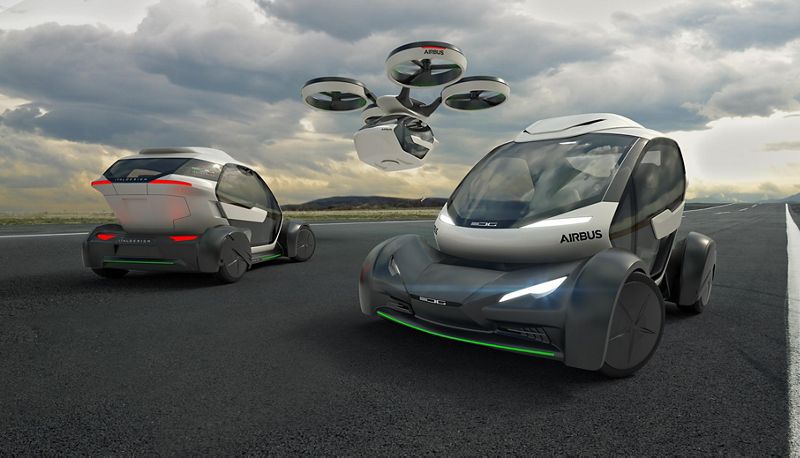
Pop.Up_copyright Italdesign 2

At the Airbus PhD workshop that I attended a couple of weeks ago [see my post entitled Making Engineering Work for Society on September 13th 2017], Axel Flaig, Head of Airbus Research and Technology, gave us an excellent opening presentation describing their vision for the future.  Besides their vision for the next generation of passenger aircraft with reductions in CO2, NOx and noise emissions of 75%, 90% and 65% respectively against 2000 levels by 2050, they are also looking at urban air mobility.  We have 55 megacities [cities with a population of more than 10 million] and it is expected that this will increase to 93 by 2035 [see my post entitled ‘Hurrying Feet in Crowded Camps’ on August 16th, 2017].  These megacities are characterized by congestion and time-wasted moving around them; so, Airbus is working on designs for intra-city transport that takes us off the roads and into the air.  Perhaps the most exciting is the electric Pop.up concept that is being developed with Italdesign.  But, Airbus are beyond concepts: they have a demonstrator single-seater, self-pilot vehicle, the Vahana that will fly in 2017 and a multi-passenger demonstrator scheduled to fly in 2018.

Soon, we will have to look left, right and up before we cross the road, or maybe nobody will walk anywhere – though that would be bad news for creative thinking [see my post on ‘Gone Walking’ on 19th April 2017], amongst other things!


Image from http://www.airbus.com/newsroom/press-releases/en/2017/03/ITALDESIGN-AND-AIRBUS-UNVEIL-POPUP.html where there is also a video.

Wanted: user experience designers

A few weeks ago, I listened to a brilliant talk by Professor Rick Miller, President of Olin College.  He was talking at a conference on ‘New Approaches to Higher Education’.  He tolds us that the most common job description for recent Olin graduates was ‘user experience designer’ rather than a particular branch of engineering.  Aren’t all engineers, user experience designers?  We design, manufacture and maintain structures, machines, goods and services for society.  Whatever an engineer’s role in supplying society with the engineered environment around us, the ultimate deliverable is a user experience in the modern vernacular.

Rick Miller’s point was that society is changing faster than our education system.  He highlighted that the relevance of the knowledge economy had been destroyed by internet search engines.  There is no longer much advantage to be gained by having an enormous store of knowledge in your head, because much more is available on-demand via search engines, whose recall is faster than mine.  What matters is not what you know but what you can do with the knowledge.  And in the future, it will be all about what you can conceive or create with knowledge.  So, knowledge-intensive education should become a thing of the past and instead we need to focus on creative thinking and produce problem-solvers capable of dealing with complexity and uncertainty.

Clueless on leadership style

Sunset from Peppercombe beachStrategic leadership is widely defined as the ability to influence others to voluntarily make decisions that enhance the prospects of the organisation’s success.  In learning and teaching, you could substitute or supplement organisation’s success with the students’ success.   I believe that this is achieved by creating an environment in which your colleagues can thrive and contribute; so, I see leadership of an academic community as being primarily a service involving the creation and maintenance of a culture of scholarship and excellence.

I have led academic departments on both sides of the Atlantic, university-industrial research programmes and various other organisations and initiatives.  However, the standard interview question about my leadership style still tends to stump me – I struggle to identify a consistent approach to my leadership and I am nervous that too much analysis could undermine my ability to lead.  However, by chance, I recently came across Daniel Goleman’s work.  His research has shown that the use of a collection of leadership styles (he identifies six styles), each at the right time and in the right amount, produces the most effective outcomes.  In other words, effective leadership is about being pragmatic and adjusting your approach to suit the circumstances. What’s more, Goleman found that most successful business leaders who followed this pragmatic approach had no idea how they selected the right style for the right time.

Goleman’s work implies that you do not have to conform to one leadership model.  Instead, you can roam across a number of leadership styles and select the right one, for the right situation and use it in just the right amount.  It sounds straightforward but this flexibility is tough to put into action.  Of course, that’s not easy to teach because most of us don’t know how or why we make those decisions but it is related to emotional intelligence and leadership competencies, which we do know how to teach.

Bibliography:

Goleman D, Boyatzis R & McKee, The new leaders: transforming the art of leadership into the science of results, London: Sphere, 2002.

Goleman D, Leadership that get results, Harvard Business Review, 78(2):4-17, 2000.


Leadership is like shepherding

Leadership is like shepherding – selfless and most of the time you have to stand back and watch.  You show them where to forage [provide the vision], you take care of their health and welfare, you protect them against predators [threats] and you worry about them.  But, when all of that’s done, you watch from a distance and feel proud of them.

If you would like to discuss ideas about leadership in science and technology then join us towards the end of this month for a CPD module on Scientific Impact and Reputation, which is part of our Science and Technology Leadership programme at the University of Liverpool in London.

Bibliography:

James Rebank, The Shepherd’s Life, Penguin, 2016.