Tag Archives: Engineering

Slowing down time to think [about strain energy]

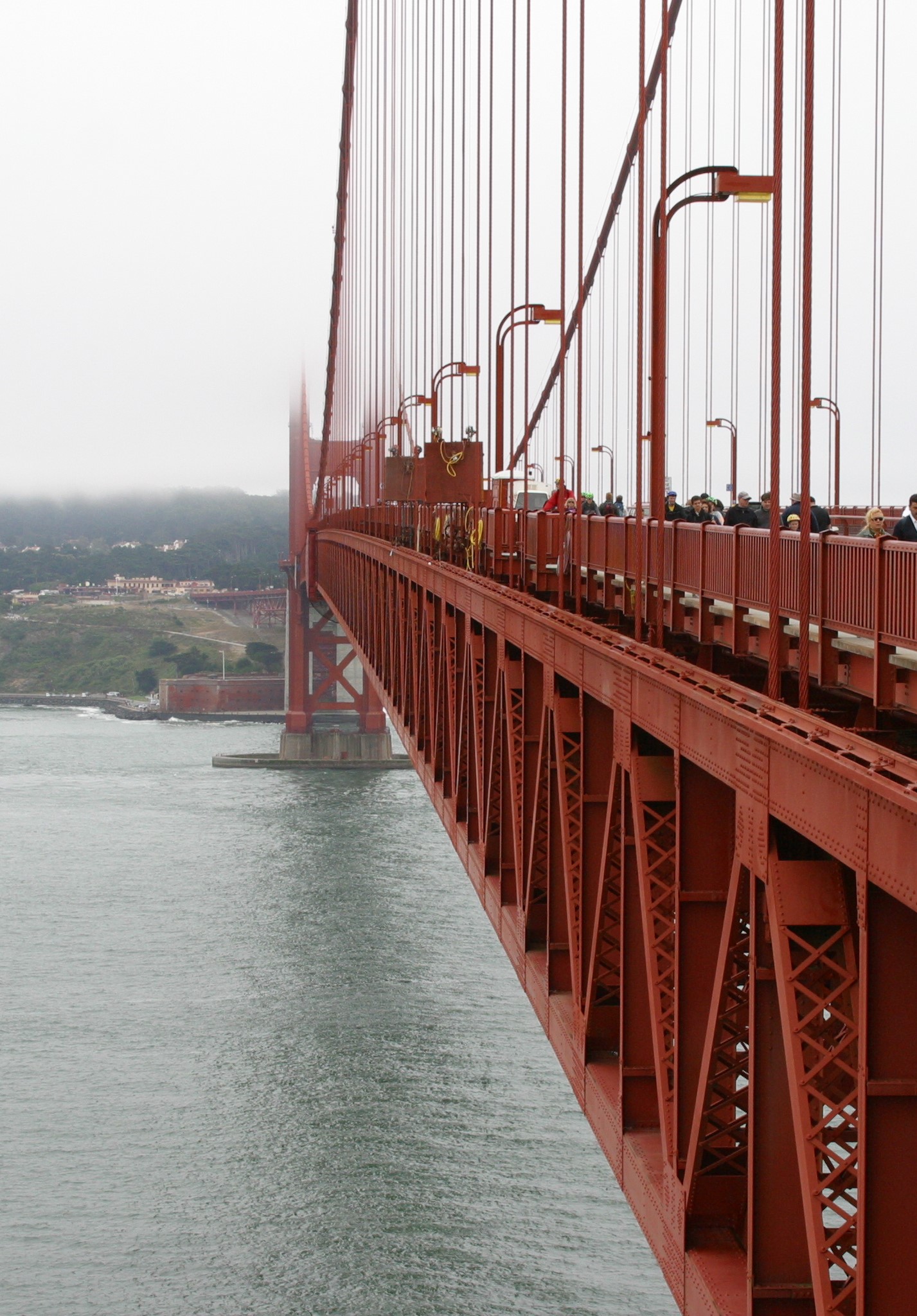
161-6167_imgLet me take you bungee jumping.  I should declare that I am not qualified to do so, unless you count an instructor’s certificate for rock-climbing and abseiling, obtained about forty years ago.  For our imaginary jump, pick a bridge with a good view and a big drop to the water below and I’ll meet you there with the ropes and safety gear.

It’s a clear early morning and the air is crisp and fresh – ideal for throwing yourself off a bridge attached to a rope.  The rope is the star of this event.  It’s brand new, which is reassuring, and arrived coiled over my shoulder.  A few days ago, I asked you how much you weigh – that’s your real weight fully clothed, at least I hope that’s the number you gave me otherwise my calculations will be wrong and you’ll get wet this morning!  I have calculated how much the rope will stretch when it arrests your free-fall from the bridge parapet; so, now I am measuring out enough rope to give you an exciting fall but to stop you short of the water.  I’m a professor of structural materials and mechanics so I feel confident of getting this bit right; but it’s a long time since I worked as an abseiling instructor so I suggest you check those knots and that harness that we’ve just tightened around you.

You’ve swung yourself over the parapet and you’re standing on the ledge that the civil engineers conveniently left for bridge jumpers.  The rope is loosely coiled ready with its end secured to a solid chunk of parapet.  As you alternate between soaking up the beautiful view and contemplating the chasm at your feet, you wonder why you agreed to come with me.  At this moment, you have a lot of potential energy due to your height above the sparkling water [potential energy is your mass multiplied by your height and gravitational acceleration], but no kinetic energy because you are standing motionless.  The rope is relaxed or undeformed and has zero strain energy.

Finally, you jump and time seems to stand still for you as the fall appears to be happening in slow motion.  The air begins to rush past your ears in a whoosh as you build up speed and gain kinetic energy [equal to one half your mass multiplied by your velocity squared].  The bridge disappeared quickly but the water below seems only to be approaching slowly as you lose height and potential energy.  In reality, your brain is playing tricks on you because you are being accelerated towards the water by gravity [at about 10 metres per second squared] but your total energy is constant [potential plus kinetic energy unchanged].  Suddenly, your speed becomes very apparent.  The water seems very close and you cry out in surprise.  But the rope is beginning to stretch converting your kinetic energy into strain energy stored by stretching its fibres [at a molecular level work is being done to move molecules apart and away from their equilibrium position].  Suddenly, you stop moving downwards and just before you hit the water surface, the rope hurls you upwards – your potential energy reached a minimum and you ran out of kinetic energy to give the rope; so now it’s giving you back that stored strain energy [and the molecules are relaxing to their equilibrium position].  You are gaining height and speed so both your kinetic and potential energy are rising with that squeal that just escaped from you.

Now, you’ve noticed that the rope has gone slack and you’re passing a loop of it as you continue upwards but more slowly.  The rope ran out of strain energy and you’re converting kinetic energy into potential energy.  Just as you work out that’s happening, you run out of kinetic energy and you start to free-fall again.

Time no longer appears to stationary and your brain is working more normally.  You begin to wonder how many times you’ll bounce [quite a lot because the energy losses due to frictional heating in the rope and drag on your body are relatively small] and why you didn’t ask me what happens at the end.  You probably didn’t ask because you were more worried about jumping and were confident that I knew what I was doing, which was foolish because, didn’t I tell you, I’ve never been bungee jumping and I have no idea how to get you back up onto the bridge.  How good were you at rope-climbing in the gym at school?

When eventually you stop oscillating, the rope will still be stretched due to the force on it generated by your weight.  However, we can show mathematically that the strain energy and deformation under this static load will be half the values experienced under the dynamic loading caused by your fall from the bridge parapet.  That means you’ll have a little less distance to climb to the parapet!

Today’s post is a preview for my new MOOC on ‘Understanding Super Structures’, which is scheduled to start on May 22nd, 2017.  This is the script for a step in week 2 of the five-week course, unless the director decides it’s too dangerous.  By the way, don’t try this home or on a bridge anywhere.

Did cubism inspire engineering analysis?

Bottle and Fishes c.1910-2 Georges Braque 1882-1963 Purchased 1961 http://www.tate.org.uk/art/work/T00445

Bottle and Fishes c.1910-2 Georges Braque 1882-1963 Purchased 1961 http://www.tate.org.uk/art/work/T00445

A few weeks ago we went to the Tate Liverpool with some friends who were visiting from out of town. It was my second visit to the gallery in as many months and I was reminded that on the previous visit I had thought about writing a post on a painting called ‘Bottle and Fishes’ by the French artist, Georges Braque.  It’s an early cubist painting – the style was developed by Picasso and Braque at the beginning of the last century.  The art critic, Louis Vauxcelles coined the term ‘cubism’ on seeing some of Braque’s paintings in 1908 and describing them as reducing everything to ‘geometric outlines, to cubes’.  It set me thinking about how long it took the engineering world to catch on to the idea of reducing objects, or components and structures, to geometric outlines and then into cubes.  This is the basis of finite element analysis, which was not invented until about fifty years after cubism, but is now ubiquitous in engineering design as the principal method of calculating deformation and stresses in components and structures.  An engineer can calculate the stresses in a simple cube with a pencil and paper, so dividing a structure into a myriad of cubes renders its analysis relatively straightforward but very tedious.  Of course, a computer removes the tedium and allows us to analyse complex structures relatively quickly and reliably.

So, why did it take engineers fifty years to apply cubism?  Well, we needed computers sufficiently powerful to make it worthwhile and they only became available after the Second War World due to the efforts of Turing and his peers.  At least, that’s our excuse!  Nowadays the application of finite element analysis extends beyond stress fields to many field variables, including heat, fluid flow and magnetic fields.

No snow at Christmas?

img-20161210-wa0002

Norwegian Arctic (Image by Sarah)

The algae in the Arctic Ocean are blooming earlier every year at the moment because the sea ice melts more quickly each Spring as a consequence of global warming. This observation was made by Kevin Arrigo, a biological oceanographer at Stanford University and confirmed by Mati Kahru, an oceanographer at the University of California, San Diego using satellite imaging. But what’s good for algae is not good for polar bears or us because less ice deprives polar bears of a hunting platform and raises sea levels globally. A 1m rise in sea level would displace 145 million people, or the equivalent of about half the population of the USA. A 2 degree temperature rise would make the Earth as warm as 3 million years ago when sea levels were between 25m and 35m higher – the temperature in the Arctic in last month was 2.22°C above average for the time of year.  The extent of the sea ice in October was 28.5% less than average for the month. So while there will be snow at Christmas in the Arctic, there might not be in the future.

Our current engineering technology is both contributing to climate change and is inadequate to mitigate the consequences. These issues present a series of great opportunities disguised as insoluble problems (quoting John Gardiner), and given the predictions of the UN Intergovernmental Panel, we have less than 40 years to replace the equivalent of 200 years of engineering development (paraphrasing Yoshiyuki Sakaki). So, the generation of students entering engineering at the moment are going to be engaged in race that’s more challenging and more important to society than the race to the moon that preoccupied the generation that preceded mine.

Sources

Carl Zimmer, Global warming altering the Arctic food chain, Taipei Times, November 27th, 2016.

Blockstein DE, Weigman L, The Climate Solutions Consensus. Island Press, Washington, 2010.

John Gardiner, founder of Common Cause cited in Friedman, Thomas L., Hot, Flat and CrowdedWhy we need a green revolution and how it can renew America, Farrar, Straus & Giroux, New York, 2008.

Yoshiyuki Sakaki, President, Toyohashi University of Technology, Japan, Keynote presentation at ICEE/ICEER conference in Seoul, Korea, 25th August 2009.

Out and about

butterfly-with-branched-scrolls-vaseI have been away from Liverpool a lot in the last few weeks. Teaching in Manchester and London but also visiting Taiwan. In the capital, Taipei they have yellow cabs and a succession of black limos pick up visitors from the airport. I even saw a baseball pro shop but despite the strong American influence, the culture is definitely Chinese so ordering meals and buying train tickets is a challenge if you don’t speak or read Mandarin. I am a Visiting Professor at the National Tsing Hua University and was there to meet with some PhD students and participate in a research workshop on computational modelling [see my post on Can you trust your digital twins?on November 22nd, 2016]. It wasn’t my first trip to Taiwan [see my post entitled ‘Crash in Taipei: an engineer’s travelogue?’ on November 19th, 2014] but I visited a high school for the first time. I spent half a day meeting teachers and pupils at the Taipei European School. I gave a talk based on my post entitled ‘Happenstance, not engineering?’ [see my post on November 9th, 2016] to several groups of science pupils in an attempt to explain what engineers do. The reception was enthusiastic and we had some good question and answer sessions. It was a first for me to do this in any school and the first time in the memory of the teachers that a professional engineer had visited the school. A while ago I wrote about nurturing the spirit through the exchange of gifts in the form of knowledge [see my post entitled ‘Knowledge spheres’ on March 9th, 2016]. My spirits were lifted by talking to the pupils and maybe one or two of them will have been persuaded to think about becoming an engineer. We also exchanged material gifts so that I have a beautiful vase to stand on my shelf and remind me of an enjoyable visit and hopefully prompt me to go again. Lots of young people have no idea what engineers do and are looking for a career that will allow them to contribute to society, so they are surprised and excited when they realise engineering offers that opportunity. So, we should get out more and tell them about it.