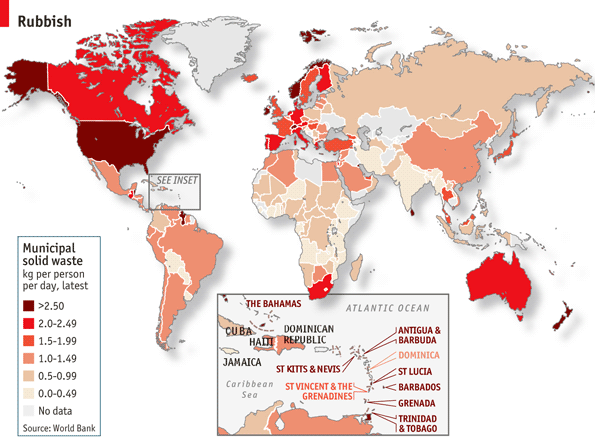
 Einstein’s famous equation, E=mc², does not influence everyday interactions of energy, E and mass, m. The speed of light, c is 299 792 458 m/s which is very big number and implies a huge amount of energy is required to create a small amount of mass. This means that energy and mass are independently conserved. For energy, this is the first law of thermodynamics while the law of conservation of mass is usually attributed to Antoine Lavoisier. On a planetary scale, the conservation of mass implies that we can assume that the quantity of matter is constant. Can we apply the second law of thermodynamics to matter as well as energy? One interpretaton of the second law is that Gibbs energy, or the energy available to do useful work, must decrease in all real processes. This also applies when matter moves through our economic system. For instance, we must do work to convert mineral ores into useful products which gradually degrade through use and natural processes, such as corrosion, until they become scrap and we must expend more resources to recycle them and make them useful again. The sun provides us with a steady supply of useful energy, so that in energy terms planet Earth can be considered an open system with energy flows in and out. Conversely in mass terms, planet Earth is effectively a closed system with negligible mass flow in or out, so that we do not have a steady supply of new matter from which to manufacture goods. However, most of us behave with open-world mindset and throw away matter (goods) that are no longer useful to us when we should be repairing and recycling [see my post entitled ‘Old is beautiful‘ on May 1st 2013]. Maybe we can’t reach the zero-waste status aimed at by people like Bea Johnson, but most of us could do better than the 2.2 kg of solid waste produced each day by each of us in OECD countries. That’s 2.1 tonnes per year for an average OECD household (2.63 people)!
Sources:
http://www.economist.com/blogs/graphicdetail/2012/06/daily-chart-3

 Realize Engineering